
Reviewed · BRITISH MUSEUM TOURS
British Museum & National Gallery of London Semi-Private 8ppl Max
The best thing about this small-group museum tour is its clear mission: help you make sense of two enormous London collections without wandering in circles. In the British Museum, you move from the Rosetta Stone and an Egyptian mummy to Assyrian reliefs and Viking chess pieces. After lunch, the National Gallery shifts the story toward European painting, from van Eyck to Van Gogh.
I like the eight-person maximum, which gives your guide room to answer questions and adjust the pace. I also like the sharp contrast between the two museums. One deals mainly in objects, civilizations, and archaeology; the other lets you watch European painting change over six centuries. The drawback is simple: five and a half hours is still a brisk visit to two places that could fill several days.
Key points to know before booking
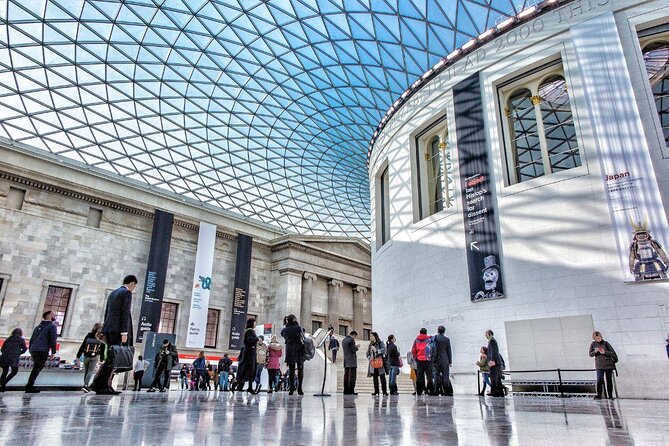
- Two major museums in one day: Spend about two and a half hours at each museum, with a lunch break in between.
- Small group, maximum eight people: The format is more personal than a large coach or headset tour.
- British Museum highlights: See the Rosetta Stone, Mummy of Katebet, Lewis Chessmen, Samurai armor, and Assyrian lion-hunt reliefs.
- National Gallery masterpieces: Look for works by Leonardo da Vinci, Botticelli, Rembrandt, Vermeer, Seurat, Monet, Jan van Eyck, and Van Gogh.
- Guides bring different strengths: The guiding team has included Stephanie, Matilda, Becky, Jamie, Sheldon, Elisha, Luis, Craig, Anthony, Andy, Kathy, Jake, and Eli.
- Central London ending point: The tour begins near the British Museum at 10:00 a.m. and finishes at the National Gallery in Trafalgar Square.
Why this pairing works so well
London has several famous museums, but these two make a sensible pair. The British Museum asks broad questions about human societies: how people worshiped, ruled, traded, fought, recorded information, and honored the dead. The National Gallery narrows the focus to painting, where you can follow changes in religious ideas, wealth, science, politics, and artistic technique.
That change of subject gives the day a useful rhythm. You are not spending five straight hours looking at framed paintings. Nor are you trying to absorb ancient objects until every carved figure starts to look alike. The tour splits the day into two distinct chapters.
A guide matters here because both buildings can be confusing on your first visit. You could easily spend half your time reading signs, checking maps, and walking past important works without knowing why they matter. A good guide gives you a route and a story, then points out details you might otherwise miss.
The experience costs $201.01 per person, so this is not a casual add-on for every London visitor. The value comes from the time saved and the quality of the explanation. General admission to both permanent collections is listed as free, but you are paying for the professional guide, the small group, and the planning that turns two huge museums into a manageable half-day.
If you already know both collections well, you may prefer to visit alone. If you are in London for a short stay, or if art and history seem more interesting when someone explains the setting and symbolism, the price is easier to justify.
More National Gallery and Tate Tours:
- London: National Gallery Guided Tour with Art Expert Guide
★ 4.7 · 440 reviews - National Gallery of London Museum Tour Semi-Private 8ppl Max
★ 5.0 · 178 reviews - London: Tate Modern Official Guided Tour
★ 4.6 · 154 reviews
Starting near the British Museum at 10 a.m.
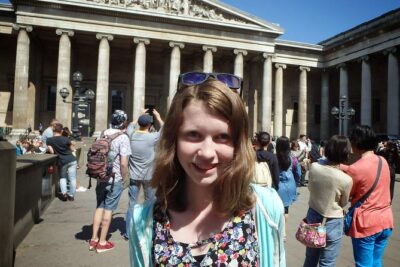
The meeting point is at British Museum Stop W, London WC1B 3BP. You do not get hotel pickup or drop-off, so plan to reach the area on your own by public transport, taxi, or Uber. The museum is near public transportation, but allow enough time to find the exact meeting point and pass through security.
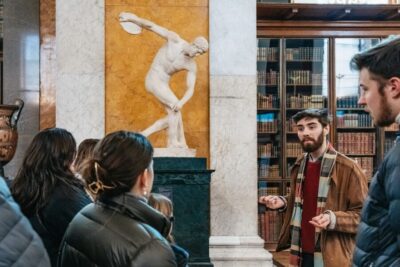
The tour starts at 10:00 a.m. Your guide introduces the group, which can include up to eight people total. The small size is important from the first few minutes. You can stay close to the guide, hear the explanation more easily, and ask a question without stopping a large crowd.
Bring a mobile phone with the country code included when you book. The operator says this is required, presumably so the guide can contact you if meeting arrangements change. Large bags and suitcases are not allowed inside, so carry only a handbag or small, thin backpack.
The British Museum in two and a half hours
The British Museum covers about 6,000 years of human history, and that scale creates the first major challenge. You will not see everything. You should not try. The point is to visit a sensible selection of important works and understand how they fit into the larger human story.
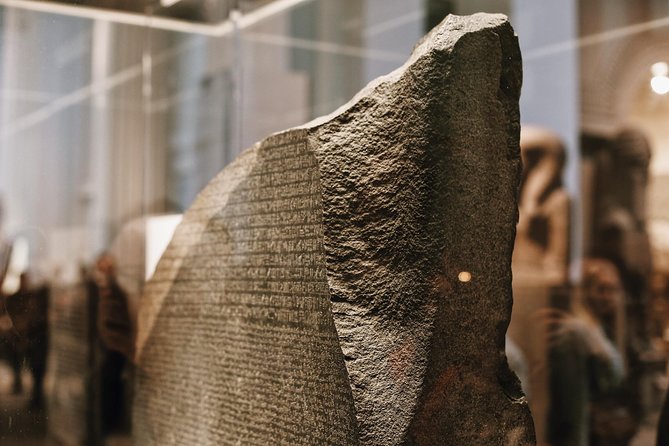
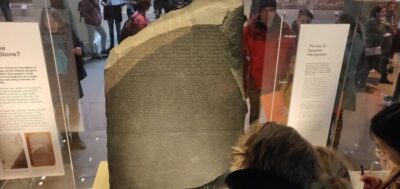
The route may include the Rosetta Stone, the famous stone that helped scholars read Egyptian hieroglyphs. It dates from the 2nd century BC and carries priestly Egyptian texts in several scripts. Seeing the actual stone is very different from recognizing its name. Your guide can explain why this particular object changed the study of ancient Egypt.
The Mummy of Katebet provides another kind of encounter. Instead of treating the mummy as a strange display, the guide can place it within ancient Egyptian ideas about death, identity, and the afterlife. That context is what turns an old case into a human story.
The Lewis Chessmen offer a different mood. These small medieval figures are memorable because they are both playful and expressive. A guide can help you look beyond their familiar shapes and consider what they reveal about craftsmanship, status, and leisure in the medieval world.
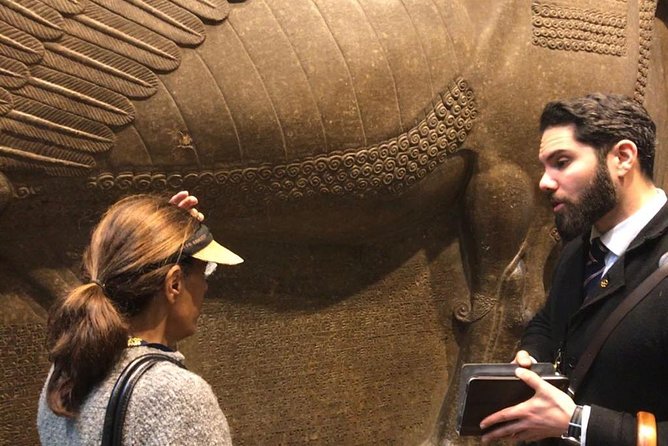
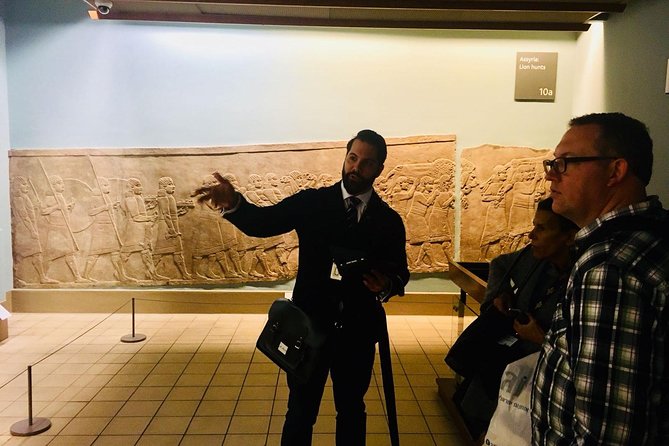
The collection also includes Samurai armor and Assyrian lion-hunt reliefs dating to the 7th century BC. The reliefs are especially useful for understanding how rulers used art to project strength. They are not simply scenes of animals and weapons. They communicate power, control, and royal skill.
This section has received the strongest praise for its storytelling. Guides such as Stephanie, Jamie, Matilda, Elisha, and Craig have been singled out for making artifacts easier to understand and for leading groups toward major pieces without wasting time. Craig’s experience working at the museum added useful insight into how the institution functions, while Elisha was praised for making ancient objects feel more human and accessible.
The main limitation is time. One visitor wanted more time with the Elgin Marbles and Rosetta Stone, and that is a fair warning. Two and a half hours gives you a strong introduction, not a complete museum visit. If one collection is your main reason for coming to London, you may want a separate return visit.
The lunch break between museums
After the British Museum, you leave the building for a lunch break at your own expense. The tour then reconvenes for the National Gallery. The information provided does not specify a restaurant, included meal, or fixed lunch duration, so you should treat this as an independent break and budget accordingly.
This pause is useful. The two museums are not next-door stops in a single building, and five and a half hours of standing and listening can become tiring. Use lunch to rest your feet and prepare for a more concentrated look at painting.
The National Gallery is at Trafalgar Square, London WC2N 5DN. Since the tour ends there, you can continue sightseeing in central London afterward rather than returning to the British Museum.
More British Museum Tours:
- London: British Museum Guided Tour
★ 4.3 · 1,182 reviews - British Museum London Guided Tour Semi-Private 8ppl Max
★ 5.0 · 984 reviews - London: Tour of the British Museum
★ 4.1 · 678 reviews - London: British Museum Audio Tour & Priority Entrance Ticket
★ 4.5 · 631 reviews
The National Gallery and six centuries of painting
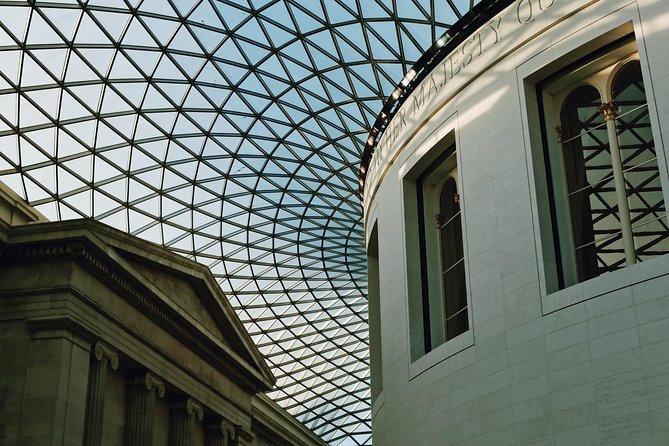
The National Gallery holds more than 2,300 European paintings dating from the 13th to the 19th centuries. That is still too much to cover in one visit, so your guide selects major works and uses them to explain how artists worked and how styles changed.
You may see Jan van Eyck’s The Arnolfini Portrait, painted in 1434. The image of a Bruges merchant and his wife is famous for its fine detail, but the real benefit of a guide is learning how to look at that detail. The room, clothing, objects, gesture, and mirror all invite questions about identity, wealth, marriage, and religious meaning.
Van Gogh’s Sunflowers offers a sharp contrast. The thick paint, bright color, and familiar subject make it approachable, but a guide can encourage you to look closely at brushwork, repeated forms, and the purpose of the series. It is one of four paintings of sunflowers created by Van Gogh in 1888.
The route can also include works by Leonardo da Vinci, Botticelli, Monet, Rembrandt, Vermeer, and Seurat. These names are well known, but recognition is not the same as understanding. The best part of this tour is the effort to place painters in context: what they were trying to show, what their patrons wanted, which techniques they used, and how one period influenced the next.
Becky has been especially praised for teaching the basics of art while discussing individual paintings. Her approach encouraged people to look carefully and form their own responses instead of simply memorizing dates. Jamie was also praised for comparing artistic periods and showing how one style influenced another.
The National Gallery portion seems to be the strongest match for anyone who thinks art museums are difficult or intimidating. A guide can give you a set of tools: look at composition, light, color, materials, facial expressions, and the relationship between the figures. Once you know what to ask, the paintings become less like silent decorations and more like evidence of a particular time and place.
Renovation work can alter the route or change which rooms are available. One guide, Becky, had to adjust the visit while work was underway, which shows why flexibility matters. Museum displays can change during the year, and occasional closures may occur without much warning.
What the eight-person limit changes
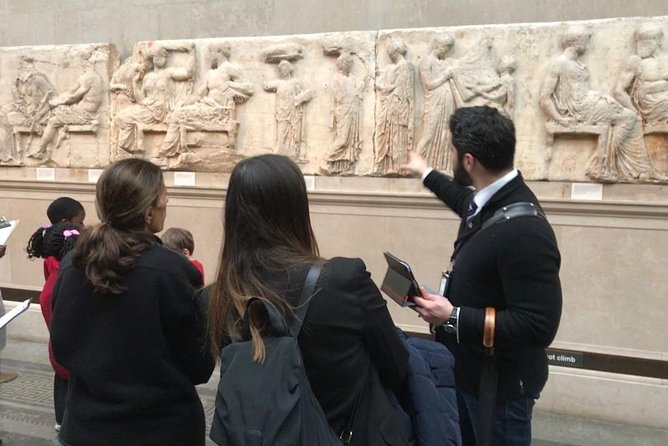
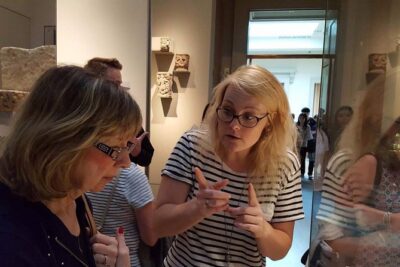
A maximum of eight people is the practical heart of this experience. You are not promised a private tour, but the group should be small enough for direct conversation. The guide can hear your questions, notice if the group is tiring, and spend more time on a work that sparks interest.
The format also suits families and mixed-age groups. Matilda was praised for being patient with children, while other guides were appreciated for keeping adults engaged through humor and clear explanations. Still, the pace may not satisfy everyone. Someone who wants to sit quietly with one painting for twenty minutes will find the guided route restrictive.
A private upgrade is available if you want more control over timing and subject matter. The private option makes more sense for a family with a specific interest, a group with different mobility needs, or anyone who wants to linger at selected works. The semi-private version offers a lower-cost compromise while keeping the group small.
The tour requires at least two people to operate. If that minimum is not met, you are offered an alternative or a full refund. The activity is not suitable for people with walking disabilities or those using a wheelchair, and a moderate level of physical fitness is expected. You will be on your feet inside large museum buildings for much of the day.
Guide quality and the value of interpretation
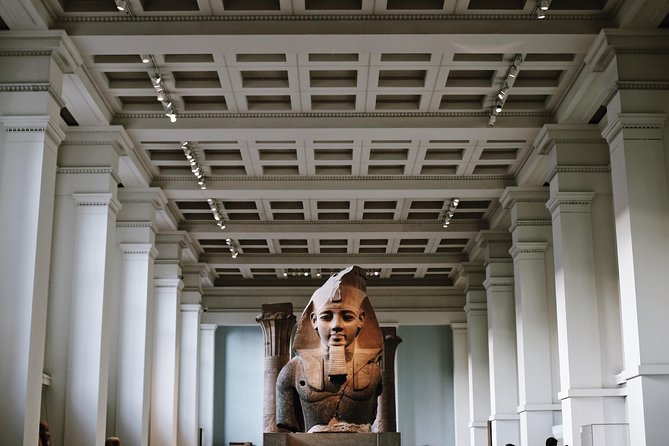
The guide is the main reason to book this rather than simply enter both museums on your own. The guiding team includes people with different strengths. Stephanie has been praised for precise British Museum explanations and strong history knowledge. Matilda combines art and history with an energetic style. Becky is particularly strong in painting and art appreciation.
Jamie, Sheldon, Luis, Anthony, Craig, Andy, Kathy, Jake, Eli, and Elisha have also led this experience. Anthony has been praised for linking world history, art history, and current events. Jake’s approach was described as similar to a personal master class, while Andy was appreciated for giving a useful overview of the British Museum despite the collection’s huge scale.
You cannot guarantee a particular guide unless the operator allows that request at booking. Still, the names are useful if you are comparing guide-led options and want to ask about availability. The most consistent strength is not a scripted list of objects. It is the ability to explain why an object or painting matters.
That distinction is worth paying for. At the British Museum, a label may tell you the date and material. At the National Gallery, a label may give you the painter and title. A guide adds the questions that make the information stick.
Practical details that affect your day
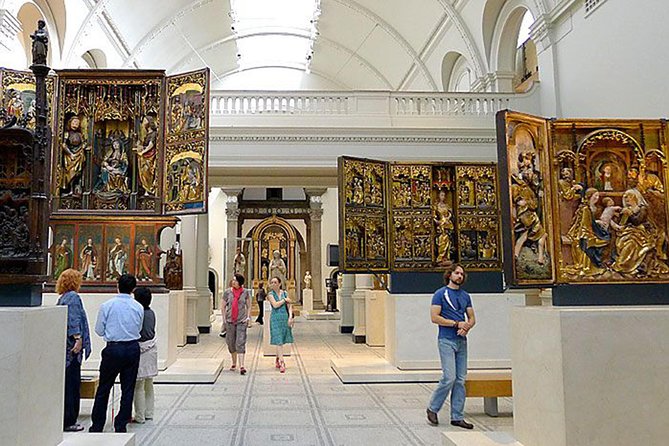
The tour lasts about 5.5 hours, including the lunch break. It is offered in English, with mobile tickets and group discounts available. Temporary exhibitions are not included, so do not book this expecting access to a special paid show.
Wear comfortable clothing and shoes. The museums require appropriate dress, and security checks may create lines even when a tour is advertised as having priority access. Some rooms require quiet or limit speaking, so your guide may explain the material before you enter.
Museum closures can happen without advance notice. If an opening is delayed by more than an hour, an alternative may be arranged, but refunds or discounts are not promised in that situation. That policy makes travel insurance or a flexible London schedule useful, especially if you are visiting during a period of strikes, maintenance, or major public events.
You can cancel for a full refund up to 24 hours before the start time. Changes or cancellations made within 24 hours are not refunded.
Who should book this museum tour?
I would choose this for a first visit to London when you want both major museums but do not want to spend days planning routes and reading labels. It also suits couples, families with older children, and adults who enjoy history but want art explained in plain language.
It is less suitable if you need wheelchair access, dislike walking, or want a slow, unstructured museum day. It may also feel expensive if you are comfortable navigating museums alone and already know which works you want to see.
The experience works best when you accept its limits. You are not getting every gallery. You are getting a focused route, a small group, and a guide who helps you see the important pieces in context.
Should you book it?
Book this tour if your London schedule gives you one museum day and you want the Rosetta Stone, Lewis Chessmen, Arnolfini Portrait, and Sunflowers without losing hours to navigation. The eight-person limit and strong art-focused guiding make the $201.01 price easier to defend than a large group tour.
Skip it if you prefer to set your own pace, need extensive accessibility support, or plan to return to the museums for several days. For most first-time visitors with limited time, though, this is a smart way to turn two intimidating collections into a clear, memorable day.
FAQ
How long does the British Museum and National Gallery tour last?
The experience lasts approximately 5.5 hours, including a lunch break between the two museums. Each museum portion is planned for about 2.5 hours.
What time and where does the tour begin?
The tour starts at 10:00 a.m. near the British Museum at British Museum Stop W, London WC1B 3BP.
Where does the tour finish?
The tour ends at the National Gallery in Trafalgar Square, London WC2N 5DN.
How many people can join the semi-private tour?
The group can include a maximum of eight travelers. At least two people are required for the tour to operate.
Is lunch included in the tour price?
No. The lunch break is included in the schedule, but lunch is at your own expense.
Are temporary exhibitions included?
No. Temporary exhibitions are not included. The tour focuses on selected works from the permanent museum collections.
Just added around London
- London: “Queen” Highlights Walking Tour★ 4.3 · 48 reviews
- Couple’s photo: Romantic photoshoot in London★ 4.8 · 22 reviews
- London: Private Tour with Locals – Highlights & Hidden Gems★ 5.0 · 8 reviews
- Luxury Private Tour in London with Lunch★ 5.0 · 7 reviews
- London 1- or 2-Hour Professional Photo Shoot★ 4.9 · 6 reviews
- London: Private Black Cab Night Tour with Hotel Pick Up★ 5.0 · 11 reviews
- London: Christmas Lights Tour – With Christmas Music★ 4.8 · 9 reviews
- London: Private Pub Tour★ 4.5 · 4 reviews
British Museum Tours, compared.
British Museum London Guided Tour Semi-Private 8ppl Max
Read our review →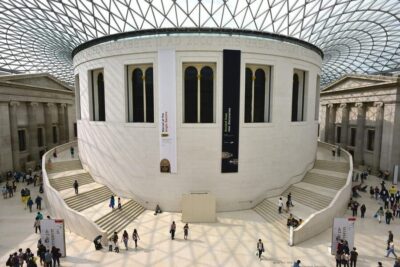
British Museum Audio Tour & Priority Entrance Ticket
Read our review →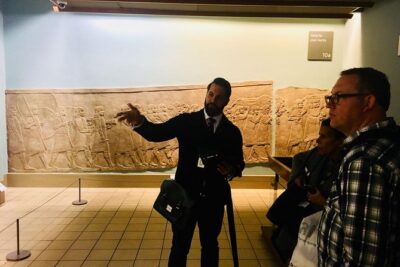
The British Museum London – Exclusive Guided Museum Tour
Read our review →
British Museum Archaeology Course and Guided Tour
Read our review →Browse the lists this tour appears in