
Reviewed · BRITISH MUSEUM TOURS
Semi Private Guided tour at British Museum
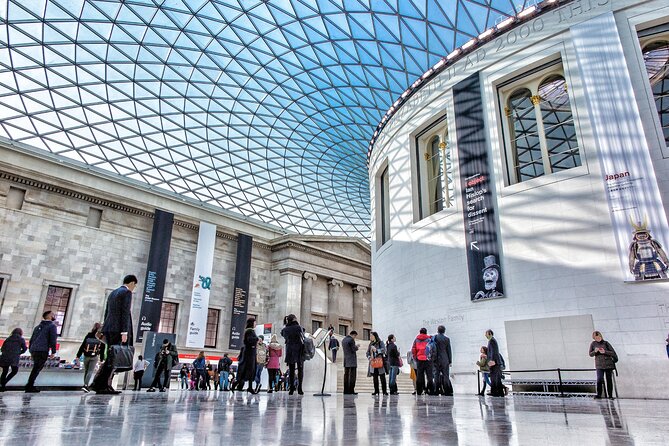
The British Museum can feel like a city of galleries, so the real value here is having a guide choose a sensible path through more than 6,000 years of human culture. In about two and a half hours, you can see the Rosetta Stone, Parthenon Marbles, Egyptian mummies, Sutton Hoo, and the Easter Island statue without spending your morning wandering in circles.
I like the small-group format, with no more than six people per guide, and I like that the route can be shaped around your interests. Guides Luca and Cecily are singled out for clear explanations, thoughtful answers, and personal attention. The main tradeoff is time: the museum is enormous, so even a well-planned visit cannot cover every room.
Key points to know before booking
- Small groups matter here: Each guide handles no more than six people, while the total activity may reach 15 participants.
- Major treasures are included: Expect the Rosetta Stone, Parthenon Marbles, Portland Vase, mummies, Sutton Hoo, and Hoa Hakananai’a.
- The route can respond to you: Your guide may adjust the visit to suit interests such as Ancient Egypt, Rome, Greece, Medieval Europe, or British archaeology.
- Two and a half hours is a useful introduction: You will see important rooms and objects, but not the entire museum.
- The meeting point is central: Start at 52 Great Russell Street, close to public transportation, and finish back at the same point.
- Pack light: Bags over 40 by 40 by 50 centimeters or weighing 8 kilograms or more cannot enter, and there is no cloakroom service.
Why a guide helps at the British Museum
The British Museum is free to enter, but free entry does not make it easy to visit. You face a huge collection spread across many rooms, with objects from Egypt, Assyria, Greece, Rome, Britain, Central America, Easter Island, and much more.
A guide gives your visit shape. Instead of trying to read every label, you can focus on the objects that changed how people understood writing, religion, art, burial, trade, and political power. That is especially useful if this is your first visit or if you have only one morning in London.
I also like the human scale of this tour. A guide leading six people can hear your questions and adjust the pace more easily than someone managing a large coach group. Cecily is noted for making time for questions and offering personal attention, while Luca is praised for explaining the objects with impressive depth. Those details matter in a museum where a small question can open up an entirely different way of seeing an object.
The guide’s role is not simply to point at famous pieces. You can ask to spend more time with Ancient Egypt, Roman Britain, Greek sculpture, the Lewis Chessmen, or Anglo-Saxon material. The tour is designed to show the museum’s major highlights while leaving room for your interests.
More British Museum Tours:
- London: British Museum Guided Tour
★ 4.3 · 1,182 reviews - British Museum London Guided Tour Semi-Private 8ppl Max
★ 5.0 · 984 reviews - London: Tour of the British Museum
★ 4.1 · 678 reviews
Meeting at 52 Great Russell Street
The tour begins at 52 Great Russell Street, London WC1B 3BA. The activity information says the museum is near public transportation, so you can plan to arrive by Underground or other local transport, though the exact route depends on where you are staying.
Give yourself enough time to find the meeting point. A guide may save a place in line, as Cecily did for one group, which can make the start easier when the museum is busy. The information provided does not promise a skip-the-line admission in every situation, so treat the saved place as a useful practical detail, not a guarantee of instant entry.
You should arrive with only what you need. Bags larger than 40 by 40 by 50 centimeters or weighing 8 kilograms or more are not permitted. The museum does not offer cloakroom services, so do not arrive with a large suitcase, oversized backpack, or heavy shopping bag and expect to store it there.
Children must be accompanied by an adult. Service animals are allowed, and most people can participate, but anyone with particular mobility or access needs should confirm the details before booking.
The Enlightenment Gallery sets the stage
The Enlightenment Gallery is included in the visit and gives you a useful starting point for understanding the museum itself. It brings together objects connected to collecting, research, classification, and the way European scholars once tried to organize human knowledge.
For you, this room can help explain why the British Museum feels different from a single-theme museum. The collection is not limited to paintings or one country. It places objects from distant periods and places into a broad story about how people studied the world.
Your guide can help turn that broad idea into something concrete. Rather than treating the gallery as a room to pass through, you can use it to ask how objects were collected, how they were interpreted, and how the museum’s view of the world has changed.
The Rosetta Stone and the breakthrough in writing
The Rosetta Stone is one of the museum’s essential stops. Its importance comes from the same text appearing in three scripts, which helped scholars compare languages and make progress in reading Egyptian hieroglyphs.
The stone is not simply famous because it is old. It represents a turning point in the ability to read a civilization’s own written record. A guide can make the connection between the stone’s inscriptions and the broader work of decoding language much clearer than a quick glance at the display label.
This is a good example of why the tour format helps. If you already know the basic story, you can ask about the scripts, the political message, or how the object became a key to Egyptian writing. If the subject is new to you, the guide can give you the short version without burying you in technical detail.
A different sort of day out in London altogether:
- From London: Harry Potter Warner Bros Studio Tour
★ 4.7 · 26,588 reviews - London: Westminster to Greenwich River Thames Cruise
★ 4.5 · 22,836 reviews - Magical London: Harry Potter Guided Walking Tour
★ 4.7 · 22,044 reviews - London: Madame Tussauds London
★ 4.6 · 20,915 reviews
Ancient Egypt, mummies, and objects beyond the famous stone
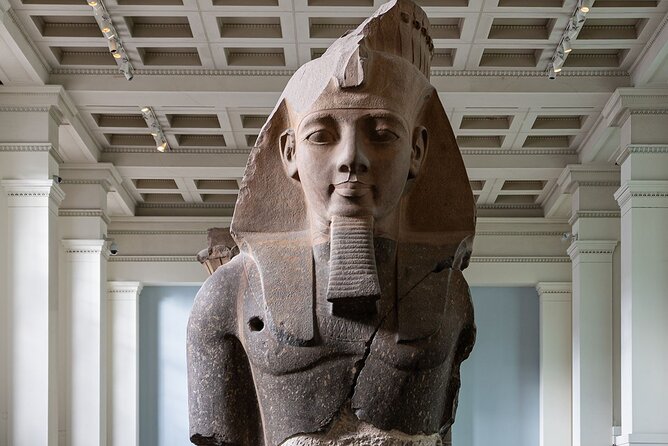
The Ancient Egypt rooms bring together mummies and other objects that show how Egyptians approached death, the body, religion, and daily life. The word mummy can make the collection sound like a single display, but the value lies in seeing burial customs alongside writing, sculpture, and religious objects.
Your guide can help connect what you see. A mummy tells you about preservation and beliefs about the afterlife, while nearby objects may reveal social rank, family life, or religious practice. The point is not to rush past several cases of similar-looking artifacts. It is to understand the ideas linking them.
Egypt is one of the areas where a short visit can easily become too narrow. You may want to spend the entire morning here, but the tour also needs to reach Greece, Rome, Britain, and other collections. Tell your guide early if Egypt is your priority so the route can reflect that.
The Parthenon Marbles and Ancient Greece
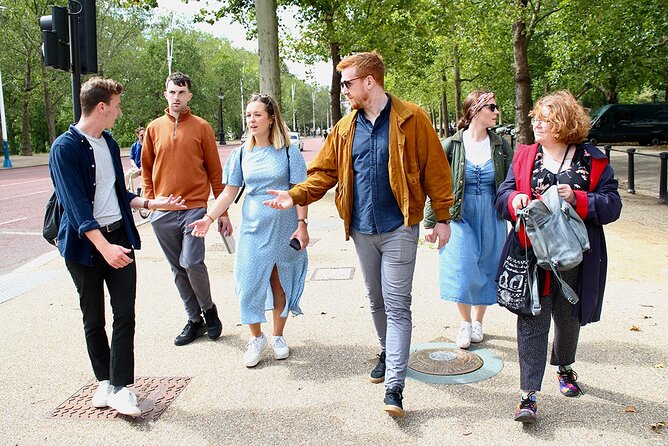
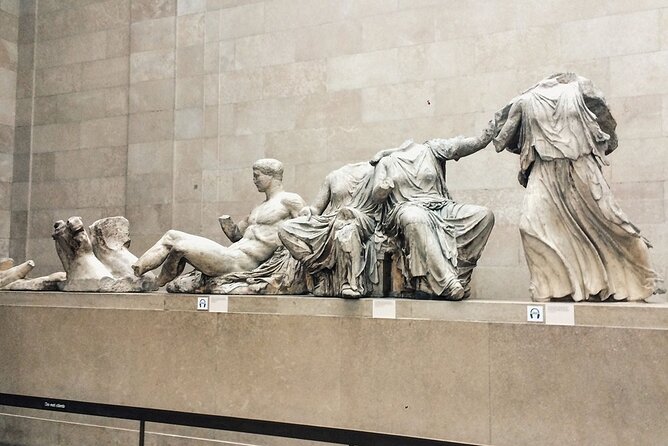
The Ancient Greece collection includes the Parthenon Marbles, among the museum’s best-known and most debated objects. They are admired for their sculptural detail, but the visit also raises questions about ownership, removal, preservation, and the responsibilities of museums.
A guide can give you the essential artistic context while acknowledging the modern dispute around the marbles. That balance is useful. You get to look closely at the figures and architectural fragments, but you also understand that these objects carry a political story beyond their ancient setting.
The Greek collection is a good place to slow down. A large group can make it difficult to ask questions or hold a conversation in front of a crowded display. A group of six gives you a better chance to pause, listen, and compare what you are seeing.
Assyria, Ancient Rome, and Roman Britain
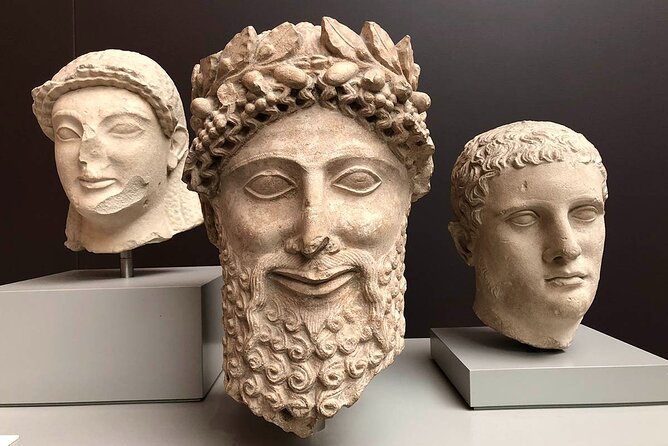
The Assyrian collection adds a different visual language, with imperial power, warfare, royal ceremony, and animal imagery expressed through monumental reliefs. These works help you see how rulers used art to project authority across a large empire.
Ancient Rome then shifts the focus to another powerful state and its influence across Europe and the Mediterranean. Roman objects can be especially helpful for understanding how architecture, religion, government, and military life spread across a wide territory.
The Roman Britain collection brings those ideas closer to home. It shows that Roman rule was not just a story of Italy or the Mediterranean. Britain became part of the Roman world, with its own local setting and changing cultural mix.
You may not have time to study every Roman object. That is one reason the guide’s choices matter. A good route can show you a few strong examples and explain how they connect, instead of leaving you with a long list of disconnected dates and names.
Sutton Hoo and Medieval Europe
Sutton Hoo is one of the most important British archaeological displays in the tour. The ship burial connects burial practice, craftsmanship, status, travel, and early Anglo-Saxon Britain.
The object that many people hope to see is the Anglo-Saxon helmet. It is memorable not only for its appearance but also for what it suggests about leadership and warfare in the period. Your guide can place the helmet and burial goods within the larger story of early medieval Britain.
The Medieval Europe collection broadens that picture. This section can help you move beyond the familiar idea that the medieval period was one long, unchanging age. Objects reveal changes in faith, power, craft, trade, and everyday life.
If British archaeology is your main interest, say so at the start. The tour includes many major areas, and you may need to choose depth in one section over a quick look at all of them.
The Lewis Chessmen and the Portland Vase
The Lewis Chessmen are a small but memorable highlight. Their carved faces and varied poses make them easy to connect with, even if you do not normally seek out medieval artifacts.
A guide can help you look past their charm and consider what a chess set reveals about status, leisure, travel, materials, and the medieval world that produced it. They are also a good reminder that museum treasures do not need to be enormous to hold your attention.
The Portland Vase offers a different experience. Its delicate decoration and technical skill show how finely Roman glass could be worked. It is the kind of object you might pass too quickly without an explanation of what makes it special.
These stops add variety to the main route. You move from huge stone reliefs and royal monuments to objects made for play, display, or private enjoyment.
Easter Island’s Hoa Hakananai’a
The Easter Island statue, Hoa Hakananai’a, is among the tour’s most distinctive stops. Its size and presence make it easy to notice, but its significance goes beyond its appearance.
The statue gives your guide a chance to discuss Polynesian art, belief, movement, and the way objects are removed from their original communities and displayed far from home. Like the Parthenon Marbles, it raises questions about collecting and cultural ownership.
This may be one of the moments when a personal question changes the direction of the conversation. You can ask about the statue’s meaning, its journey to London, or how the museum presents an object separated from its original setting.
Aztec and Mayan collections
The Aztec and Mayan collections add Central American perspectives to the tour. They help broaden your visit beyond the most familiar European, Egyptian, and Roman material.
The value here is comparison. You can consider how different societies represented power, religion, time, and the natural world. The tour cannot spend equal time in every gallery, so this is another area to mention if it is high on your list.
A guide can also help you avoid treating Aztec and Mayan cultures as one subject. They belong to different traditions, and a short explanation can prevent a vague, catch-all understanding of the region.
What two and a half hours can realistically cover
The advertised duration is approximately 2 hours and 30 minutes. That is long enough for a strong first look, but not enough to see all 6,000-plus years of material in detail.
The museum is simply too large. You may see the major highlights listed here, but the exact order and amount of time in each room can change with crowd levels, your interests, and the guide’s judgment. The activity information makes clear that not every room can be covered.
I see this as a benefit rather than a flaw, provided you book it for the right purpose. This is a guided introduction, not a complete museum study day. Afterward, you can return on your own to a favorite gallery, using the tour to decide where you want to spend more time.
Is $142.98 a fair price?
At $142.98 per person, this is a premium way to visit a museum that has free admission. You are paying for the guide’s time, planning, personal attention, and small-group setting, not simply for entry.
The price makes more sense if you have limited time in London, feel overwhelmed by very large museums, or want to ask questions as you go. Six people per guide is a meaningful difference from a large group, especially in front of famous objects where space and attention can be limited.
It is less compelling if you enjoy wandering alone, already know the museum well, or plan to spend an entire day reading labels at your own pace. You can enter the British Museum without buying this experience, so the value depends on how much structure and interpretation you want.
Group discounts may be available, which could improve the cost for a larger booking. Food, drinks, gratuities, and hotel pickup or drop-off are not included, so budget for those separately.
Who should book this British Museum tour?
I would consider this tour a good fit for first-time visitors, couples, families with older children, and anyone who wants the major objects explained without doing hours of preparation. It also suits people who prefer questions and conversation over a recorded audio guide.
It is especially useful for a short London stay. If you have only one morning, a guide can help you spend it on important rooms rather than trying to map the entire building yourself.
You may want a different plan if your interest is highly specialized. Someone devoted to Egypt, Assyria, or medieval art may prefer an independent visit with several hours set aside for one collection. The tour can adapt to your preferences, but its purpose is still to introduce you to a wide range of highlights.
The service is offered in English. The total activity may include up to 15 people, though each guide handles no more than six. That distinction matters, so check how your particular departure is organized if group size is a major concern.
Practical details that can make the morning easier
Confirmation is provided when you book, and free cancellation is available up to 24 hours before the start time. Cancellations made less than 24 hours ahead, along with late changes, are not accepted for a refund.
The tour ends back at the meeting point. Since there is no hotel pickup or drop-off, plan your next stop from the British Museum area rather than expecting transport to your accommodation.
Bring a small bag only. Avoid packing food, drinks, or large belongings unless you have checked the current museum rules separately. Food and beverages are not included in the tour, so plan those outside the activity.
Should you book it?
Book this tour if you want a focused first visit, personal help in a huge museum, and access to a guide who can connect famous objects to the wider story. The strongest reasons are the small guide-to-group ratio, the flexible route, and the chance to ask questions directly.
Skip it if you are happy exploring alone and want to spend most of the day in one collection. At $142.98, the cost is high beside free museum entry, but it can be sensible for a short London visit when time and direction matter more than saving every pound.
FAQ
Where does the British Museum tour start?
It starts at 52 Great Russell Street, London WC1B 3BA, UK.
Where does the tour end?
The activity ends back at the meeting point.
How long does the guided visit last?
The tour lasts approximately 2 hours and 30 minutes.
How many people are in each guide’s group?
Each guide leads a maximum of six participants. The total activity may have up to 15 travelers.
What language is the tour offered in?
The tour is offered in English.
Does the tour include the Rosetta Stone?
Yes. The Rosetta Stone is included among the featured museum highlights.
Are the Parthenon Marbles included?
Yes. The tour includes the Parthenon Marbles, also called the Greek Parthenon Marbles in the activity details.
Can I see Egyptian mummies?
Yes. Ancient Egypt and mummies are included in the guided experience.
Are food and drinks included?
No. Food and beverages are not included.
Can I cancel for a full refund?
Yes, if you cancel at least 24 hours before the experience start time. Cancellations made less than 24 hours ahead are not refundable, and late changes are not accepted.
Are large bags allowed?
No. Bags larger than 40 by 40 by 50 centimeters or weighing 8 kilograms or more are prohibited. The museum does not offer cloakroom services.
Are children allowed on the tour?
Yes, but children must be accompanied by an adult.
Just added around London
- Up at The O2:Twilight Climb with Guided Tour with Panoramic Views★ 5.0 · 50 reviews
- Private Chauffeur-London Heathrow from/to Southampton Cruise Port★ 5.0 · 9 reviews
- Kensington Palace VIP Garden Tour with Royal High Tea★ 4.5 · 71 reviews
- Up at The O2: Sunset Climb with Guided Tour with Panoramic Views★ 5.0 · 110 reviews
- Secrets of the London Underground Small Group Walking Tour★ 4.5 · 38 reviews
- Urban Canvas: Exploring Shoreditch’s Vibrant Street Art★ 5.0 · 36 reviews
- Ultimate introduction to photography in Central London★ 5.0 · 19 reviews
- Full-Day Self-Guided Paris Tour from London by Eurostar with Seine River Cruise★ 3.5 · 22 reviews
British Museum Tours, compared.
British Museum London Guided Tour Semi-Private 8ppl Max
Read our review →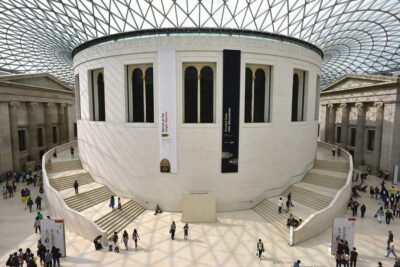
British Museum Audio Tour & Priority Entrance Ticket
Read our review →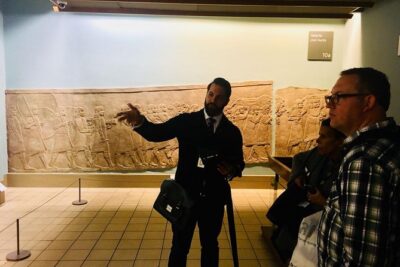
The British Museum London – Exclusive Guided Museum Tour
Read our review →
Private Guided Tour of the British Museum – Tickets Included
Read our review →Browse the lists this tour appears in