
Reviewed · BRITISH MUSEUM TOURS
Private Tour, The British Museum, popular with Families & Small Groups
The British Museum can feel like several museums packed into one. This private tour gives you a clear route through Egypt, Assyria, Greece, Rome, Britain, and later history, using stories and questions to keep children involved. I especially like the family quizzes and the built-in break, two small touches that make a huge museum easier to handle.
I also like the one-group format. Your Blue Badge guide can give your party undivided attention, adjust the pace, and explain objects in plain language. Guides including Lucy, Marina, Lawrence, Denisa, and Ainura have been praised for turning difficult material into lively stories. The main drawback is the price: at $286.41 per person, this makes the most sense for a family or small group that values a private guide.
Key points to know
- Rosetta Stone and mummies: Start with Egypt, then return upstairs for mummified people and animals, including an ibis and baboon.
- A family-friendly route: Gory stories, questions, and simple challenges give children a reason to keep looking.
- Private attention: Only your group takes part, so the guide can respond to your interests and energy level.
- A planned comfort break: The tour pauses after the main ground-floor galleries before continuing upstairs.
- Skip-the-line access: A Blue Badge guide provides guaranteed access without waiting in the long general line.
- Two hours through major collections: You cover famous highlights rather than trying to see every room in the museum.
Why a private British Museum tour helps
The British Museum is free to enter, but free does not mean easy. Its collections cover thousands of years and many parts of the world. If you walk in without a plan, you can spend a long time finding your way between famous objects, then leave without understanding how they fit together.
This tour gives you a backbone. You begin with ancient Egypt, move through Assyria and Athens, pause, then return to Egypt before visiting Britain, Rome, and a modern display involving medicine. That sequence gives you variety without asking you to cross the entire museum at random.
A private format matters here. In a large public group, you may hear only the guide’s prepared route. In your own group, you can ask for more detail about a favourite object, keep the pace moving for restless children, or spend a little longer in a gallery that catches your attention.
The tour is designed for families, but adults without children can also benefit. The stories are lively rather than academic, and the route focuses on objects that are easy to connect with: a carved monster, a famous stone, royal treasure, mummies, and Roman engineering.
More British Museum Tours:
- London: British Museum Guided Tour
★ 4.3 · 1,182 reviews - British Museum London Guided Tour Semi-Private 8ppl Max
★ 5.0 · 984 reviews - London: Tour of the British Museum
★ 4.1 · 678 reviews
Meeting your Blue Badge guide at the museum
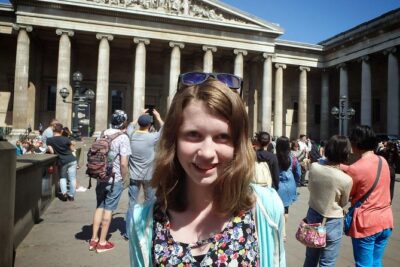
Your guide waits at the main museum gates beside the phone box opposite the Museum Tavern. Pay close attention to this meeting point. One party had trouble finding the guide at first, though Lucy sorted out the confusion and salvaged the day with a strong tour afterward.
The start time is allocated when you book, so arrive with enough time to find the gates and identify the phone box. The experience ends back at the meeting point in the Great Court area, making it simple to continue your day from the museum.
The advertised duration is approximately two to two and a half hours, while the itinerary describes a two-hour visit. Plan for roughly two hours, with a little flexibility. The route includes a comfort and refreshment pause, but food and drinks are not included.
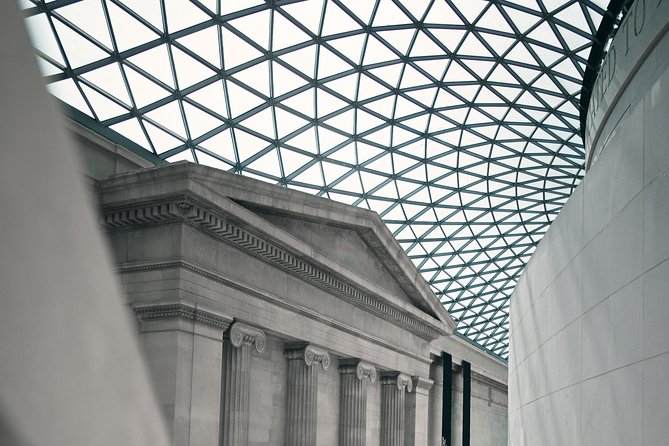
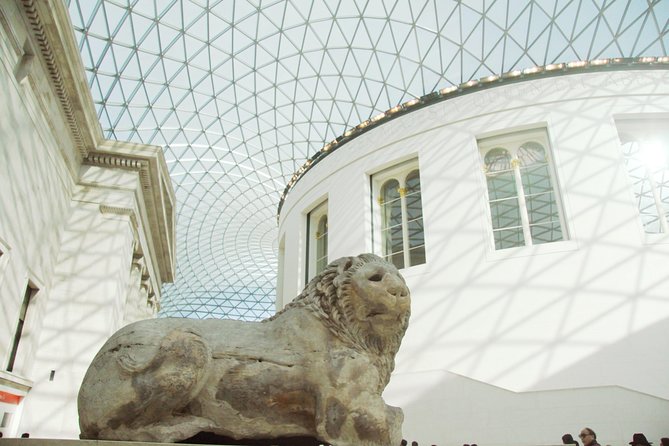
The Great Court gives you an instant sense of scale
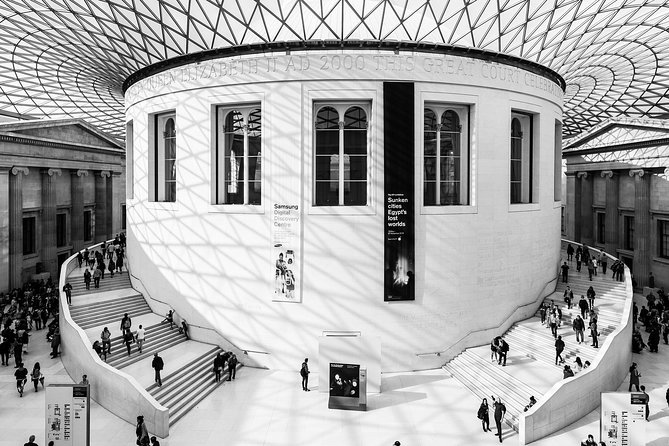
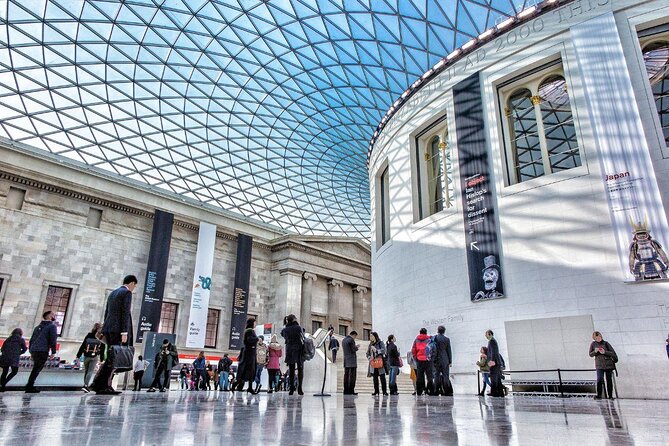
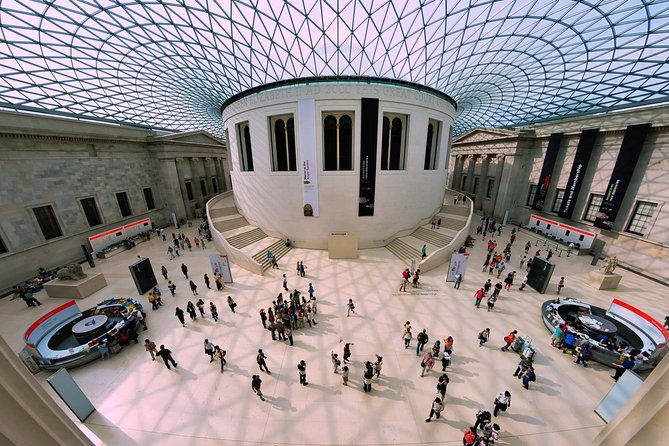
Once inside, you enter the Great Court, the museum’s vast central space. It is a useful first stop because it gives you a strong visual sense of the building before you head into the galleries.
It is also the natural place for family photographs. Take them early, while everyone is still fresh, or at the end, when the tour returns here. The Great Court is more than a meeting area on this visit. It provides a pause between the museum’s many subjects and gives you a place to sit and think about what you have seen.
The museum can feel overwhelming even before you reach the galleries. A private guide helps by setting expectations: you are not trying to see everything. You are following a selected route through major displays.
Egypt and the Rosetta Stone start the story
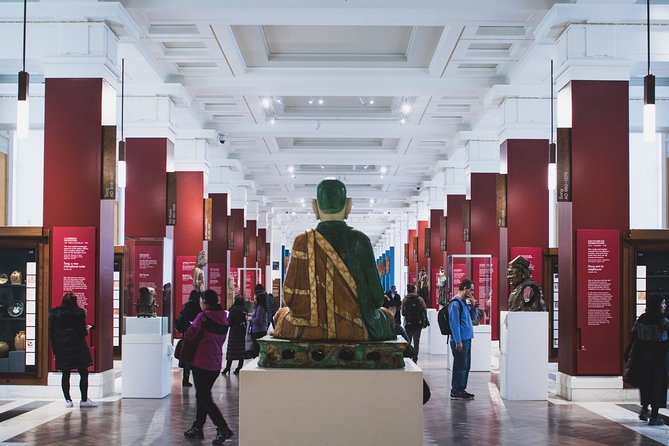
The tour normally begins in the Egyptian galleries with the Rosetta Stone. This is a smart opening because the stone is instantly recognisable, yet its importance is easy to miss if you only stop for a photograph.
The guide can use it to explain how the same text appears in different scripts. Children are invited to look for how the word cat is written in hieroglyphics, turning a famous object into a visual puzzle. That simple question gives younger visitors something specific to search for rather than asking them to absorb a long explanation.
The Egyptian galleries also establish one of the tour’s main strengths: objects are presented through stories and questions. The route is not just a parade of names and dates. You are encouraged to look closely, make a guess, and then hear the explanation.
The first galleries can still be a lot for small children. The objects are striking, but two hours is a long time for anyone who is not used to museums. The private guide and planned pause help, though you should expect the full route to require steady attention.
A different sort of day out in London altogether:
- From London: Harry Potter Warner Bros Studio Tour
★ 4.7 · 26,588 reviews - London: Westminster to Greenwich River Thames Cruise
★ 4.5 · 22,836 reviews - Magical London: Harry Potter Guided Walking Tour
★ 4.7 · 22,044 reviews - London: Madame Tussauds London
★ 4.6 · 20,915 reviews
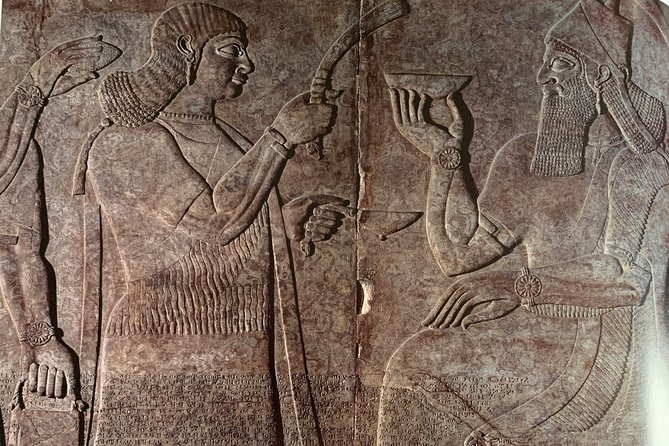
Assyria brings kings, monsters, and lion hunts
From Egypt, you move to Assyria, another major ancient empire. Here the material becomes especially useful for families because it has instant drama.
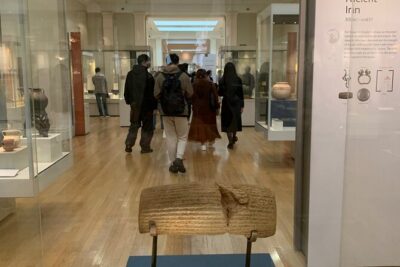
Winged bulls guarded royal cities, combining a human head, animal body, and powerful wings. The carved figures invite children to ask why a creature would be made that way and what it was meant to protect.
Assyrian royal reliefs also show kings hunting lions. The guide uses this material to pose a memorable contest: who wins in a battle between a human king and an animal king? It is a playful question, but it opens the door to ideas about power, courage, kingship, and how rulers wanted to be seen.
This section is a good example of what private guiding adds. You can look at the carving first, form an opinion, and then hear the historical meaning behind it. The guide can also judge how much detail your group wants. If children are hooked by the lions, you can stay with that theme instead of rushing to the next room.
Athens, the Acropolis, and the Elgin Marbles
The route then turns to Athenian artefacts in the Duveen galleries, home to the Elgin Marbles. The guide addresses a common point of confusion: the Acropolis and the Parthenon are not the same thing.
That distinction makes the Greek section more useful than a quick look at carved stone. You get a basic sense of the site, the temple, and the sculptures connected with it. The conversation can also help you understand why these objects are so important and why their location in London has long prompted debate.
The Duveen galleries provide a grand setting, but the sculptures can be difficult for younger children to approach without context. A guide who asks direct questions and relates the carvings to a building and a city gives them a clearer entry point.
This is one place where your group may want to ask questions. The tour has limited time, so it cannot explore every issue around the Parthenon sculptures. Still, it gives you a sound introduction and lets you see one of the museum’s best-known collections without wandering in search of it.
A short break keeps the museum from becoming too much
After the main ground-floor galleries, the tour includes a quick comfort and refreshment break. This is not a minor detail. A family can enjoy a museum far more when the visit acknowledges that attention fades and feet get tired.
The break comes before you return to the Egyptian collection upstairs. You can use it to regroup, get a drink if needed, and decide how much energy remains for the second half.
Because the tour is private, your guide can read the mood of your group better than a large scheduled party could. The break is still described as quick, so do not treat it as a long café stop. Food and drinks are not included in the tour price.
Upstairs Egypt: mummies of people and animals

The second Egyptian section focuses on mummification. You compare two different styles, then look for the mummies of an ibis, a baboon, and a young woman.
The animal mummies are particularly useful for children because they show that ancient Egyptian burial customs were not limited to human beings. The ibis and baboon also encourage close looking. You are not simply told that mummies exist. You are asked to find particular examples and notice how the objects differ.
The young woman brings a more personal element to the display. Mummies can be unsettling, especially for young children, and the tour is clearly intended to include some gory stories. That tone will suit families who enjoy a little mystery and the darker side of history, but it may not suit a child who is sensitive to death or medical displays.
This is another part of the tour where the guide’s storytelling matters. A long museum label can feel remote. A clear explanation of why bodies were preserved and how the process differed gives the objects human meaning without turning the visit into a lecture.
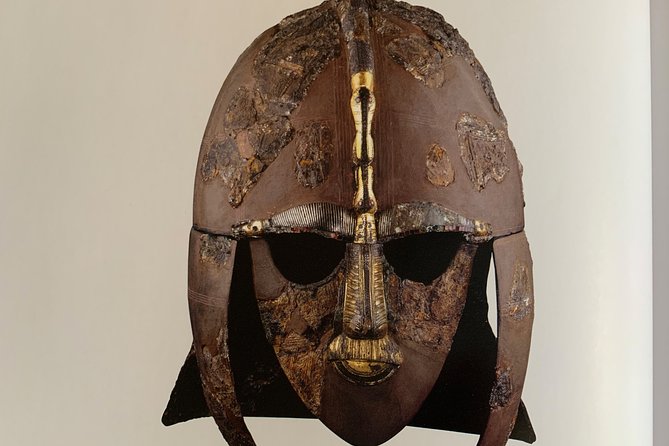
Sutton Hoo keeps the story closer to Britain
The route does not stay overseas. You also see the Sutton Hoo treasure, one of Britain’s major archaeological finds.
This section offers a welcome change after Egypt, Assyria, and Greece. It shows that Britain has its own ancient stories and important objects, and it gives children a local connection after several foreign empires.
Sutton Hoo works well within this route because it broadens the idea of ancient history. The past is not limited to pyramids and classical temples. Britain, too, had wealthy rulers, skilled craftspeople, burial customs, and long-distance links.
The time available is limited, so expect a highlight rather than a complete treatment of Sutton Hoo. The guide’s job is to show you the key treasure and explain why it matters, not to cover every detail of the excavation.
Roman Britain shows practical ancient engineering
Next comes the Roman collection, with a focus on what Roman influence meant for Britain. The tour asks a simple question: what did the Romans do for us?
The answer includes building, engineering, and art. These galleries help you see the Roman world as practical as well as military. Children who enjoy construction, roads, machines, or problem-solving may respond well to this part of the route.
Roman objects also connect the museum to the history of Britain itself. After seeing distant empires, you are reminded that one of those empires reached the islands where London now sits.
The Roman galleries can contain a great deal to absorb, and the tour cannot give equal time to every display. That is a fair trade for a two-hour route. You see selected examples and get enough context to understand the Roman impact before moving on.
A modern medical display provides a surprising finish
Near the end, the tour shifts from ancient cultures to more modern times. You are asked to guess how many tablets an average person consumes during a lifetime, then see them laid out in front of you.
This is an unexpected change of mood after mummies, kings, and Roman artefacts. It also gives the tour a present-day connection. Instead of ending with another ancient object, you finish by thinking about ordinary modern life and medicine.
The tablet display is likely to appeal to children because the question is concrete and the answer becomes visual. It also gives the guide a chance to make the final section feel less remote from your own experience.
The tour ends back in the Great Court, where you can sit and reflect. That final pause is useful after a fast trip through many periods. You leave with a sequence of stories rather than a blur of unrelated galleries.
Price, group size, and overall value
At $286.41 per person, this is an expensive museum visit if you are paying for one or two people. The value improves for a family or small group that would otherwise struggle to organise the museum alone, especially if several people can share the private guide experience.
You are paying for planning, access, and attention. The guide selects major highlights, leads you through the building, provides guaranteed skip-the-line access, and adjusts explanations for your group. You also avoid spending part of your limited London time trying to find the Rosetta Stone, mummies, Parthenon sculptures, Sutton Hoo, and Roman galleries on your own.
The price is harder to justify if you already know the museum well, want a slow visit, or prefer to choose every gallery yourself. You may also want more than two hours, since the British Museum can occupy an entire day if you explore at your own pace.
Group discounts are available, and the activity is private. The booking includes a mobile ticket and is offered in English. Food and drinks are extra.
Which families and small groups will enjoy it most
I would choose this tour for a family that wants structure but does not want a dry school lesson. The quizzes, gory stories, animal mummies, winged bulls, and lion hunts give children clear hooks.
It also suits a small group with only a short window in London. The route covers many headline collections in about two hours, so you can see the museum before lunch or fit it between other plans.
Adults who want a broad introduction will also get plenty from the visit. Lawrence is noted for combining storytelling with strong subject knowledge, while Denisa is praised for showing major highlights within a limited timeframe. Ainura is associated with guiding groups through the museum’s many treasures, and Marina is known for keeping a family group engaged.
I would think twice if you want long, quiet time with a single collection. This experience moves across several departments. It is about orientation and memorable highlights, not an exhaustive study of Egypt, Greece, Rome, or Britain.
The museum is near public transportation, and service animals are allowed. Most people can take part, but the tour involves moving through galleries and includes a full two-hour schedule, so consider your group’s stamina.
Should you book this British Museum tour?
Book it if you want a private guide, a clear route, family-focused storytelling, and guaranteed access without the long line. The strongest reason to choose it is the combination of famous objects and a guide who can make them understandable for different ages.
I would be especially comfortable recommending it to families visiting London for the first time, or to small groups that do not want to spend half a day finding their way around. The planned break is a real advantage, and the ending in the Great Court gives the visit a calm finish.
Skip it if the $286.41 per-person price feels too high, if you prefer self-guided exploration, or if you want to examine one collection at length. For the right group, though, this is a focused and lively way to meet the British Museum without being swallowed by it.
FAQ
Where does the British Museum tour begin?
Your Blue Badge guide waits at the main museum gates beside the phone box opposite the Museum Tavern.
Where does the tour end?
The activity ends back at the meeting point in the Great Court area.
How long does the experience last?
The tour is advertised at approximately two to two and a half hours. The itinerary describes a two-hour visit.
Is this a private activity?
Yes. Only your group takes part in the tour.
Is skip-the-line access included?
Yes. Guaranteed access without waiting in the long lines is included with the Blue Badge guide.
What language is the tour offered in?
The tour is offered in English.
Is food included?
No. Food and drinks are not included.
Is there a break during the tour?
Yes. The route includes a quick comfort and refreshment break after the main ground-floor galleries.
What does the tour visit?
The route includes Egyptian objects such as the Rosetta Stone and mummies, Assyrian sculptures, Athenian artefacts and the Elgin Marbles, Sutton Hoo treasure, Roman galleries, a modern tablet display, and the Great Court.
Can I cancel for a full refund?
Yes. You can cancel at least 24 hours before the experience start time for a full refund. Cancellations or changes made less than 24 hours before the start time are not accepted for a refund.
Just added around London
- Up at The O2:Twilight Climb with Guided Tour with Panoramic Views★ 5.0 · 50 reviews
- Private Chauffeur-London Heathrow from/to Southampton Cruise Port★ 5.0 · 9 reviews
- Kensington Palace VIP Garden Tour with Royal High Tea★ 4.5 · 71 reviews
- Up at The O2: Sunset Climb with Guided Tour with Panoramic Views★ 5.0 · 110 reviews
- Secrets of the London Underground Small Group Walking Tour★ 4.5 · 38 reviews
- Urban Canvas: Exploring Shoreditch’s Vibrant Street Art★ 5.0 · 36 reviews
- Ultimate introduction to photography in Central London★ 5.0 · 19 reviews
- Full-Day Self-Guided Paris Tour from London by Eurostar with Seine River Cruise★ 3.5 · 22 reviews
British Museum Tours, compared.
British Museum London Guided Tour Semi-Private 8ppl Max
Read our review →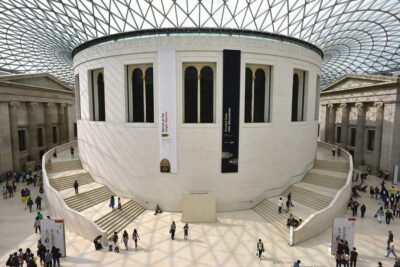
British Museum Audio Tour & Priority Entrance Ticket
Read our review →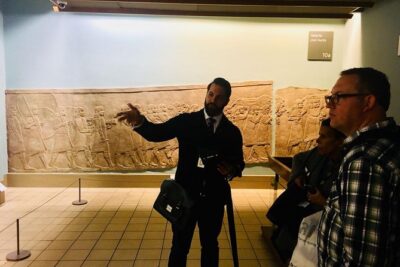
The British Museum London – Exclusive Guided Museum Tour
Read our review →
Private Guided Tour of the British Museum – Tickets Included
Read our review →Browse the lists this tour appears in