
Reviewed · NATURAL HISTORY MUSEUM TOURS
London: Natural History Museum Guided Tour
The most memorable part of this museum tour is the sheer range packed into 2.5 hours. You move from dinosaur teeth and a Dodo skeleton to Pompeii victims, a giant sequoia slice, and a first edition of On the Origin of Species. It is a smart way to get your bearings in a museum with 80 million specimens and more rooms than most people can sensibly tackle in one visit.
I like the focus on the museum’s best stories, not just its biggest objects. I also like the small group limit of eight, plus the private option, since guides such as Ivo, Matilda, Sacha, Luis, and Guy have been praised for clear explanations and for keeping children involved. The tradeoff is that the tour cannot cover everything, and temporary exhibits are not included.
Key points at a glance
- Iguanodon teeth and Archaeopteryx: See fossils tied to the changing story of evolution and the link between dinosaurs and birds.
- Pompeii casts: Look closely at casts of people caught in the volcanic disaster, a sobering change of pace from the dinosaur galleries.
- Dodo skeleton and Darwin: Connect extinction, evolution, and scientific debate through a Dodo and a first edition of On the Origin of Species.
- Small, child-friendly format: Group tours hold no more than eight people, and guides have done especially well at explaining difficult ideas to children.
- Unusual objects: The Cursed Amethyst and a huge slice of Giant Sequoia give the tour some welcome surprises.
- Practical limits: Large bags are not allowed, temporary exhibits cost extra, and wheelchair access requires a private tour arranged in advance.
Why this museum is hard to tackle alone
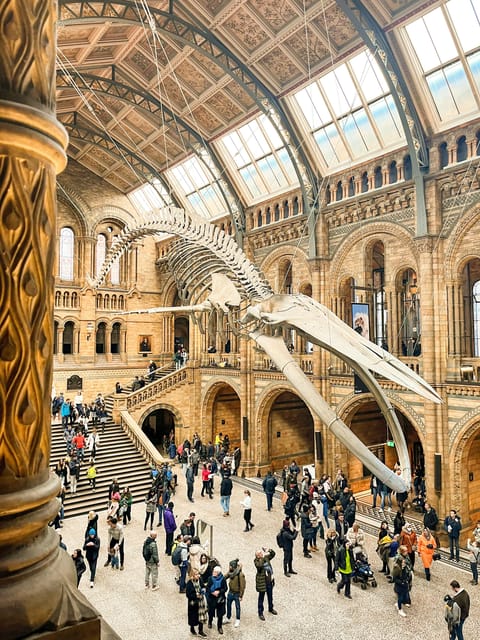
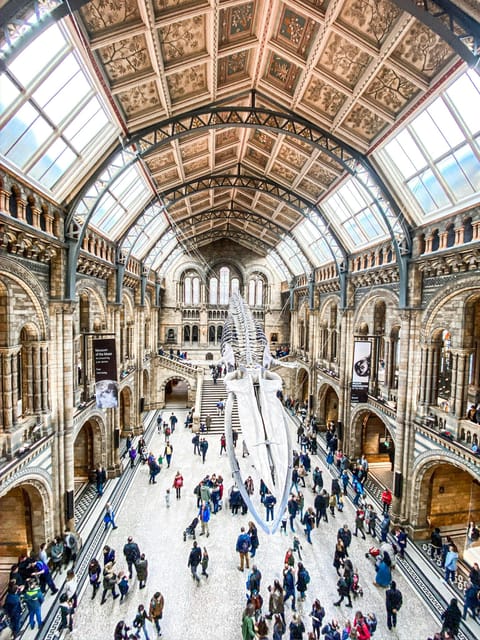
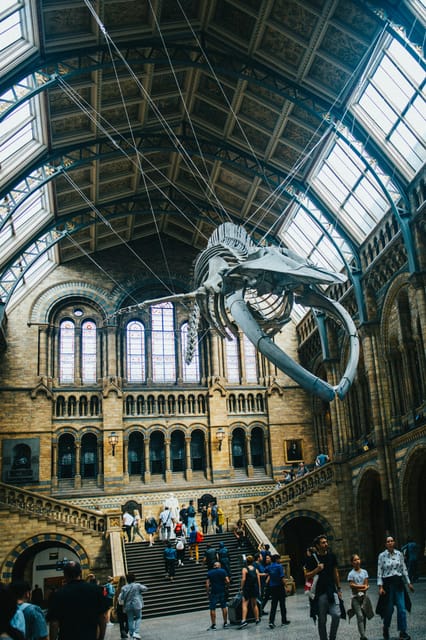
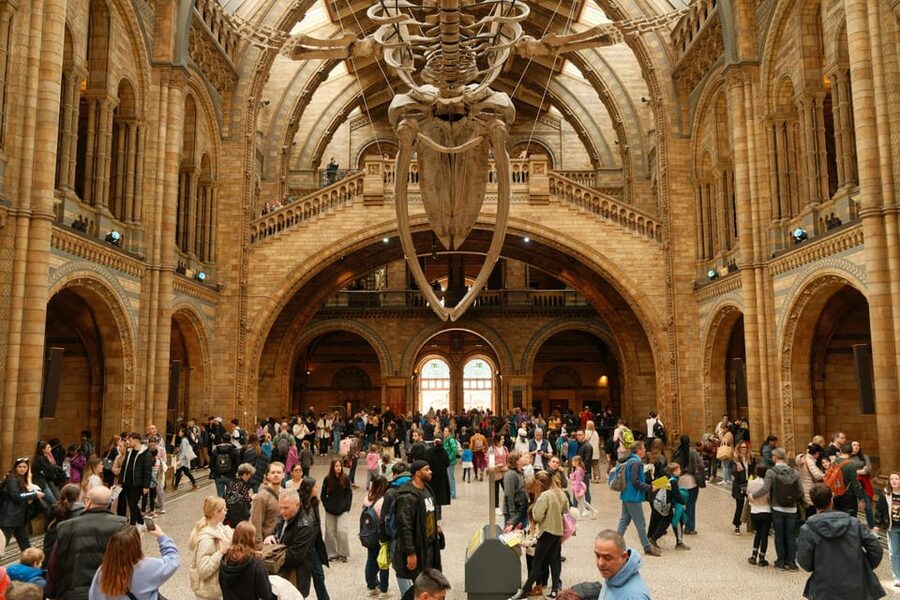
London’s Natural History Museum is not a single tidy display hall. Its 80 million specimens are spread through a maze of galleries covering the earth, animals, fossils, human origins, geology, and scientific history. You can easily spend an hour admiring the building and still have no idea which objects deserve your limited time.
That is where this tour earns its price. A guide gives you a route and a storyline. Instead of wandering from one attractive case to another, you follow the broad arc of earth’s beginnings, ancient life, extinction, human development, and the ways people have tried to understand nature.
The guide is an art historian, which adds a useful layer. You are not only shown bones and fossils as scientific objects. You also get attention to the building, presentation, visual drama, and the human stories behind the collection. The best guides, including Ivo, Matilda, Sacha, and Luis, have been described as animated, patient, and good at adjusting their explanations for different ages.
The format matters. A group tour is limited to eight people, and private bookings are available. That is small enough for questions to be practical rather than disruptive. It also explains why this works well for a family. One guide, Ivo, was especially praised for including children aged 11 and 16 while still giving their parent the larger picture.
More Natural History Museum Tours:
- London: Natural History Museum Entry Ticket and Guided Tour
★ 3.8 · 212 reviews - Natural History Museum London – Exclusive Guided Museum Tour
★ 5.0 · 153 reviews - London: Natural History Museum Private Tour & Skip the line
★ 5.0 · 42 reviews
Starting with fossils and the first big questions
The tour traces the history of life rather than treating the museum as a string of unrelated displays. Early stops include fossils such as Iguanodon teeth, which give you a tangible connection to animals that once lived millions of years ago.
Teeth are useful museum objects because they make ancient life feel concrete. A large skeleton can seem like a theatrical prop. A tooth shows how scientists infer what an animal ate, how it lived, and how it fits into the wider story of prehistoric life. Your guide can turn a small fossil into a discussion about evidence, rather than leaving you with only the animal’s name.
You will also meet Sophie the Stegosaurus, one of the museum’s recognizable dinosaur characters. The appeal is obvious for children, but adults get something from it too. A named skeleton is easier to remember, and the guide can use it to explain body shape, armor, movement, and how museum displays are built.
This early section should suit families particularly well. The tour has enough visual material to hold an 8-year-old’s attention, while the larger questions about extinction and evolution give older children and adults something to think about. Anthony, one guide praised for working with an 8-year-old, was credited with making human ancestors and dinosaurs feel like a story rather than a school lesson.
Archaeopteryx and the story of evolution
The Archaeopteryx is one of the more important scientific stops. It is often presented as a missing link between dinosaurs and birds, though that simple phrase can hide a more complicated scientific story. Your guide can help you see why the fossil matters: it brings together features associated with both groups and shows how scientists use physical evidence to understand change over time.
This is also where the tour can connect naturally to Darwin. You will see a first edition of On the Origin of Species, a landmark text in the history of evolutionary thought. Seeing the actual early edition gives the scientific story a human scale. Darwin’s ideas were not created in a vacuum. They grew from observation, comparison, debate, and a long attempt to explain the variety of life.
The value here is context. You can look at an isolated fossil and admire it, or you can understand how fossils, living species, extinction, and natural selection fit into one conversation. That larger picture was a repeated strength of guides such as Ivo and Matilda, who were praised for explaining important objects in a way that worked for both adults and children.
The museum’s displays can tempt you to rush from one famous object to the next. I would resist that urge during this section. Give yourself time to hear why the object matters. The point is not simply to see a rare fossil. It is to understand how one piece of evidence can alter the way people see the natural world.
Getting close to a Dodo skeleton
The Dodo is one of the tour’s clearest reminders that extinction is not only ancient history. You will see a Dodo skeleton and consider an animal that disappeared after human activity changed the conditions in which it lived.
The object has strong family appeal, but it is not presented only as a curious bird. It can lead into questions about how people record species, how quickly an animal can vanish, and what a museum preserves after an animal is gone. That makes the stop more meaningful than a quick photograph.
For children, the Dodo offers a friendly entry point into a serious idea. It looks distinctive and is easy to remember. For adults, the stop can connect the museum’s prehistoric fossils with the continuing story of extinction in the modern world.
This is one reason a guide can add real value over a self-guided visit. The museum gives you the object. A skilled guide supplies the thread that links the Dodo to Darwin, fossils, natural selection, and the question of how humans affect other species.
More Historical Tours:
- London Small Group Tour of Historical Pubs
★ 5.0 · 10,422 reviews - Soho Music & Historic Pubs Tour
★ 5.0 · 1,993 reviews - London: Historic Pubs of Central London Walking Tour
★ 4.9 · 1,065 reviews - London: Soho Music and Historic Pubs Walking Tour
★ 4.9 · 836 reviews
Pompeii casts bring a darker human story
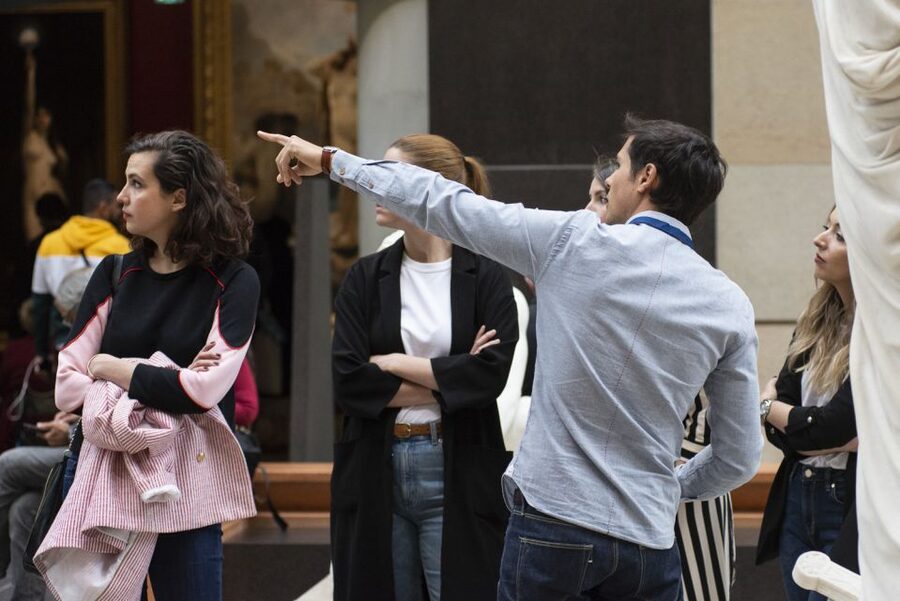
The Pompeii casts change the mood. Instead of animals preserved through fossilization or scientific collection, you see casts of people caught in the volcanic disaster at Pompeii.
This part is more solemn than the dinosaur displays. The casts make the disaster personal, and a guide can explain what you are seeing without turning the moment into spectacle. If you are visiting with children, the tone may be worth discussing in advance. The casts are not a light attraction, even though they are part of a wider museum tour.
The Pompeii section also broadens the tour beyond natural history in the narrow sense. It asks how people respond to disaster, how evidence survives, and how museums use physical remains to tell stories about past societies. That variety helps prevent two and a half hours of fossils from feeling repetitive.
The tour also touches on civilizations that used human skulls as drinking glasses. It is an unsettling detail, but a useful reminder that human cultures have treated death and remains in very different ways. This is the kind of unusual fact that tends to stay with you after the more familiar dinosaur names have faded.
The Cursed Amethyst and the giant sequoia
Two of the most unusual stops are the Cursed Amethyst and an enormous slice of a Giant Sequoia tree. They add surprise to a route otherwise dominated by fossils, bones, and human evolution.
The Cursed Amethyst brings a touch of mystery. The title alone invites questions about belief, storytelling, and the way objects gather reputations. It gives the guide a chance to shift from hard scientific evidence to the stories people attach to natural materials.
The Giant Sequoia slice works in the opposite direction. Its size makes time visible. A tree trunk can record years through its growth rings, and a huge section gives you a sense of age and scale that a date on a label cannot. It is an excellent pause between smaller specimens and skeletons.
These objects are valuable partly because they are not the stops most people name first. If you have already seen dinosaur displays elsewhere, the amethyst and sequoia may become the details you remember. They give the tour character and keep the experience from feeling like a standard greatest-hits route.
What makes the guides effective
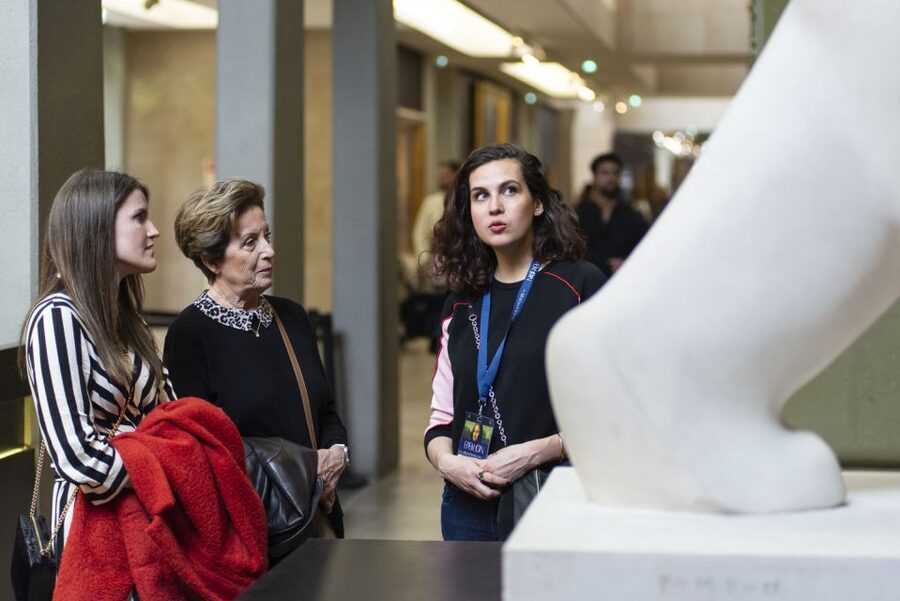
The guide is the main reason to book this rather than simply enter the museum. The strongest comments about the experience focus on explanation, pacing, friendliness, and the ability to involve children.
Ivo has been especially well regarded for giving families the big picture while adding funny anecdotes and keeping the tour moving. Guy V. was praised for answering children’s questions patiently and clearly. Matilda has been valued for knowing which objects matter most and explaining them in a way that worked for a 13-year-old and an adult together.
Sacha’s calm style may suit you if you prefer a guide who does not rush or perform every explanation. Luis has been praised for precise explanations, clear English, and the ability to offer Spanish as well. Laurence has been noted for showing a great deal of the museum within the available time, while Becky was credited with making a visit more meaningful through guidance.
These are not interchangeable details. A museum tour depends heavily on the person leading it. You may not receive one particular guide, so book this for the format and subject rather than a promised personality. Still, the repeated emphasis on patient explanations and family appeal is encouraging.
English is the listed tour language. If English is your second language, the clear speaking style described by families can help, but you should not assume another language unless it is confirmed for your booking.
Is $112 a fair price?
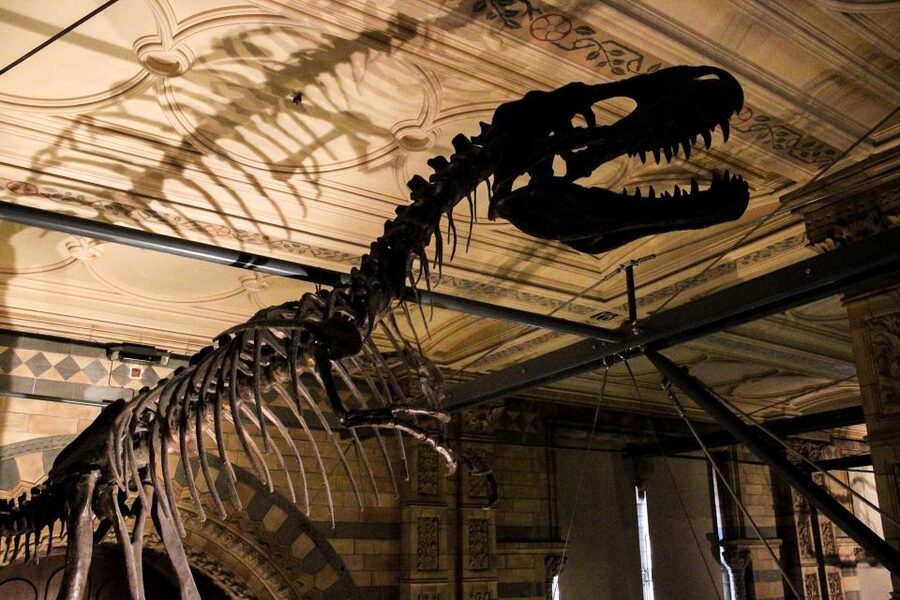
At $112 per person, this is not the cheapest way into the museum. The price makes most sense if you value direction, interpretation, and a small group. A 2.5-hour route with an art historian can save you from spending your first half hour lost among galleries and your next two hours seeing objects without understanding their importance.
The value is strongest for a first visit, a family with limited time, or anyone who wants a planned introduction rather than a day of independent reading. The private option may also suit a family or couple that wants to ask many questions and set its own pace.
The value is weaker if you already know the museum well, prefer wandering alone, or plan to spend most of the day with the exhibits. A guided route will necessarily leave out many rooms. Temporary exhibits are not included, so you should treat this as an introduction to the permanent collection, not a ticket to everything the museum may offer.
The tour includes skip-the-ticket-line access, though security checks can still create lines. The price does not include food, drinks, or hotel pickup and drop-off. The museum is central enough for you to arrange your own transport, but you need to plan the meeting point carefully because it can vary by booking option.
Timing, bags, and the practical details
Allow a small amount of walking. This is not described as a strenuous outing, but you will be moving through a large museum for two and a half hours. Comfortable clothing and shoes make sense, and appropriate dress is required for entry into some sites on the route.
Do not arrive with luggage. Large bags and suitcases are not allowed inside. Only handbags or small, thin backpacks can pass through security, and increased security can mean some waiting even with skip-the-line access.
Bring a passport or identity card, as this is listed among the required items. Food and drinks are not included, so plan around the tour rather than expecting refreshments as part of it.
The tour is available daily, with start times depending on availability. For a group booking, at least two people are required for the tour to run, and the maximum is eight. If the minimum is not reached, an alternative date or full refund is offered.
Museum closures can happen without advance warning. If the opening time is delayed by more than an hour, an appropriate alternative is provided, but a refund is not offered in that situation. That policy is worth understanding before you book a tightly packed London day.
Free cancellation is available up to 24 hours before the start time, and you can reserve now and pay later. Those terms are useful if your schedule is still changing.
Wheelchair tours are available only on request and only as private tours. The activity is also listed as unsuitable for wheelchair users, so contact the provider before booking rather than assuming a standard group tour will work.
Who should book this Natural History Museum tour?
I would choose this tour for a first visit, especially if you have only one morning or afternoon in the museum. It is also a strong choice for families with children who ask lots of questions and need more than labels to stay interested.
It suits adults who want the major scientific ideas explained in plain language. The route covers fossils, evolution, extinction, human remains, geology, and scientific history, so it gives you a broad introduction without asking you to read every display.
You may prefer independent entry if you want to linger at one subject, visit temporary exhibits, or spend a full day moving at your own pace. The guided route is selective by design. That is its strength, but also its limit.
Should you book it?
Book it if you want the Natural History Museum to make sense quickly, especially with children or a mixed-age group. The combination of a small group, an English-speaking art historian, and a focused route gives you more structure than a casual visit.
I would be less keen if you dislike guided pacing or already know the museum’s main galleries. At $112, the tour needs to earn its keep through explanation, and its best guides appear to do exactly that. For a first visit, the Dodo, Archaeopteryx, Pompeii casts, Darwin edition, and giant sequoia make a strong set of anchors for understanding one of London’s most demanding museums.
FAQ
How long does the Natural History Museum tour last?
The tour lasts 2.5 hours.
What language is the tour offered in?
The tour is offered in English with a live guide.
How many people can join a group tour?
Group tours have a maximum of eight guests. At least two guests are required for a group tour to run.
Are private tours available?
Yes. The experience is offered as either a private tour or a small group tour.
Are temporary exhibits included?
No. Temporary exhibits are not included in the tour.
Can I bring a suitcase or large backpack?
No. Large bags and suitcases are not allowed inside the museum. Handbags and small, thin backpacks are permitted through security.
More British Museum Tours
- Tower of London and Crown Jewels Exhibition Ticket
★ 4.5 · 6,677 reviews - London: Chelsea Football Club Stadium and Museum Tour
★ 4.8 · 4,576 reviews - Chelsea FC Stadium Tours and Museum
★ 5.0 · 1,908 reviews - London: British Museum Guided Tour
★ 4.3 · 1,182 reviews
Just added around London
- London: “Queen” Highlights Walking Tour★ 4.3 · 48 reviews
- Couple’s photo: Romantic photoshoot in London★ 4.8 · 22 reviews
- London: Private Tour with Locals – Highlights & Hidden Gems★ 5.0 · 8 reviews
- Luxury Private Tour in London with Lunch★ 5.0 · 7 reviews
- London 1- or 2-Hour Professional Photo Shoot★ 4.9 · 6 reviews
- London: Private Black Cab Night Tour with Hotel Pick Up★ 5.0 · 11 reviews
- London: Christmas Lights Tour – With Christmas Music★ 4.8 · 9 reviews
- London: Private Pub Tour★ 4.5 · 4 reviews
Natural History Museum Tours, compared.
Natural History Museum Entry Ticket and Guided Tour
Read our review →
Natural History Museum London – Exclusive Guided Museum Tour
Read our review →
Browse the lists this tour appears in