
Reviewed · BRITISH MUSEUM TOURS
London: British Museum Guided Tour with Priority Entrance
The best reason to take this tour is simple: the British Museum is far too large to understand by wandering without a plan. In two focused hours, your guide takes you from the Great Court to the Parthenon Sculptures, Egyptian mummies, the Rosetta Stone, and Sutton Hoo, giving each stop a useful piece of context.
I like the clear route through major civilizations and the fact that headsets help you hear in crowded galleries. I also like the friendly, flexible guiding style reported from guides such as Antonio, Mira, Alex, Tony, Tara, and James. The main drawback is time: two hours gives you a strong introduction, not a complete museum visit.
Key points to know
- Two hours, carefully paced: You see major displays from ancient Egypt, Greece, Asia, and Anglo-Saxon England without trying to cover every room.
- Priority entrance with a timed slot: This can save valuable time, though your guide meets you inside by the information desk.
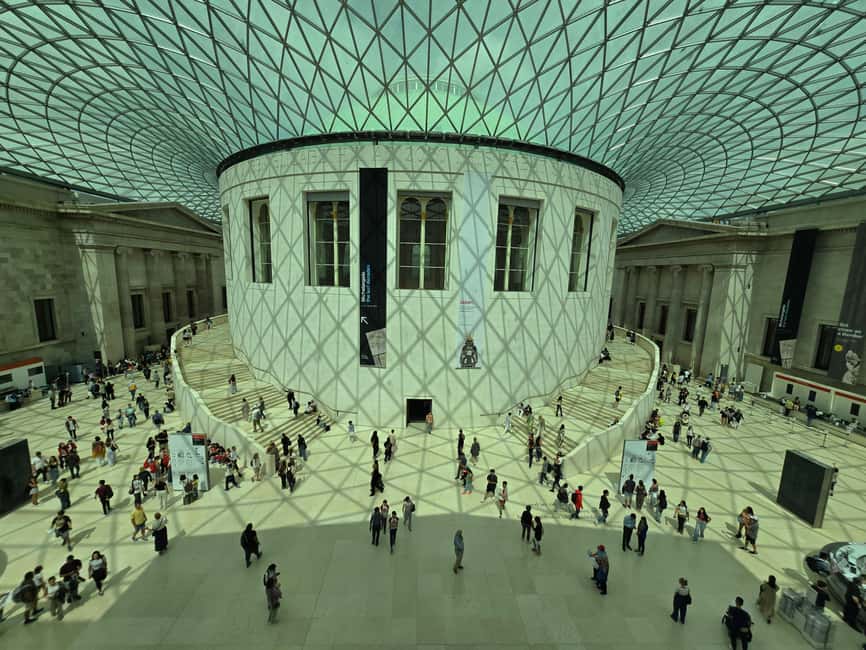
- Great Court first: The glass roof gives you an immediate sense of the museum’s scale and architecture.
- Headsets help in crowded rooms: You can follow the commentary without standing shoulder to shoulder with the guide.
- Strong guide-led storytelling: Antonio, Mira, Alex, Tony, Tara, and James are among the named guides praised for clear explanations and good crowd control.
- Plan extra time afterward: The tour finishes at the meeting point, leaving you free to return to rooms that caught your attention.
Why a guided route helps at the British Museum
The British Museum holds more than 8 million objects spread across more than 70 galleries. That figure is exciting until you face the floor plan. Without a plan, you can spend a great deal of time choosing rooms and still miss the objects that give the museum its clearest story.
This tour solves that problem with a brisk route through famous pieces and major periods. You are not simply led from display case to display case. The guide links objects to belief, trade, power, burial customs, science, and art, so the museum feels less like a warehouse of old things.
I especially like this approach for a first visit. You get your bearings quickly, learn where the major galleries are, and can then return to the subjects that interest you. Several guides are praised for showing the most important objects while pointing out where to spend more time after the tour.
The two-hour limit keeps the pace moving. That is useful, but it also means you should not expect long, quiet study of every object. If you want a slow look at Egyptian writing, Greek sculpture, or Chinese art, reserve extra time after the guided portion.
More British Museum Tours:
- London: British Museum Guided Tour
★ 4.3 · 1,182 reviews - British Museum London Guided Tour Semi-Private 8ppl Max
★ 5.0 · 984 reviews - London: Tour of the British Museum
★ 4.1 · 678 reviews
Starting at 52 Great Russell Street
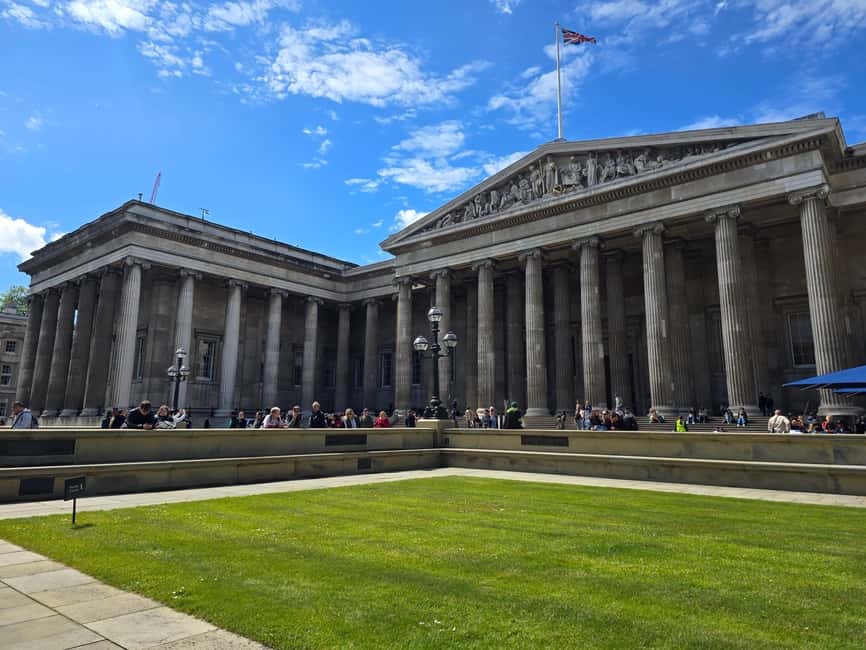
The listed starting point is 52 Great Russell Street, but the guide waits inside the museum beside the information desk. This detail matters. Do not assume the tour begins with a street-side welcome or a long orientation outside.
You need to enter the museum using the allocated priority entrance and timed admission arrangement, then make your way to the information desk. Your guide will be waiting there. Since the meeting point is inside, allow enough time to reach the desk after entering, especially if you are unfamiliar with the building.
The priority arrangement is useful because a delayed entry can eat into a short tour. It is described as a separate entrance with a reserved time slot. The precise entry process can depend on the time you book, so check your confirmation carefully and arrive ready to find the information desk.
The activity begins and ends at the same meeting point. Transportation is not included, and food and drinks are not included, so this is a museum visit rather than a wider London sightseeing package.
The Great Court gives you the museum’s first big idea
A view of the Great Court and its glass roof is an excellent opening. The roof itself is a work of art, and the open space helps you understand how the museum is arranged around a central gathering place.
This stop is not just a photo break. It gives you a visual sense of the building before the tour moves into darker, denser galleries. I like having this architectural pause at the start because the British Museum can otherwise feel like a sequence of disconnected rooms.
Your guide may use the Great Court to explain the scale of the collection and set expectations for the visit. With millions of objects and dozens of galleries, you are seeing a carefully selected route, not the whole institution.
That is also where the headset becomes useful. The museum can be crowded, and a wireless audio system lets you look at the building or move a little closer to an object while keeping up with the explanation. The equipment was specifically praised for working well, which is important on a tour that relies on spoken detail.
Egyptian mummies, the Rosetta Stone, and the pharaohs
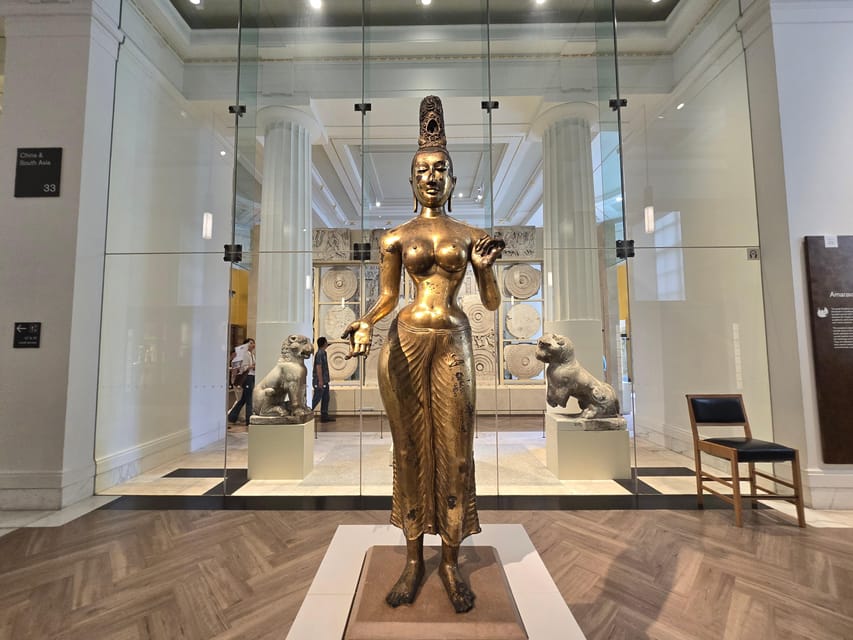
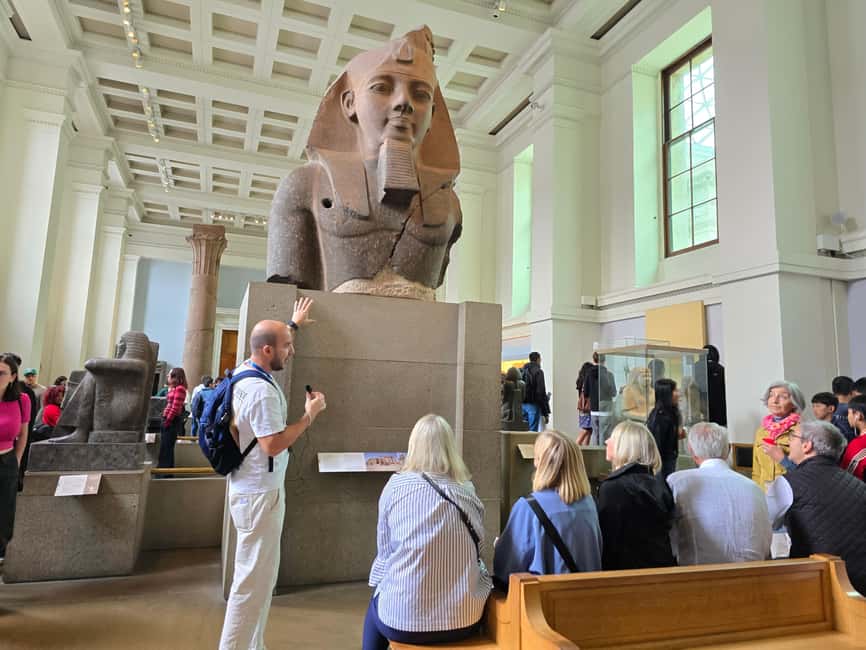
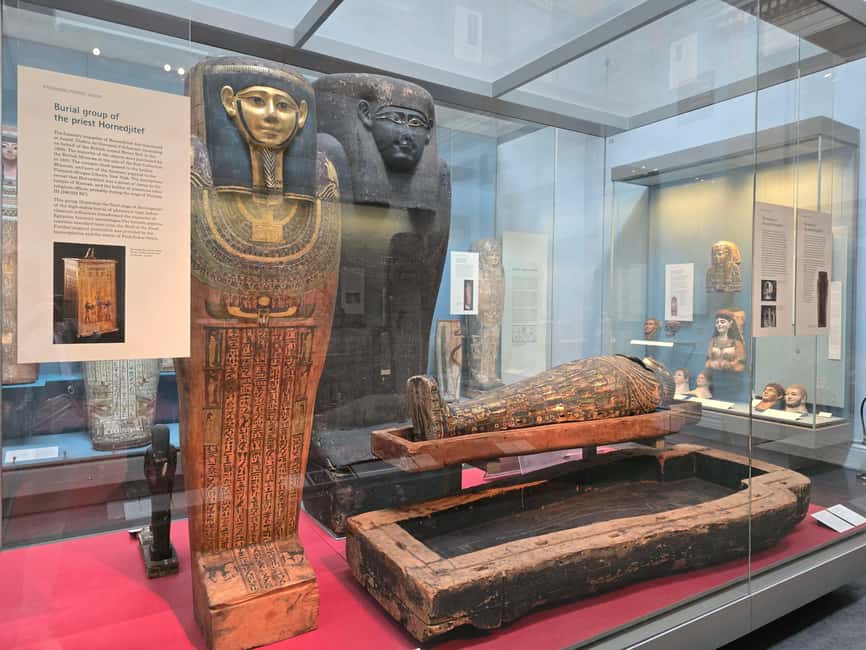
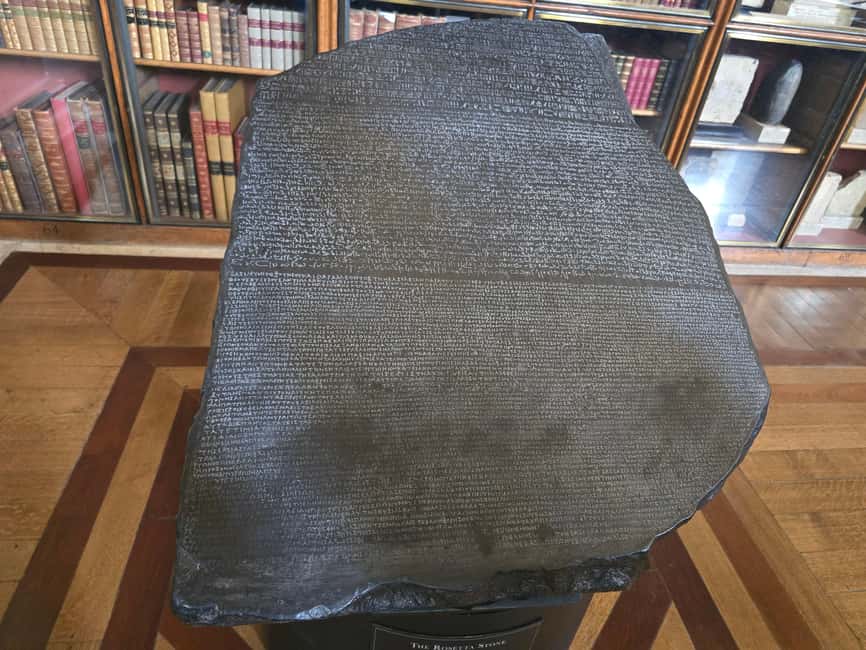
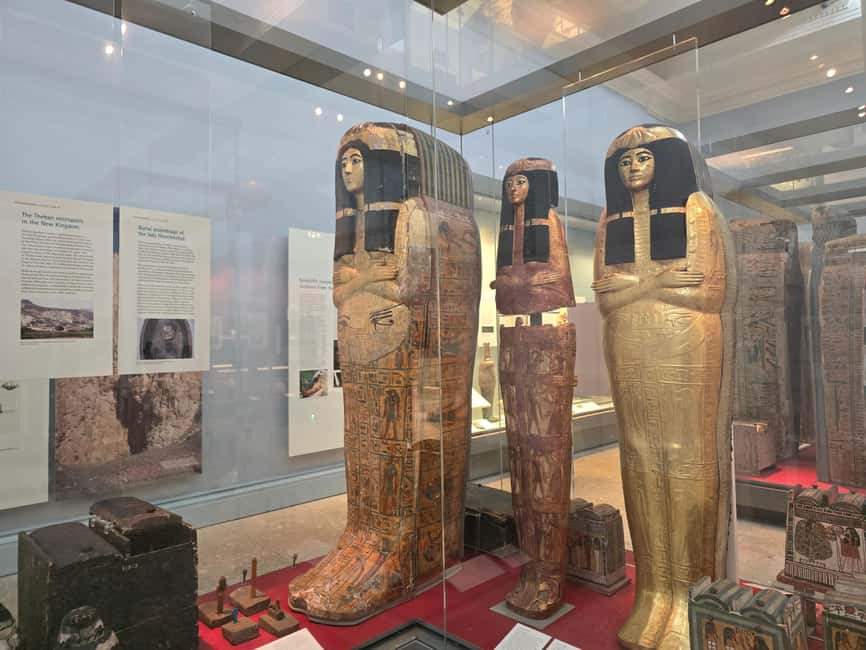
The Egyptian section is one of the tour’s central stops. You can expect to see mummies, the Book of the Dead, the bust of Ramesses II, and the Rosetta Stone.
These objects work well together because they present several sides of ancient Egyptian life. The mummies open a discussion about burial practices and religious beliefs. The Book of the Dead brings written instructions and ritual into the picture. The Ramesses II bust gives you a powerful example of royal representation.
The Rosetta Stone is especially valuable with a guide because its importance is easy to reduce to a single sentence about translation. A good explanation places it within the story of written language and the deciphering of hieroglyphs. Guides are also praised for their work with hieroglyphics, so this may be one of the more satisfying portions if you want to understand how the writing system functioned.
Expect a popular gallery and a steady pace. You may not have much time to examine every mummy or inscription. If Egypt is your main interest, make a note of the rooms and return after the tour.
A different sort of day out in London altogether:
- From London: Harry Potter Warner Bros Studio Tour
★ 4.7 · 26,588 reviews - London: Westminster to Greenwich River Thames Cruise
★ 4.5 · 22,836 reviews - Magical London: Harry Potter Guided Walking Tour
★ 4.7 · 22,044 reviews - London: Madame Tussauds London
★ 4.6 · 20,915 reviews
The Parthenon Sculptures and the questions they raise
The Parthenon Sculptures, also called the Elgin Marbles, bring ancient Greece into the route. Their scale, carved detail, and connection to the Parthenon make them essential viewing.
A guide can do more here than identify figures and myths. You may hear about the stories shown in the sculpture, the way classical artists represented the human body, and the role these works played in the decoration of the Athenian temple.
There is also a major question of ownership and removal connected with these sculptures. The supplied tour details emphasize Greek myths and legends, but the description does not promise a detailed treatment of the modern dispute. If that issue is important to you, ask your guide directly.
This stop is a good example of the tour’s value. You see an object that can be overwhelming in a large gallery, then receive a short explanation that gives it a place in Greek art and mythology. The tradeoff is that a group tour cannot linger over every figure.
The Enlightenment Room connects objects with ideas
The Enlightenment Room shifts the focus from ancient civilizations to the intellectual life of the 18th century. Its objects reflect scientific progress, collecting, research, and the period’s appetite for knowledge.
I like this section because it shows the museum as more than a parade of famous antiquities. The British Museum also tells the story of how people in Europe tried to classify and understand the wider world. That perspective adds a useful layer to the Egyptian, Greek, and Asian collections.
The guide’s role here is to explain connections among objects that may not appear related at first glance. You may see how scientific interests, travel, study, and collecting shaped the way museums developed.
As with the other stops, the room is an introduction rather than a full lesson in 18th-century thought. It works best if you listen for the main ideas and mark it as a place to revisit later.
Chinese and Southeast Asian collections
The route also includes Chinese art and objects from Southeast Asia. This is a welcome choice because a short museum tour could easily focus only on Egypt, Greece, and Britain.
You can expect beautifully made objects and an introduction to the artistic traditions and histories of the region. The guide helps give these collections a place in the overall route, showing that the museum’s reach extends well beyond the most famous European and Egyptian displays.
This section may appeal to you if you want a broader view of world history. It also helps keep the tour balanced. Instead of moving through only one part of the ancient world, you get a sample of different cultures and artistic traditions.
The limitation is the same as elsewhere: the collection is too large for a complete treatment in two hours. Treat this as a carefully chosen preview. If a particular Chinese or Southeast Asian display catches your eye, return to it after the guide leaves you at the meeting point.
Sutton Hoo and Anglo-Saxon England
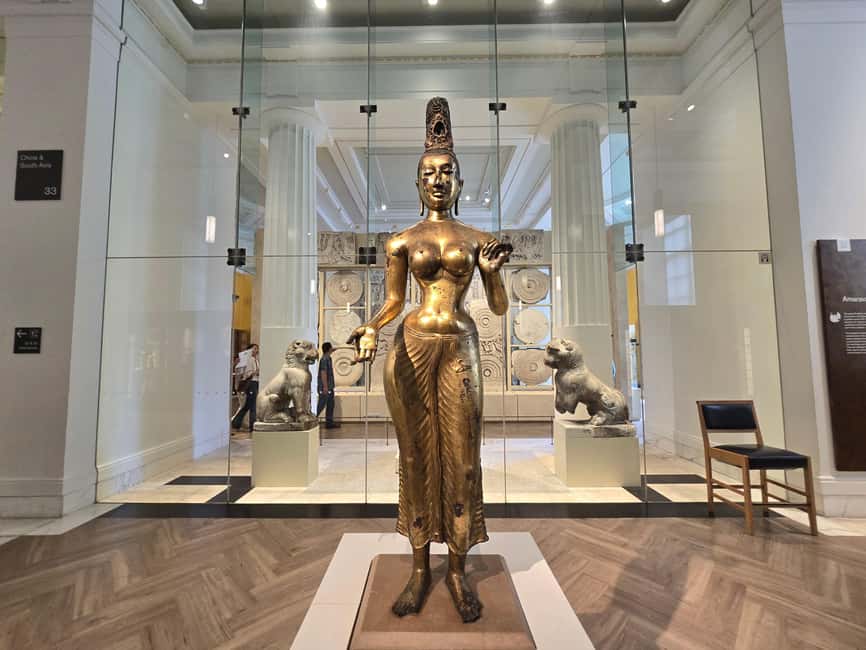
The Sutton Hoo ship burial gives the tour a strong British chapter. The helmet, shield, and other burial objects reveal the skill and culture of early medieval England.
The helmet is the obvious star, but the value of the display lies in seeing the objects together. A ship burial tells you about status, ceremony, craftsmanship, and beliefs about death. The guide can help connect the individual pieces to the wider society that produced them.
This stop is especially helpful if you know little about Anglo-Saxon England. It places British material in the same broad conversation as the Egyptian and Greek collections, while still giving the tour a local anchor.
The display also provides a change of mood after the monumental ancient galleries. You move from pharaohs and classical myths to a burial from early medieval England, which makes the two-hour route feel varied rather than repetitive.
Guides, headsets, and group size
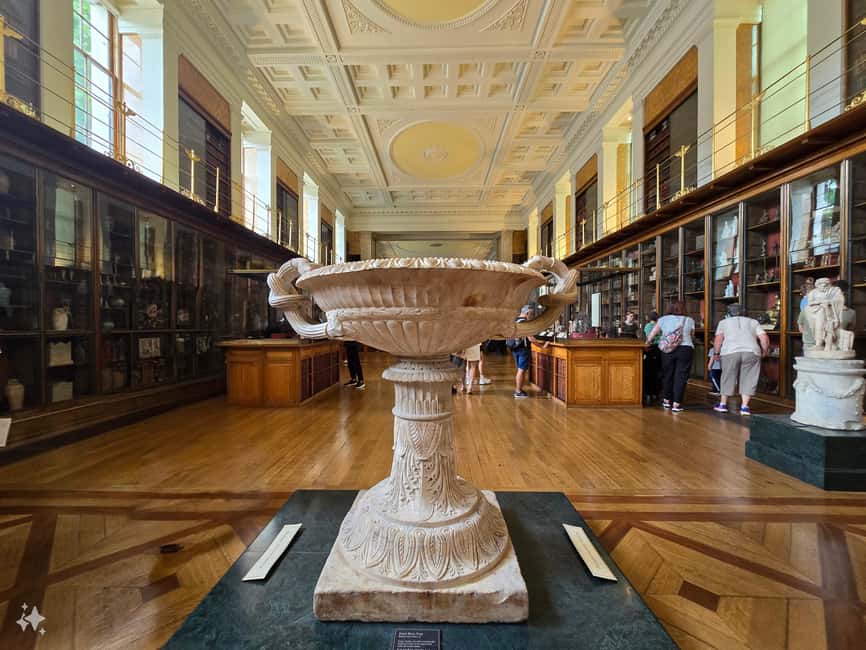
The strongest feature of this experience is the guiding. Names repeatedly associated with excellent tours include Antonio, Mira, Alex, Tony, Tara, and James. Their praised qualities are practical: clear explanations, good timing, friendly interaction, and the ability to keep a group together in crowded rooms.
Mira and Alex are noted for checking that everyone was present, using easy participation, and adjusting the pace when needed. Antonio is praised for putting objects into wider world-history context and answering questions. Tony is described as especially effective at giving first-time visitors an overview.
A small group is available. Group size can shape the experience considerably in a museum. A compact group makes it easier to hear, ask questions, and stay close to the guide. Very small bookings may even become a near-private conversation, though you should not book on the assumption that this will happen.
Headsets are available, and the tour information says commentary is offered in English, Italian, and Chinese. Another section specifies guided commentary in English and Italian, so check your selected option carefully if language matters to your booking. The audio equipment is a real help in busy rooms and reduces the need to crowd around one person.
Is $53.87 good value?
At $53.87 per person, this is not the cheapest way to enter a museum, but the price includes a timed priority entrance and a two-hour guided route. You are paying mainly for structure, interpretation, and time saved.
I find the value strongest for a first visit, a short London stay, or anyone who feels overwhelmed by huge museums. Two hours with a good guide can prevent aimless wandering and show you where to return. The tour also gives you a useful overview of several continents rather than concentrating on a single gallery.
The value is weaker if you already know exactly what you want to see or prefer to read labels alone. In that case, you may want to spend your full visit at your own pace instead of following a fixed route.
Remember that food, drinks, and transportation are not included. The activity finishes at the museum meeting point, so you can arrange lunch or continue sightseeing afterward.
Who should book this museum tour?
This tour suits first-time British Museum visitors, families with older children, and anyone with only a few hours in London. It also works well for people who enjoy stories and connections more than reading every label independently.
You should book it if you want to see the headline objects and leave with a workable plan for the rest of your visit. The guide’s explanations are particularly useful for the Rosetta Stone, hieroglyphics, the Parthenon Sculptures, and Sutton Hoo, where context adds much more than a quick photograph.
It is less suitable for wheelchair users, people with mobility impairments, babies under one year, or people with hearing impairments, according to the stated restrictions. Flash photography is not allowed.
Free cancellation is available up to 24 hours before the activity for a full refund, and you can reserve now and pay later. Those policies give you some flexibility, but the museum entry still has a scheduled time, so do not treat the booking as an open-ended admission.
Should you book the British Museum guided tour?
Book it if you want a smart introduction rather than an all-day museum marathon. The combination of priority entry, a focused route, headsets, and guides such as Antonio, Mira, Alex, Tony, Tara, and James gives you a practical way to see major highlights without losing the thread.
Do not book it expecting to see everything. You will need extra time for the many galleries left outside the route. The best plan is to take the two-hour tour early in your museum visit, note the rooms that interest you, then continue independently after it ends.
FAQ
How long is the British Museum guided tour?
The tour lasts two hours. You can check available starting times when you choose your date.
Where does the tour start?
The guide waits inside the British Museum beside the information desk. The listed meeting location is connected with 52 Great Russell Street.
Where does the activity end?
The tour ends back at the meeting point beside the information desk.
Is priority entrance included?
Yes. The activity includes priority tickets for the main entrance with an allocated timeslot and access through a separate entrance.
Which languages are available?
Live guiding is listed in English, Italian, and Chinese. The included commentary is specified as English or Italian, so check the language option available for your selected booking.
Are headsets provided?
Headsets are available for the tour, and the experience information says they help you follow the guide’s commentary.
What objects are included in the route?
The route includes the Great Court, Parthenon Sculptures, Egyptian mummies, the Book of the Dead, the bust of Ramesses II, the Rosetta Stone, the Enlightenment Room, Chinese and Southeast Asian collections, and Sutton Hoo objects.
Is transportation included?
No. Transportation is not included, and you make your own way to the British Museum.
Is food or drink included?
No. Food and drinks are not included.
Can I cancel for a full refund?
Yes. You can cancel up to 24 hours in advance for a full refund.
Is the tour suitable for wheelchair users?
No. The activity is listed as unsuitable for wheelchair users and people with mobility impairments.
Is photography allowed?
Flash photography is not allowed.
Can I reserve now and pay later?
Yes. The booking option allows you to reserve your place and pay later.
Just added around London
- London: “Queen” Highlights Walking Tour★ 4.3 · 48 reviews
- Couple’s photo: Romantic photoshoot in London★ 4.8 · 22 reviews
- London: Private Tour with Locals – Highlights & Hidden Gems★ 5.0 · 8 reviews
- Luxury Private Tour in London with Lunch★ 5.0 · 7 reviews
- London 1- or 2-Hour Professional Photo Shoot★ 4.9 · 6 reviews
- London: Private Black Cab Night Tour with Hotel Pick Up★ 5.0 · 11 reviews
- London: Christmas Lights Tour – With Christmas Music★ 4.8 · 9 reviews
- London: Private Pub Tour★ 4.5 · 4 reviews
British Museum Tours, compared.
British Museum London Guided Tour Semi-Private 8ppl Max
Read our review →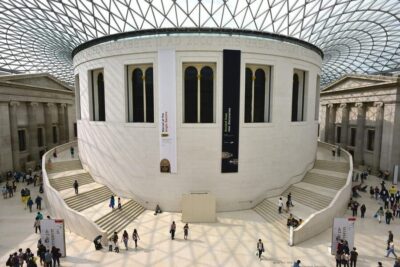
British Museum Audio Tour & Priority Entrance Ticket
Read our review →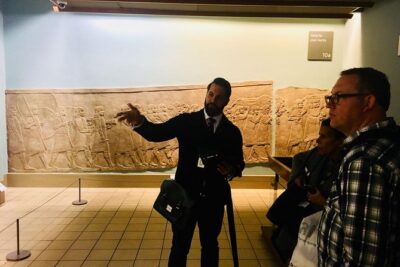
The British Museum London – Exclusive Guided Museum Tour
Read our review →
British Museum & National Gallery of London Semi-Private 8ppl Max
Read our review →Browse the lists this tour appears in