
Reviewed · BRITISH MUSEUM TOURS
The British Museum: a highlights tour with a TV historian
The most useful thing about this British Museum tour is the guide’s inside knowledge. Loona, a former British Museum staff guide, leads you from the Rosetta Stone and Rameses II to Sutton Hoo, the Parthenon Sculptures, and some wonderfully odd fakes. I like the private format, which lets the pace and explanations fit your group, and I like the behind-the-scenes stories about how objects were found, translated, displayed, and acquired.
The main catch is practical: the museum is free, but you must book your own timed-entry ticket online. Entry can take about 30 minutes, so arriving at 11:00 am means you should not stroll up at the last moment. The tour itself lasts about three hours, and the museum’s scale means you will see highlights rather than every gallery.
Key points to know before booking
- Former British Museum staff guide: Loona knows the building and collections from professional experience, including the unusual detail of supervising museum sleepovers with the mummies.
- A private three-hour route: Only your group takes part, so you can ask questions and pause when a display catches your eye.
- Major objects, plus strange surprises: The route includes the Rosetta Stone, Parthenon Sculptures, Benin Bronzes, Lewis Chess pieces, Sutton Hoo, and disputed crystal skulls and mermaids.
- History explained through objects: You hear how hieroglyphs and cuneiform were translated, not just what the inscriptions say.
- Good for mixed-age groups: Harry Potter, Hollywood, and modern-life references help make ancient objects easier for children to grasp.
- Free museum entry, paid guiding: You pay for the personal guide service, while your museum admission ticket must be reserved separately at no charge.
Why a guide changes the British Museum

The British Museum can feel like several museums joined together. You move from ancient Egypt to Mesopotamia, the Americas, Anglo-Saxon England, China, India, Africa, and Greece, often within a few minutes. The problem is not a lack of things to see. It is deciding what deserves your limited time and understanding why each object matters.
A self-guided visit can work well if you enjoy reading labels and choosing your own route. But a guide gives the collection a human thread. Instead of treating the Rosetta Stone, a Maya carving, and an Assyrian relief as separate curiosities, you begin to see recurring questions: How did people record language? How did rulers present power? What happens when objects move from one culture to another?
That is where Loona’s former museum experience matters. The tour is not just a sprint past famous objects. You get stories about acquisition, translation, mistaken identification, and the way museums decide what to display. Those details can make a familiar object feel new.
The private setup is also worth noting. You are not attached to a large group with a fixed script. If your children want to ask about a monster-shaped object, or you want more time with Anglo-Saxon treasure, the guide can respond to that interest. One review describes a route lasting three and a half hours, while the stated duration is about three hours, so allow some flexibility if conversation takes hold.
More British Museum Tours:
- London: British Museum Guided Tour
★ 4.3 · 1,182 reviews - British Museum London Guided Tour Semi-Private 8ppl Max
★ 5.0 · 984 reviews - London: Tour of the British Museum
★ 4.1 · 678 reviews
Starting at the Reading Room
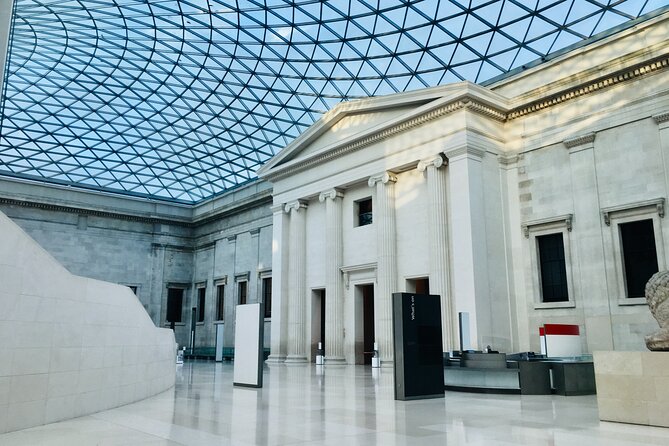
The meeting point is the British Museum Reading Room on Great Russell Street. The tour starts at 11:00 am and ends inside the museum near the mummies gallery. Since the museum requires its own timed ticket, sort that out before arranging your day.
This matters more than it may seem. The museum is free, but free tickets can still be limited. The practical advice is to reserve your entry several days ahead through the British Museum’s own website. You are responsible for that ticket because guiding services are the only inclusion in this experience.
Allow roughly 30 minutes to enter. Security, ticket checks, and the walk into the building can eat into your schedule. If you arrive late, you may miss the beginning of the tour or spend the opening minutes trying to find the group. Public transport is nearby, and the meeting point is central, but the museum itself is large enough that you should leave time for orientation.
The Rosetta Stone and the work of translation
The Rosetta Stone is an obvious starting point because it tells a larger story than the object’s appearance suggests. Its importance comes from the same decree being written in three scripts, including hieroglyphs and ancient Greek. Since scholars could read Greek, the stone helped them work out the meaning of the Egyptian writing.
A good guide makes this feel like a detective story rather than a grammar lesson. You learn why the stone mattered, how translation proceeded, and how the ability to read hieroglyphs changed the study of ancient Egypt. The point is not simply to say that the Rosetta Stone helped decipher a script. It is to show how one multilingual object opened access to an entire written world.
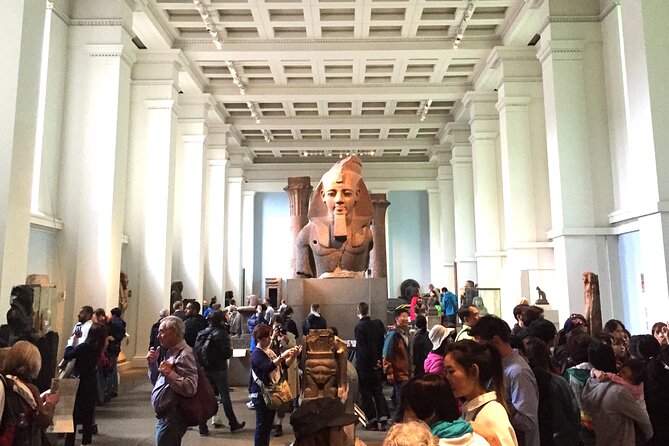
The bust of Rameses II adds a ruler’s face to that story. It gives you a chance to consider how ancient kings wanted to be remembered, and how a museum object can carry both artistic and political meaning. These early stops are especially useful for children because a face and a puzzle are easier to grasp than a long chronological lecture.
Egypt, mummies, and stories that keep children listening
The tour reaches the mummies gallery, and the guide’s museum background becomes particularly memorable here. Loona has supervised sleepovers with the mummies, an unusual detail that gives the subject a personal spark without turning the visit into a ghost story.
If your children are not naturally drawn to ancient history, the guide can connect the displays to Harry Potter, Hollywood, and modern life. That does not replace serious explanation. It gives younger minds a familiar hook before moving to the harder questions about belief, death, writing, and power.
The route is designed for a broad group rather than a specialist audience. You can expect clear stories, comparisons, and room for questions. Still, the museum is full of delicate objects and busy display areas, so very young children may need help staying with the group during the full three hours.
More London Sightseeing and Highlights Tours:
- London: London by Night Sightseeing Open-Top Bus Tour
★ 4.5 · 5,516 reviews - London: Tootbus Must-See Hop-On Hop-Off Bus Tour with Cruise
★ 4.0 · 3,653 reviews - London: River Thames Hop-On Hop-Off Sightseeing Cruise
★ 4.4 · 3,112 reviews - Westminster to Greenwich Sightseeing Thames Cruise in London
★ 4.5 · 2,969 reviews
From Aztec jewellery to Maya carvings
The Americas section brings a different set of questions. You may see Aztec jewellery associated with Montezuma and Maya carvings, objects that invite discussion about ceremony, authority, craftsmanship, and the way European accounts shaped later understanding of these cultures.
The value here is the connection between a small object and a much larger society. Jewellery can reveal rank and belief. A carved inscription can show how writing worked and how rulers recorded events. The guide’s job is to keep the object in view while explaining the world around it.
This part also helps prevent the museum from becoming an Egypt-and-Greece-only visit. The route covers multiple regions and time periods, so you are not simply collecting famous names. You get a broader look at how different societies used art and writing to explain power, religion, and identity.
Fakes, crystal skulls, and mermaids
One of the most entertaining sections concerns objects that are not what they first appear to be. Crystal skulls and mermaids offer a way to talk about fakes, collecting, and the desire to believe that an object is older or stranger than it really is.
This is valuable because museums are not only places of certainty. They are also places where experts test claims, compare materials, examine provenance, and revise earlier opinions. A fake can teach you about the market, popular taste, and the methods used to establish authenticity.
For children, this may be one of the easiest sections to remember. For adults, it adds welcome skepticism to a tour otherwise filled with celebrated masterpieces. You are reminded to ask not only What is this? but also How do we know?
Libraries, cuneiform, and the world’s oldest epic
The tour then moves into early writing and the history of recorded knowledge. The oldest library and cuneiform displays show how people preserved information long before modern books, databases, or printing presses.
Cuneiform is especially useful because it reveals writing as a practical technology. It was used to record language, administration, stories, and public life. Hearing how it was translated gives you a better sense of the work involved. These marks are not decorative symbols. They are evidence of people trying to store and transmit ideas.
The world’s oldest epic story adds a more personal note. Epic literature is not only about kings and battles. It also deals with friendship, loss, ambition, and mortality. A short explanation can turn a block of ancient writing into a story with concerns you still recognize today.
The first declaration of human rights offers another strong discussion point. The tour can help you consider how later generations interpreted such a document and why it has become important in modern arguments about rights and government. This is a good example of the museum’s wider appeal: objects are not locked in the past. People keep giving them new meaning.
Sutton Hoo and Anglo-Saxon England
The Sutton Hoo material is a highlight for anyone interested in early English history. The Anglo-Saxon treasure brings together burial customs, metalwork, belief, status, and long-distance contact. It also has the visual appeal needed to keep a fast-moving museum visit grounded in a single memorable collection.
I would pay particular attention here if you have only a general idea of Anglo-Saxon England. The display can make the period feel less like a blank stretch between Roman Britain and medieval castles. Fine jewellery and burial goods show a society with skilled makers, powerful leaders, and connections beyond its immediate home.
This is also a section where a guide can prevent you from rushing past the smaller pieces. A visitor may notice the glitter first, but the meaning lies in the group of objects and the burial setting. The explanation helps you see the treasure as evidence of a society, not merely a collection of attractive things.
Assyrian power and the machinery of war
The Assyrian war machine brings a harder edge to the visit. Reliefs and related objects show how empire used military force, ceremony, and visual storytelling. The displays can feel imposing, but they also raise questions about who created the image, who saw it, and what rulers wanted their enemies and subjects to believe.
This is a good stop for understanding how museums present power. A carved scene is not a neutral photograph of a battle. It is a political statement. With a guide, you can look at the detail while also asking what has been left out.
That approach makes the tour more than a parade of impressive objects. It gives you tools for reading them. You learn to notice the message behind the workmanship.
Benin Bronzes and the difficult questions of acquisition
The Benin Bronzes are among the most important stops for understanding the British Museum today. They are beautiful, technically accomplished works, but their presence also raises serious questions about conquest, removal, ownership, and the responsibilities of museums.
The tour promises attention to how objects were acquired, and that context matters greatly here. You should expect a more complicated conversation than a simple account of artistic achievement. A private tour gives you space to ask questions and consider the issue without being hurried through a crowded group explanation.
This is one reason I would choose a guided visit over a quick highlight checklist. The object itself is only part of the story. How it reached London, how museums interpret that history, and what different communities want today all shape the way you should look at it.
Celtic jewellery, Lewis Chess pieces, and the pleasure of smaller objects
Celtic jewellery provides another chance to look closely at workmanship and identity. The pieces may be smaller than a monumental statue, but that can make them more rewarding when a guide points out details you might otherwise miss.
The Lewis Chess pieces are a different kind of crowd-pleaser. Their faces and poses make them instantly approachable, while their age and survival give them a larger story about games, trade, craftsmanship, and medieval society. They are especially effective for families because you can begin with the simple question of who looks most memorable and move toward more serious historical questions.
These stops help vary the pace. After large reliefs and famous stones, smaller objects bring your attention closer. A three-hour route needs that rhythm.
The Parthenon Sculptures and the problem of ownership
The Parthenon Sculptures are among the museum’s most famous displays, and they are also tied to one of the most persistent debates in the museum world. You can admire the carving while also considering how the sculptures were removed, collected, and displayed in London.
The important point is that beauty does not settle the ownership question. A good explanation should give you the background needed to understand why the sculptures matter to Greece, Britain, and the wider debate about cultural property.
This is another section where the guide’s discussion of acquisition adds value. Without context, you might simply photograph the figures and move on. With context, you see them as works of art and as objects caught in a long-running argument about museums, empire, and national identity.
Easter Island, China, and India
The Easter Island statue adds a striking change of scale and setting. It is a reminder that the museum’s collections reach far beyond Europe and the Mediterranean. The object invites questions about movement, cultural meaning, and the experience of seeing an item far from the place where it was made.
The Chinese Buddha and Shiva statue from India bring the tour into religious art. Here, form and symbolism matter as much as age. A guide can help you look at posture, gesture, and expression without assuming that every religious image communicates in the same way.
These final stops broaden the tour’s cultural range. You get a chance to compare how different traditions represent the sacred, the human body, authority, and spiritual practice.
Who will get the most from this private tour
I would recommend this experience if you have about three hours and want a focused first visit to the British Museum. It suits couples, families, and small private groups who prefer asking questions rather than following a large crowd.
It is particularly useful if:
- You want the major highlights but also care about how objects were acquired.
- You are visiting with children who need stories and modern references to stay interested.
- You find large museums overwhelming and want someone else to choose a sensible route.
- You enjoy unusual details, including fakes, translation puzzles, and museum work behind the scenes.
- You are short on time but do not want to reduce the museum to a quick photo stop.
I would not choose it if you want to spend a whole day in one specialist collection, wander alone, or move at your own pace. The route is broad by design. You will see many important objects, but you will not have unlimited time with each one.
Is the guiding fee worth paying?
Admission to the British Museum is free, so the value of this experience rests entirely in the guide. You are paying to save planning time, make sense of a huge collection, and hear explanations that are not limited to short gallery labels.
That can be good value for a first visit, especially if your museum time is limited. A private guide also means the cost is shared only within your own group, rather than paying for a large public tour with a fixed pace.
Remember that the museum ticket, souvenirs, and fees or taxes are not included. The separate entry reservation costs nothing, but it still requires advance planning. If you miss the timed entry, the private guide cannot solve that part for you.
Final verdict: book it if you want the museum to make sense
Book this British Museum highlights tour if you want a lively, organized introduction led by someone with direct experience of the institution. Loona’s former staff role, the private format, and the attention to acquisition give it more substance than a basic greatest-hits walk.
Reserve your free museum ticket several days ahead, allow 30 minutes to get inside, and keep the late-morning start in mind. If you prefer independent wandering, skip the guide and use the free museum admission to build your own route. If you want the Rosetta Stone, Sutton Hoo, Parthenon Sculptures, Benin Bronzes, and a long list of other objects explained in one manageable visit, this is a strong choice.
FAQ
How long does the British Museum highlights tour last?
The tour lasts about three hours. One experience may run closer to three and a half hours if the group spends extra time talking and asking questions.
Is museum admission included?
No. British Museum admission is free, but you must book your own free timed-entry ticket directly through the museum’s website.
Where does the tour start?
The meeting point is the British Museum Reading Room on Great Russell Street in London.
Where does the tour end?
The tour ends inside the British Museum near the mummies gallery.
What time does the tour start?
The stated start time is 11:00 am.
Is this a private tour?
Yes. Only your group takes part in the activity.
What is the cancellation policy?
You can cancel up to 24 hours before the start time for a full refund. Cancellations or changes made less than 24 hours before the start time are not accepted for a refund.
Just added around London
- Up at The O2:Twilight Climb with Guided Tour with Panoramic Views★ 5.0 · 50 reviews
- Private Chauffeur-London Heathrow from/to Southampton Cruise Port★ 5.0 · 9 reviews
- Kensington Palace VIP Garden Tour with Royal High Tea★ 4.5 · 71 reviews
- Secrets of the London Underground Small Group Walking Tour★ 4.5 · 38 reviews
- Urban Canvas: Exploring Shoreditch’s Vibrant Street Art★ 5.0 · 36 reviews
- Up at The O2: Sunset Climb with Guided Tour with Panoramic Views★ 5.0 · 110 reviews
- Ultimate introduction to photography in Central London★ 5.0 · 19 reviews
- Full-Day Self-Guided Paris Tour from London by Eurostar with Seine River Cruise★ 3.5 · 22 reviews
British Museum Tours, compared.
British Museum London Guided Tour Semi-Private 8ppl Max
Read our review →
British Museum Audio Tour & Priority Entrance Ticket
Read our review →
The British Museum London – Exclusive Guided Museum Tour
Read our review →
Private Guided Tour of the British Museum – Tickets Included
Read our review →Browse the lists this tour appears in