
Reviewed · BRITISH MUSEUM TOURS
Explore Biblical Artifacts at the British Museum
The striking idea here is simple: you walk through the British Museum with biblical names attached to real ancient objects. David builds a timeline from Egypt and Assyria to Greece and Rome, linking Joseph, Moses, Jonah, Hezekiah, Jesus, and Paul to the cultures around them.
I like the small maximum of 10 people, which gives you room to ask questions. I also like the practical study material, including a Google Doc with Bible verses and notes, plus David’s tip about finding a folding stool for the long museum walk.
The main consideration is pace. Three to four hours on museum floors can be tiring, and the tour is best for people who want a focused Bible and ancient-history lesson rather than a broad introduction to every part of the British Museum.
Key points to know before you book
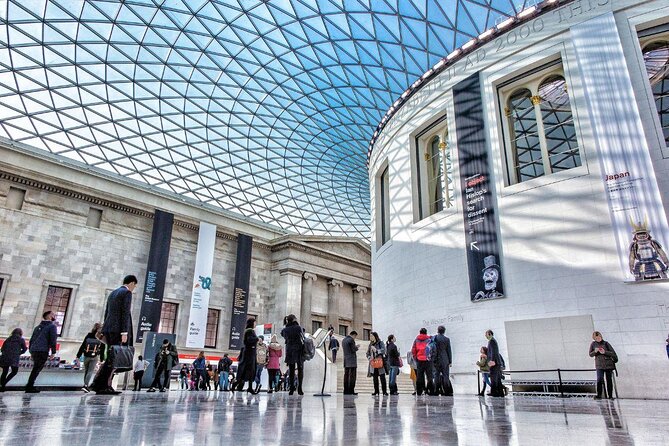
- Assyrian lamassu set the scale: You’ll face enormous 40-ton guardian figures before moving into the stories of kings, prophets, and Israel’s neighbors.
- David leads with a timeline: The tour connects Egypt, Assyria, Babylon, Persia, Greece, and Rome rather than treating each gallery as a separate stop.
- Bible verses are part of the method: Use the supplied Google Doc or an offline Bible app to read passages alongside the objects.
- The group stays small: A maximum of 10 people makes questions and conversation practical.
- You cover more than Old Testament material: The Roman galleries bring in Jesus, Paul, emperors, coins, and objects from the world of the New Testament.
- Allow half a day: The scheduled time is about three to four hours, though a small group with many questions may run longer.
Why this British Museum tour feels different
The British Museum can be a lot to take in. You may admire a carved relief, read a short label, and then move on without knowing how it fits into the wider story. This tour gives you a firm thread to follow: biblical people and events set against the major powers of the ancient world.
That approach matters because the Bible names many rulers, cities, and peoples without giving you a museum label for each one. David’s route helps place those names in time. Egypt becomes more than a backdrop for Joseph and Moses. Assyria becomes the power behind stories involving Jonah, Ahab, and Hezekiah. Rome becomes the setting for Jesus and Paul, not just a collection of marble portraits.
I would not treat the tour as a neutral overview of biblical archaeology. It is presented through a Bible-centered lens, with the guide drawing links between Scripture and museum objects. That is a strength if you want that connection. If you prefer a strictly secular art-history tour, you may find the religious framing too strong.
More British Museum Tours:
- London: British Museum Guided Tour
★ 4.3 · 1,182 reviews - British Museum London Guided Tour Semi-Private 8ppl Max
★ 5.0 · 984 reviews - London: Tour of the British Museum
★ 4.1 · 678 reviews
Starting with Egypt, Assyria, and Greece
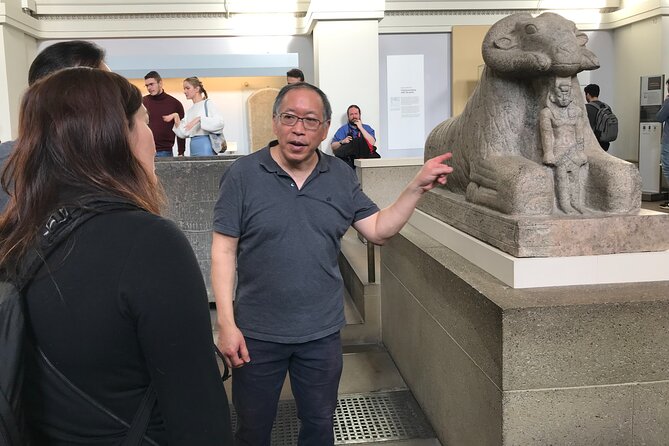
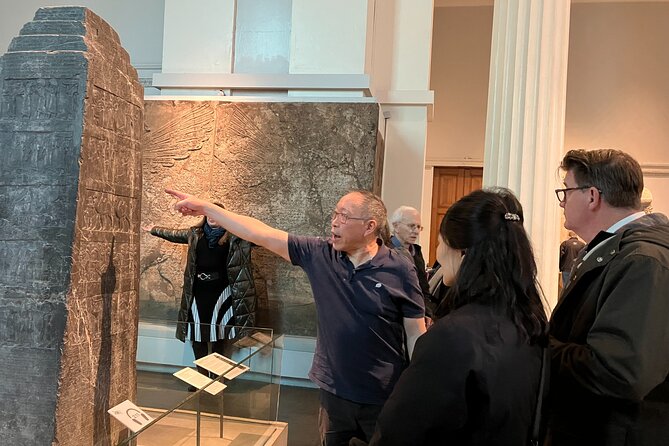
The tour begins on the ground floor, where the first galleries give you an immediate sense of scale and power. The Assyrian lamassu are the memorable opening point. These huge winged guardian figures were made to protect royal spaces, and their size helps you understand the authority ancient rulers wanted to project.
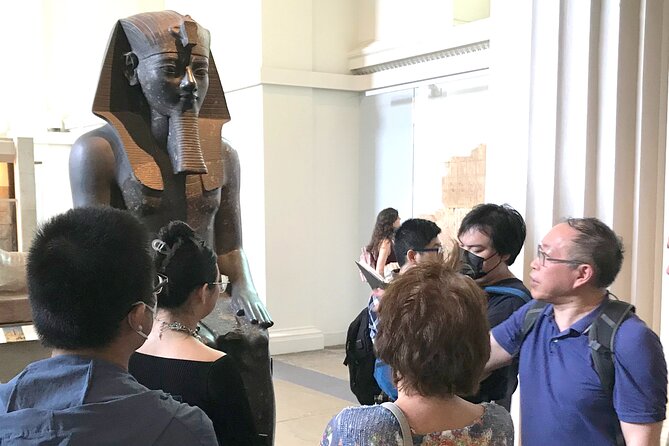
From there, the tour moves through Egyptian displays, including statues of famous pharaohs. This is where Joseph and Moses enter the discussion. You are not simply looking at royal sculpture as art. You are considering Egypt as the political and cultural world connected with the early biblical story.
The value of having David guide this section is the timeline. He helps you keep rulers and civilizations in order, which can be difficult when you are looking at objects from different centuries in nearby rooms. His teaching style, described as clear, lively, and sometimes funny, keeps the material from becoming a list of unfamiliar names.
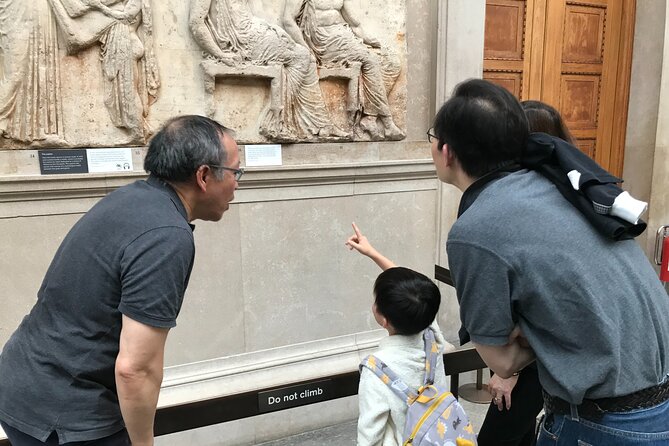
The Greek galleries add another layer. The Parthenon sculptures of Athens are among the British Museum’s best-known sights, but this tour uses them as part of the wider Greek setting associated with Paul. That gives the famous marbles a different purpose. You are not just looking at idealized bodies and temple decoration. You are thinking about the Greek-speaking world in which early Christian ideas traveled.
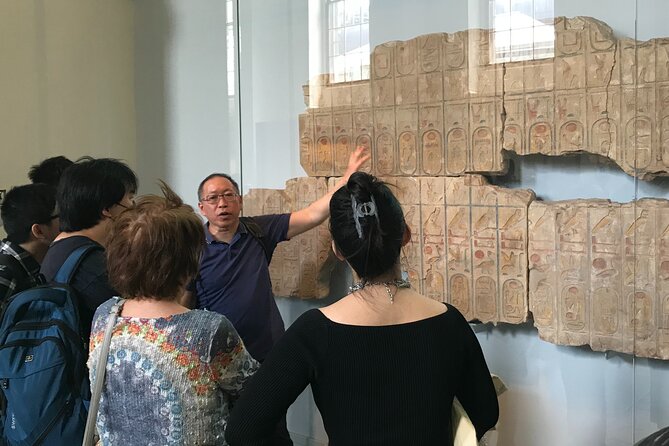
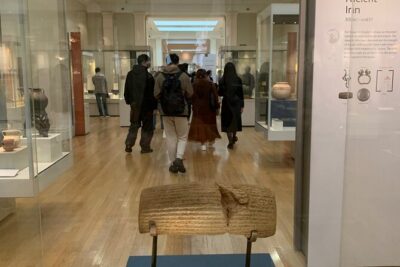
One useful feature is the chance to ask about small details. The tour can include points such as the direction of reading a cartouche, the bronze bands on a city gate, and the practical use of objects that are easy to overlook when you walk through alone. Those details help turn a grand gallery into a place of close observation.
A break before the Roman galleries
After the ground-floor galleries, you take a break before going upstairs. That pause matters. This is a long tour, and the change of level gives you a chance to rest, check your notes, and prepare for a different part of the story.
The museum provides folding stools that you can take with you if standing becomes uncomfortable. David points out where to find them, which is a small but useful bit of guidance. Museum floors are hard, and a three-hour tour can feel much longer if you have to stand in one spot for every explanation.
The break also helps separate the Old Testament material from the Roman section. The first portion centers on Egypt, Assyria, Babylon, Persia, and Greece. Upstairs, the focus shifts toward Rome and the world of Jesus and Paul.
Roman emperors, coins, Jesus, and Paul
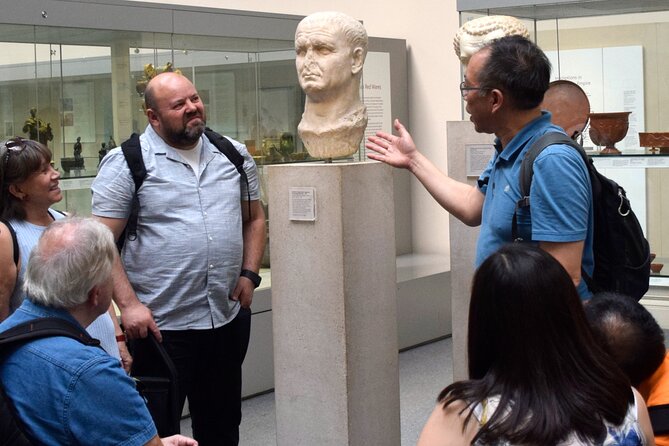
The Roman galleries bring the story closer to the New Testament. You will see Roman emperors and objects tied to the political world that shaped the period of Jesus and Paul. The guide may also point out coins from the time of Jesus, including the faces of rulers who were present in the background of the crucifixion era.
That is one of the most useful connections on the tour. A name in the Bible can feel remote until you see the portrait on a coin or the image of an emperor from that period. The object does not tell the whole biblical story, but it gives you a physical marker for the world described in the text.
Paul also connects the Roman and Greek sections. His work crossed cultural and political boundaries, so the tour uses both galleries to explain the settings in which he traveled and wrote. That broader view helps you see why the tour does not stay in one biblical period or one civilization.
The route may include Persian and Babylonian galleries if time and group interest allow. These additions are useful for Old Testament passages involving imperial power and exile, but they are not guaranteed as a fixed, equal part of every visit. If those civilizations matter most to you, ask David early how the available time will be divided.
A different sort of day out in London altogether:
- From London: Harry Potter Warner Bros Studio Tour
★ 4.7 · 26,588 reviews - London: Westminster to Greenwich River Thames Cruise
★ 4.5 · 22,836 reviews - Magical London: Harry Potter Guided Walking Tour
★ 4.7 · 22,044 reviews - London: Madame Tussauds London
★ 4.6 · 20,915 reviews
The study tools make a real difference
Before or during the tour, you receive access to a Google Doc with study notes and related Bible verses. You are also advised to have a Bible app that works without an internet connection. YouVersion is suggested.
I would prepare this before arriving. Download the app, check that it works in airplane mode, and open the study material in advance. The tour is easier to follow when you can read a passage as David points to the related object, rather than trying to install an app or search for a verse while the group waits.
The verse references also make the experience more active. You are not only listening to a guide explain what an object means. You can check the passage, compare the names, and keep notes for later study. David may send follow-up material after the tour, including extra references or a video connected with an object discussed during the visit.
This is particularly helpful if you want to continue the subject after leaving the museum. The experience can become a starting point for your own reading rather than a single afternoon that ends at the exit.
How long the tour really takes
The planned duration is about three to four hours. That is a sensible half-day commitment, but you should leave some flexibility. A small group with many questions may take longer, and one group stayed close to five hours because of the number of discussions and side questions.
That longer pace can be wonderful if you are fully engaged. It can also be tiring if you have a tight afternoon schedule. I would not book a major theater performance, train departure, or timed attraction immediately afterward.
Plan to spend the rest of the day elsewhere in London. The British Museum is near public transportation, and the meeting point is at the museum on Great Russell Street. The tour ends back at the starting point, so you can continue your sightseeing from there.
Avoid booking this for the day you land after a long-haul flight. The combination of jet lag, hard floors, a busy museum, and a three-hour lesson is not a good welcome to London.
Is the $77.50 price good value?
The cost is $77.50 per person, while admission to the British Museum itself is listed as free. So you are paying for the guided structure, the specialist preparation, the small group, the study notes, and the links between objects and Scripture.
That is a fair value if you would otherwise walk through the museum without much context. A self-guided visit costs less, but it also leaves you to build the timeline and make the biblical connections yourself. The tour turns a huge collection into a focused lesson.
The price may feel high if you have little interest in the Bible or if you mainly want to see the museum’s famous highlights at your own speed. You can visit the Assyrian, Egyptian, Greek, and Roman galleries independently. The added value comes from the guide’s specific approach, not from special admission access.
Group discounts are available, which may help families or church groups. With a maximum of 10 people, the format is much more personal than a large coach tour. That small scale also makes it easier to ask about a passage, ruler, or object that catches your attention.
Who should take this tour?
I would recommend it most strongly to:
- Christians who want to connect Scripture with ancient objects
- People studying the Bible alongside ancient history
- First-time British Museum visitors who prefer a clear route
- Families with older children or teenagers who can handle several hours of focused discussion
- Visitors who enjoy asking questions and reading along
- Anyone interested in Assyria, Egypt, Babylon, Persia, Greece, Rome, Jesus, or Paul
Older children and teenagers can follow the material, especially if they enjoy history or visual learning. Younger children may struggle with the length, the amount of standing, or the warm conditions in some galleries.
You should also know that this is not a quick highlights tour. You will not cover the entire museum, and you will not receive an equal look at every civilization. David selects objects that serve the biblical timeline, so the experience has a clear purpose.
Practical ways to enjoy the visit
Arrive ready for a serious museum walk. Wear comfortable shoes, bring your phone fully charged, and download the Bible app before meeting the guide. If you use the Google Doc during the tour, make sure you can open it easily.
Take a folding stool if you need one. The tour is designed for general participation, and service animals are allowed. Most people can take part, but the length and standing are worth considering before you book.
Keep your questions coming, but stay aware of the clock. The strongest part of the experience is the conversation between objects, dates, and Bible passages. If you want the Persian or Babylonian rooms included, mention that preference early so David can judge what fits.
The meeting instructions are sent through the booking email and apps, including Viator or Tripadvisor. Check those messages after booking, since they may include important directions or preparation notes.
Should you book Explore Biblical Artifacts at the British Museum?
Book it if you want the British Museum to function as a Bible study, history lesson, and guided walk all at once. David’s strength is connecting large events to physical details: a lamassu, a royal statue, a coin, an inscription, or a small feature in a relief. The supplied notes and verse references give the experience value after the visit, too.
Skip it if you want a fast museum introduction, a general art tour, or complete freedom to linger wherever you wish. The religious focus is central, and the three to four hour schedule requires stamina.
For the right audience, $77.50 buys more than a route through famous galleries. It gives you a way to read ancient objects alongside the biblical timeline, with enough room for questions and personal study. Plan carefully, bring the Bible app, use the stool, and keep the rest of your day open.
FAQ
How long does the British Museum biblical artifacts tour last?
The planned duration is approximately three to four hours. A small group with many questions may stay longer, so leave extra time afterward if your schedule is tight.
What does the tour cost?
The price is $77.50 per person. Group discounts are available, and the British Museum admission ticket itself is listed as free.
How large is the tour group?
The maximum group size is 10 travelers. This allows time for questions and discussion during the museum visit.
Which museum galleries are included?
The tour starts with the Assyrian, Egyptian, and Greek galleries on the ground floor. It then continues to the Roman galleries upstairs. Persian and Babylonian galleries may be included if time allows and the group prefers them.
What should I prepare before the tour?
Install a Bible app that works in airplane mode, such as YouVersion, and review the Google Doc with study notes and Bible verses if possible. Check your booking email and app messages for important information.
Can I cancel for a full refund?
Yes. You can cancel at least 24 hours before the experience start time for a full refund. Cancellations or changes made less than 24 hours before the start time are not accepted for a refund.
Just added around London
- Up at The O2:Twilight Climb with Guided Tour with Panoramic Views★ 5.0 · 50 reviews
- Private Chauffeur-London Heathrow from/to Southampton Cruise Port★ 5.0 · 9 reviews
- Kensington Palace VIP Garden Tour with Royal High Tea★ 4.5 · 71 reviews
- Up at The O2: Sunset Climb with Guided Tour with Panoramic Views★ 5.0 · 110 reviews
- Secrets of the London Underground Small Group Walking Tour★ 4.5 · 38 reviews
- Urban Canvas: Exploring Shoreditch’s Vibrant Street Art★ 5.0 · 36 reviews
- Ultimate introduction to photography in Central London★ 5.0 · 19 reviews
- Full-Day Self-Guided Paris Tour from London by Eurostar with Seine River Cruise★ 3.5 · 22 reviews
British Museum Tours, compared.
British Museum London Guided Tour Semi-Private 8ppl Max
Read our review →
British Museum Audio Tour & Priority Entrance Ticket
Read our review →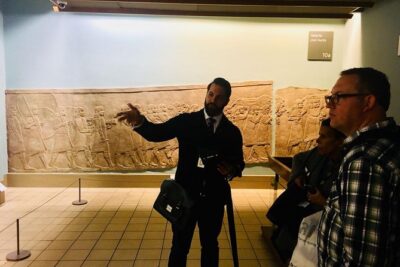
The British Museum London – Exclusive Guided Museum Tour
Read our review →
Private Guided Tour of the British Museum – Tickets Included
Read our review →Browse the lists this tour appears in