
Reviewed · WORKSHOPS
Woolf & Dickens: London Literary Tour & Writing Workshop
London becomes your writing prompt on this intimate walk, which links Virginia Woolf’s view from Waterloo Bridge with T.S. Eliot, Dickens, Samuel Johnson, and the city around you. This is not a lecture where you nod politely and forget everything by lunch. You write, observe, and discuss as you go.
I especially like the hands-on format and the way each stop gives you a different task. I also like the welcoming tone Joseph brings to the session. One participant described him as well read, passionate, and skilled at creating a safe place for writers at every level.
The main consideration is time. At 90 minutes, this is a compact introduction rather than a full literary walking tour or a long writing class. You’ll need to bring your own pen, notebook, water, and internet access, and an umbrella is wise in London.
Key points at a glance
- Waterloo Bridge and Virginia Woolf: Use the view toward the river and city as a prompt for a short biographical sketch.
- Somerset House writing exercise: Practice mindful observation and turn the setting into material for your own work.
- St Mary Le Strand and T.S. Eliot: Consider time and history, then write an ekphrasis inspired by the church interior.
- Gladstone, Dickens, and politics: Explore how truth and public memory can shift with perspective.
- Doctor Johnson’s House: Read from Johnson’s dictionary and think about how language, religion, politics, and art shape identity.
- Private, accessible format: The tour is in English, wheelchair accessible, and designed for a private group.
A literary walk that asks you to write
Many literary tours give you a writer’s address, a date, and a few memorable anecdotes. This one asks you to do something with them.
Joseph Pierson, an award-winning novelist with a PhD in Creative Writing, leads the session as both a city walk and a workshop. He uses readings from major English writers to open up questions, then gives you a short exercise so the place itself becomes part of your response.
That structure matters. You do not need to arrive with a polished short story or a stack of published poems. The exercises are intended for everyone from a complete beginner to an experienced novelist. You can write a few lines, make a list, sketch a scene, or simply think through the prompt before sharing anything.
The tone is meant to be kind and inclusive. That is important in a writing class, especially one held with other people. You are not being asked to perform literary brilliance on demand. You are being invited to notice more carefully and find your own angle.
The private group format should help keep the experience focused. It also means the session can feel more personal than a standard walking tour, though the short duration leaves limited time for extended discussion or lengthy writing.
More Workshops:
- London: Traditional English Scone Making and Tea Workshop
★ 5.0 · 702 reviews - London: East End Street Art Tour and Spray Painting Workshop
★ 4.8 · 297 reviews - London Traditional English Scone Making and Tea Workshop
★ 5.0 · 271 reviews
Waterloo Bridge through Virginia Woolf’s eyes
The meeting point is at the north end of Waterloo Bridge, on a slope to the right that runs behind Somerset House. This is a practical spot, but take care to arrive with a few minutes to spare. London bridge approaches can be confusing, and you do not want to begin by hunting for the group.
The first literary lens is Virginia Woolf and her wistful reflections on the view from Waterloo Bridge. Woolf was particularly alert to the way London holds several times at once: the immediate scene, personal memory, and the older stories attached to a place.
You use that idea for a biographical sketch inspired by what you see. The exercise is not simply a description of the Thames or the buildings. It asks you to connect the view with a person, a memory, or a life story.
This is a strong opening because it gets you writing before the tour has settled into a routine. The city gives you material, while Woolf gives you a way to think about it. You may find the prompt easier if you focus on one detail rather than trying to capture all of central London at once.
The drawback is that this is an urban meeting point, not a quiet writing retreat. Traffic, pedestrians, and changing weather are part of the setting. Bring a notebook that is easy to hold and a pen that works outdoors.
Somerset House and the art of noticing
From the bridge area, the workshop continues around Somerset House. Here the focus shifts toward mindful writing.
That can sound vague, but the practical idea is simple: slow down, pay attention, and turn direct observation into language. Instead of rushing from landmark to landmark, you are encouraged to notice the environment in a more deliberate way.
I like this part because it gives the tour a useful purpose beyond literary sightseeing. You are not only learning about writers who responded to London. You are testing how you respond to a place yourself.
For a new writer, this can make the blank page less intimidating. You do not have to invent a plot from nothing. You can begin with a surface, a sound, a building, a movement, or a detail in the space around you.
For an experienced writer, the value may be different. A constrained prompt can interrupt familiar habits. Writing in a public setting also makes you work with the world as it is, rather than waiting for perfect silence and perfect inspiration.
The session is not described as requiring entry into Somerset House, and no entry tickets are needed for the tour. That keeps the price focused on the guide’s leadership and workshop material rather than admissions.
St Mary Le Strand and T.S. Eliot’s sense of time
The route continues to the church of St Mary Le Strand, where the workshop turns to T.S. Eliot’s study of time and history. A timeline on the walls at Aldwych helps connect those ideas with the physical setting.
This is where the tour moves from personal memory toward a broader question: how does a place contain layers of the past while you experience it in the present?
You then practice ekphrasis, a writing exercise inspired by a work of art or a visual scene. In this case, the grand interior of St Mary Le Strand becomes the starting point.
You might describe what you see, but the exercise can also push you toward interpretation. What does the interior suggest about belief, power, taste, order, or human ambition? How does the building change when you look at it as an object with a past rather than simply as a beautiful room?
This stop should appeal to anyone who likes architecture, art, or writing that begins with close observation. It also gives you a clear change of pace after the open view from Waterloo Bridge. The bridge asks you to look outward across the city. The church asks you to look closely at one interior.
The practical limit is that church access and the pace of the group can affect how long you spend looking and writing. The supplied details confirm that no entry tickets are needed, but they do not promise a long private period inside the church. Think of the stop as a focused prompt within a walking workshop, not an extended architectural visit.
A different sort of day out in London altogether:
- From London: Harry Potter Warner Bros Studio Tour
★ 4.7 · 26,588 reviews - London: Westminster to Greenwich River Thames Cruise
★ 4.5 · 22,836 reviews - Magical London: Harry Potter Guided Walking Tour
★ 4.7 · 22,044 reviews - London: Madame Tussauds London
★ 4.6 · 20,915 reviews
Gladstone, Dickens, and the problem of truth
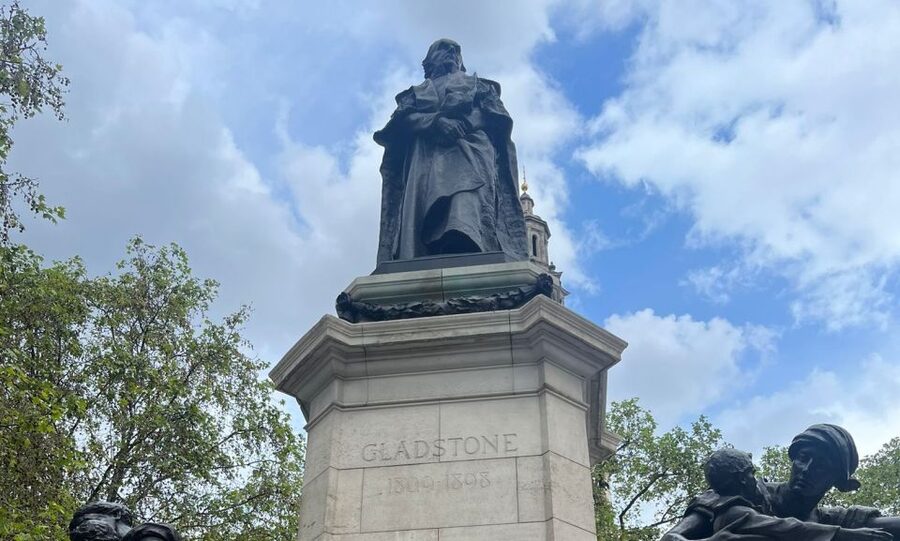
A statue of William Gladstone leads to one of the more unusual exercises: a list of facts that blends your personal history with the environment around you.
The point is not to produce a neutral schoolbook list. It is to examine how facts are selected, framed, and remembered. The statue opens questions about politics, truth, and the way history can change with perspective.
This is also where Dickens enters the experience. Dickens is a useful prompt for thinking about public life, social observation, and the gap between official stories and lived experience. The details provided do not assign one specific Dickens text to the exercise, so you should expect a literary discussion and reading rather than a staged Dickens performance.
I find this portion especially valuable for writers who want to work with nonfiction, memoir, essays, or historical subjects. A list can seem plain, but it can reveal what you choose to include and what you leave out. By mixing personal facts with details from the city, the exercise makes private memory part of a public setting.
It is also a good reminder that literary writing is not always about grand sentences. Sometimes the most revealing form is a simple sequence of observations.
If you prefer a tour built around fixed dates and settled answers, this section may feel less tidy. The workshop is designed to raise questions, not close every question down. That is a benefit for many writers, but less useful if you want only straightforward literary biography.
Doctor Johnson’s House and the structure of language
The final literary stop is Doctor Johnson’s House, where the group reads from Samuel Johnson’s dictionary and considers how language helps shape us.
This brings together several of the workshop’s main themes. Religion, politics, art, and language are treated as structures that influence personal identity. Johnson’s dictionary provides a concrete way to think about that idea. Words do not merely label the world. They carry judgments, habits, history, and social assumptions.
The stop should work well for readers who enjoy language itself. It also gives the tour a fitting finish because you have spent the session turning places and ideas into words. You begin with a view, move through architecture and public monuments, and end by examining the tool used to describe all of them.
Again, the experience does not promise a full museum visit or a long examination of Johnson’s life. Doctor Johnson’s House functions as a literary prompt within the walk. If you want to spend more time there, plan a separate visit rather than expecting the workshop to cover everything.
What the $101 price really buys you
At $101 per person, this is not a budget sightseeing walk. The value depends on what you want from the experience.
You are paying for a private, guided workshop led by Joseph Pierson, not simply for transport between literary landmarks. The cost includes the tour and writing exercises, and no entry tickets are needed. The group’s private format can make the price more reasonable for people who want personal attention and a session shaped around discussion rather than a large public crowd.
For someone who already writes, the appeal is the structure. You get a sequence of prompts, a professional writer leading the session, and a setting that gives you material without requiring you to plan your own literary route through London.
For a beginner, the price buys a low-pressure way to try creative writing with a clear framework. You do not need specialist training, and the exercises are designed to leave room for your own interpretation.
The value is weaker if you mainly want historical facts, interior visits, or a long list of famous writers. The tour covers several literary ideas in a short period, so it cannot give every author or site equal attention.
The available rating is 5 out of 5 from three reviews. One detailed assessment specifically praised Joseph’s readings, questions, and prompts, noting that they left room for participants to make the exercises their own. That is the clearest sign of what you are buying: guided thinking, not a passive recital of literary facts.
Who will enjoy this workshop most
I would recommend it first to people who like writing but do not always make time for it. The city provides a reason to stop, observe, and put something on paper.
It should also suit:
- New writers who want a gentle introduction to creative exercises.
- Experienced writers looking for fresh prompts outside a classroom.
- Readers who enjoy Woolf, Eliot, Dickens, or Samuel Johnson.
- Couples, friends, or private groups who want a more thoughtful London activity.
- Visitors who prefer discussion and participation to standard sightseeing.
You may enjoy it less if you dislike writing in front of others, though the format is described as inclusive and suitable for all skill levels. You may also want a different tour if your main goal is a long historical walk, extensive church sightseeing, or a detailed tour of Dickens-related London.
The session is in English and includes live guidance. It is wheelchair accessible. Since the walk uses public outdoor areas, bring water and an umbrella, and carry a notebook that will not be awkward to use while standing.
Timing, meeting point, and booking details
The experience lasts 1.5 hours, with start times based on availability. That makes it easy to fit into a London day, but you should treat the timing as a compact workshop. There is enough room for several prompts and readings, not for a full writing seminar.
Meet at the north end of Waterloo Bridge. Look for the slope on the right, behind Somerset House. The exact meeting instruction is useful, but I would still arrive early because the area has several paths and entrances.
Bring a pen, notebook, water, and internet access. An umbrella is also listed as a useful item. No entry tickets are required.
You can cancel up to 24 hours before the start for a full refund, and you can reserve now and pay later. Those terms are helpful if your London schedule is still shifting.
Should you book Woolf and Dickens?
Book this if you want London to prompt your own writing, not simply provide a backdrop for someone else’s lecture. The best parts are the change in focus from Woolf’s view, to mindful observation, to Eliot’s ideas about time, then to politics, truth, and Johnson’s language.
The session is particularly appealing if you are new to writing and want a safe starting point, or if you already write and want fresh material. Joseph Pierson’s role is central, since the experience depends on thoughtful questions, well-chosen readings, and prompts that do not force everyone into the same answer.
Skip it if you want a conventional literary sightseeing tour with lots of dates, biographies, and long visits inside landmarks. At $101 for 90 minutes, it is worth the price mainly when you value the private workshop format and active participation.
For the right reader, this is a smart way to spend a short stretch of time in central London: walk a little, read a little, and leave with pages that belong to you.
FAQ
How long does the Woolf and Dickens tour last?
The tour and writing workshop last 1.5 hours.
Where does the tour meet?
Meet at the north end of Waterloo Bridge, at the slope on the right that goes behind Somerset House.
Who leads the writing workshop?
The session is led by Joseph Pierson, an award-winning novelist with a PhD in Creative Writing.
Is the experience suitable for beginners?
Yes. The writing exercises are designed for all levels, from novice writers to experienced novelists.
What should I bring?
Bring a pen, notebook, water, and internet access. An umbrella is also recommended in case of rain.
Is the tour wheelchair accessible?
Yes, the experience is listed as wheelchair accessible.
Do I need entry tickets for the sites?
No. Guided tour and workshop access are included, and no entry tickets are needed.
Just added around London
- London: “Queen” Highlights Walking Tour★ 4.3 · 48 reviews
- Couple’s photo: Romantic photoshoot in London★ 4.8 · 22 reviews
- London: Private Tour with Locals – Highlights & Hidden Gems★ 5.0 · 8 reviews
- Luxury Private Tour in London with Lunch★ 5.0 · 7 reviews
- London 1- or 2-Hour Professional Photo Shoot★ 4.9 · 6 reviews
- London: Private Black Cab Night Tour with Hotel Pick Up★ 5.0 · 11 reviews
- London: Christmas Lights Tour – With Christmas Music★ 4.8 · 9 reviews
- London: Buckingham Palace & Big Ben & Abbey Private Tour★ 5.0 · 7 reviews
Workshops, compared.

Traditional English Scone Making and Tea Workshop
Read our review →
East End Street Art Tour and Spray Painting Workshop
Read our review →London Traditional English Scone Making and Tea Workshop
Read our review →




Browse the lists this tour appears in