
Reviewed · JACK THE RIPPER TOURS
Jack the Ripper Private Immersive Tour
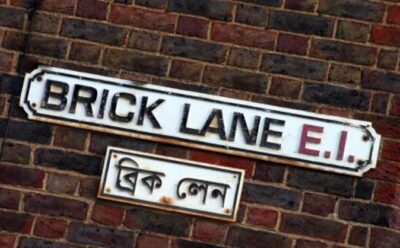
The most striking part of this private Whitechapel walk is how it joins real streets with period photographs, newspaper sounds, pub music, and a guide’s running account of the murders. You move from Aldgate toward Brick Lane and Spitalfields, tracing the victims’ last known movements rather than simply hearing a list of suspects.
I like the social history here, especially the explanation of common lodging houses, workhouses, unemployment, and homelessness in 1888. I also like the small-group format, which gives you room to ask Jenny questions and follow the details that interest you.
The main caution is physical and practical: this is about two and a half hours on foot with no planned break. A past booking problem also led to confusion over the headphones and the separate use of the word immersive, so confirm the equipment and tour details before setting out.
Key points to know before you book
- The walk covers 15 stops: You visit sites tied to the canonical five victims, plus Elizabeth Stride and a possible earlier victim discussed by criminologist David Wilson.
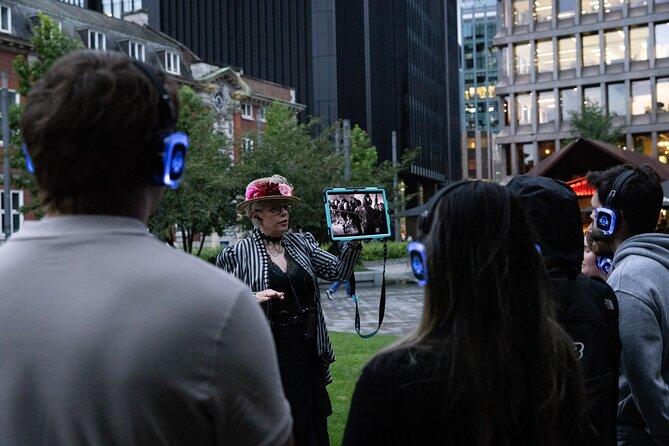
- Jenny leads with photos and audio: A 14-inch tablet displays victims, locations, letters, and old streets, while headphones or a microphone system help you follow the narration.
- The route is strongest on social history: Poverty, lodging houses, police divisions, newspapers, and the pressure of finding nightly accommodation receive serious attention.
- It runs after dark: The listed operating window is Monday through Thursday, from 3:00 PM to 9:00 PM, during the published 2026 to 2027 period.
- You need decent walking stamina: There is no break during the roughly 2.5-hour route, and bottled water is not supplied.
- The ending is convenient: The guide points you toward Liverpool Street Station from the final stop.
Starting at Aldgate with Whitechapel in 1888
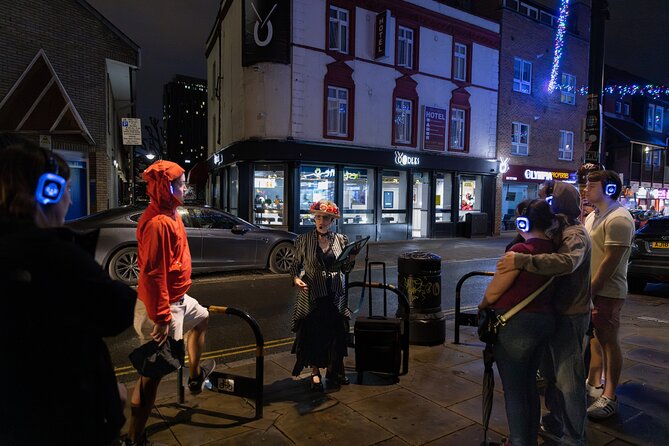
The meeting point is Aldgate Station, where the walk begins near the Dorsett City Hotel. The first stop takes only a few minutes, but it sets the scene well. You get an introduction to the murders and a sense of how this edge of the City of London connected with Whitechapel.
At St Botolph’s Aldgate, the tour slows down for one of its best sections. On the green beside the church, Jenny explains the hard facts of daily life in 1888: unemployment, homelessness, common lodging houses, workhouses, and the constant problem of finding enough money for a bed.
This context matters. Without it, the murders can become a grim scavenger hunt through old streets. With it, you begin to understand why some women were outdoors late at night, why a few pennies mattered, and why the search for a safe place to sleep shaped so many decisions.
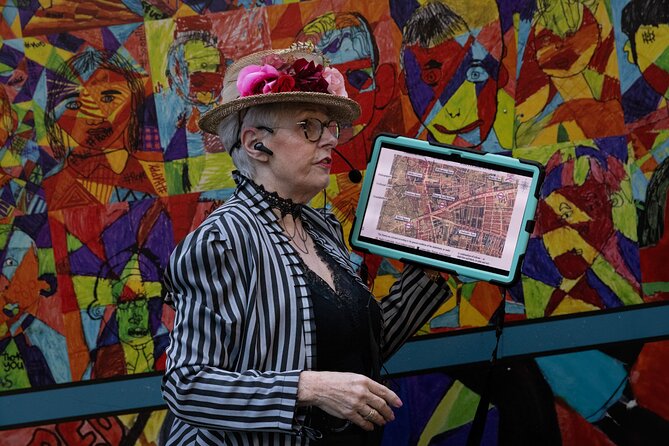
The tablet is useful here. Period photos make the discussion easier to follow in the dark, though the small screen means you may want to stay close to the guide. If you have hearing difficulty, say so at the start and stand near the front. One past participant found the audio hard to hear when the group was large and the guide kept the microphone volume low because of local noise concerns.
More London Immersive and Escape Experiences:
- Frameless – Immersive Art Experience in London
★ 4.5 · 3,660 reviews - London: Entry Ticket to Frameless Immersive Art Experience
★ 4.7 · 2,923 reviews - Moriarty’s Game: The Professor’s Invitation by HiddenCity
★ 5.0 · 445 reviews
Mitre Street and Mitre Square, where two murders reshaped the case
The next stops cover Elizabeth Stride and Catherine Eddowes. At Mitre Street, you hear about the hours before Stride’s death and how Louis Diemschütz discovered her body at the entrance to Dutfield’s Yard. Photos help you compare the old scene with the modern street.
At Mitre Square, the focus shifts to Eddowes. The guide explains how her body was found on a police beat and how the second murder in such a short period intensified the response from the City of London Police. You then follow the route taken during the search for the killer.
This section also introduces an important point that many casual tours skip: two police forces worked in the area. The Metropolitan Police and the City of London Police were separate organizations, and their boundaries affected communication and the investigation. At Goulston Street, you hear how that division became especially important after the discovery of the case’s most famous possible clue.
Standing opposite the doorway near 108 to 119 Goulston Street gives the story a clear physical focus. The guide explains what was found, what happened afterward, and why the clue remains disputed. The tour does not pretend that one piece of writing solved the case. That uncertainty is part of the appeal.
Wentworth Street and Brick Lane, following the victims’ difficult choices
At Wentworth Street, the story moves back toward the beginning of the murders. This stop discusses a woman who is not normally counted among the canonical five, but whose case has been considered a likely Ripper crime by Professor David Wilson.
That addition gives the route a point of difference. You are not limited to the standard five names repeated in every Jack the Ripper book. The guide presents the murder site, the victim’s story, and the argument for including her in the wider case.
As you turn toward Brick Lane on Osborn Street, the sound design changes. Music from pubs and music halls helps suggest what the area might have sounded like in 1888. It is a brief moment, but it breaks up the spoken narration and gives the walk a more atmospheric rhythm.
Opposite the Frying Pan pub, the tour tells Polly Nichols’s story. You hear about her last drink there, her need to find lodging money, and the discovery of her body in Berner’s Street. The point is not only how she died, but how poverty and the nightly search for shelter narrowed her choices.
That is where the tour is at its most human. The victims are not treated only as evidence in a puzzle. Their work, housing, money worries, and movements through the neighborhood receive attention. Street vendors and police questioning return in the next Brick Lane stop, adding more sound and detail to the scene.
Hanbury Street and Wilkes Street, from one murder to public fear
Hanbury Street is linked to Annie Chapman, and the guide gives this stop more time than several earlier points. You hear about Chapman’s life, the events before her death on September 8, 1888, and her reported sighting with a man outside number 27 less than an hour before the murder.
The narration then moves into the backyard of number 29, where Chapman was killed. The account is graphic, so you should expect frank detail rather than a softened museum-style presentation. Photos of the victim and location support the explanation, but this remains a true-crime tour for adults who are comfortable with disturbing material.
A suspect once connected to the case is also discussed, along with the reasons that person was later discounted. This is useful for separating documented events from later theories. Still, the tour has a strong storytelling style, and you should treat any proposed solution as the guide’s interpretation rather than a settled fact.
On Wilkes Street, the emphasis shifts from the crime scenes to the community’s reaction. By this point, local fear was growing, newspapers were feeding that fear, and the old houses along the street offer a physical reminder of the district’s earlier building history.
This balance between murder detail and neighborhood history is one of the tour’s best features. You see how panic spread through newspapers and word of mouth, not just through police reports. The streets become a place where people lived, worked, drank, slept, and worried, not merely a backdrop for a famous criminal case.
More Jack the Ripper Tours:
- London: The Original Jack the Ripper Walking Tour
★ 4.7 · 7,833 reviews - London Jack the Ripper Guided Tour with Ripper-Vision
★ 4.5 · 4,840 reviews - London: Jack the Ripper Small Group Tour
★ 4.7 · 3,159 reviews - London Jack The Ripper Guided Walking Tour
★ 5.0 · 3,131 reviews
Puma Court and the two letters that shaped the legend
At Puma Court, the guide discusses one of the letters sent to the police or press. More than a thousand letters were received, but only a small number are treated as especially significant. The tour explains why this letter attracted attention and lets you consider how newspapers helped build the killer’s public image.
As you leave, recorded or performed newspaper cries add a little period drama. This is one of the more theatrical parts of the walk. Some people will enjoy the sound effects, while others may prefer a quieter, more evidence-based presentation.
The London Fruit and Wool Exchange provides the setting for the Lusk letter. You hear how it arrived in a box with a piece of human tissue that might have come from one of the victims. A photograph of the letter and its recipient helps make this notorious part of the case easier to understand.
The value of showing the letters on a tablet is simple: you do not have to rely on a guide’s description alone. You can see the handwriting and layout while hearing how the messages were handled. In the dim evening light, stay close enough to view the screen clearly.
Commercial Street and Mary Kelly’s final room
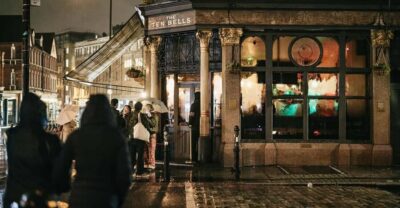
Near Commercial Street, opposite the Ten Bells pub, the guide discusses the area around Spitalfields Market and Mary Kelly’s connection with the pub. You also hear about Christchurch Graveyard, which was important to people without homes, and about the everyday disputes that arose over basic needs.
This stop adds texture to the story. Something as ordinary as access to a place to rest or sleep could matter greatly to a person living on the street. The tour uses these details to show how fragile life was for poor women in the district.
The final stop is in the courtyard of the London Fruit and Wool Exchange, the closest point on this route to the room where Mary Kelly was killed. Kelly was the youngest of the commonly accepted five victims and the only one killed indoors.
Her case receives the longest treatment, with about 15 minutes devoted to the events before her death, the murder itself, and the suspects linked to the crime. The description is graphic. If you prefer a light evening walk, this is not the right tour. If you want the full case presented without much softening, it provides the most detailed ending.
Jenny then gives her own view of who may have been responsible. That personal theory can make the finale more engaging, but you should keep it in perspective. Jack the Ripper’s identity remains unresolved, and a guide’s theory is not proof.
From here, the guide directs you toward Liverpool Street Station, which is helpful after a long walk. The stated endpoint is Bell Lane, but the route to the station gives you a practical way to continue your evening.
How the headphones, photos, and private format affect the experience
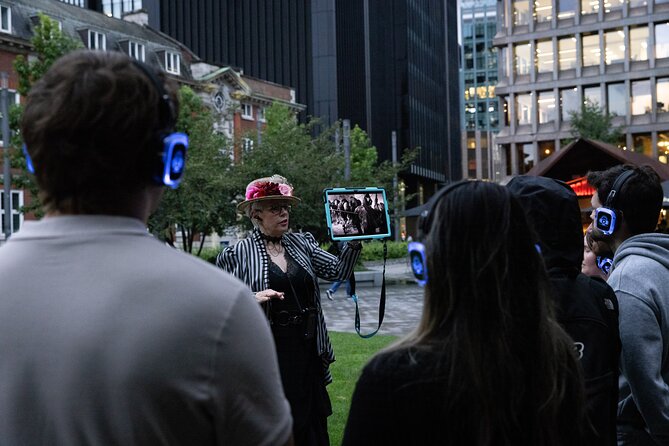
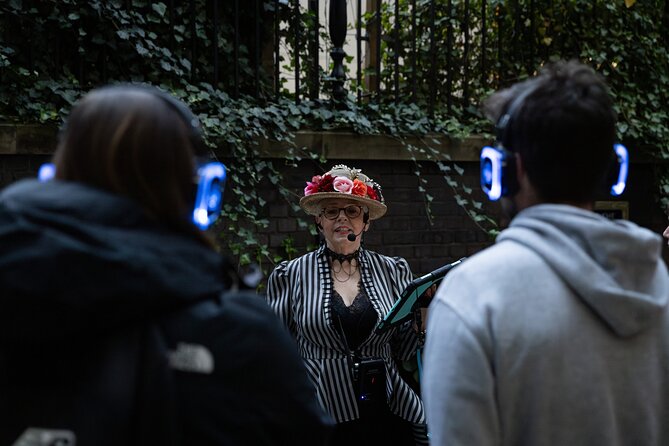
The tour includes high-tech headphones, and this is meant to keep you connected to the narration while walking. Several bookings praised the headphones for making the experience feel more intimate and for ensuring that people could hear while moving between stops.
There is a complication. One past group received conflicting booking information and expected a different version of the experience. That group did not receive private headphones and instead heard the guide through a microphone and speaker. The guide explained that a large group and local noise complaints affected the setup.
For that reason, I would confirm exactly what equipment is planned for your booking. If you are hard of hearing, tell Jenny before the first stop and position yourself near her. The guide is described as energetic and willing to answer questions, which helps in a private setting, but good audio still matters.
The private format is a real advantage. Your group alone participates, so you can ask about a suspect, a victim, or a police detail without waiting for a large crowd to move on. The route is also more flexible in spirit, though the published stop times show that the walk has a full schedule.
Price, timing, and who gets the best value
At $47.52 per person, the tour sits in a reasonable range for a two-and-a-half-hour private experience in central London. The price makes more sense if you value a personal guide, visual material, and a route built around specific crime sites rather than a general walking tour.
It is less convincing if you only want a quick introduction to the case. You spend time standing at many stops, and some explanations last under ten minutes. The value comes from the total package: social history, police procedure, old images, letters, sound effects, and the chance to ask questions.
The operating hours listed are Monday through Thursday, 3:00 PM to 9:00 PM, for the published period from February 26, 2026, through March 18, 2027. Since the experience depends on good weather and a minimum number of participants, a cancellation or alternate date is possible if those conditions are not met.
Wear comfortable shoes and bring water. Bottled water is not included, and there is no scheduled break. The route requires a moderate level of fitness and is not suited to anyone who has trouble walking or standing for 2.5 hours.
Service animals are allowed, and Aldgate Station makes the start accessible by public transport. You can cancel for a full refund up to 24 hours before the start time. Changes or cancellations inside that window are not accepted.
Should you book the Jack the Ripper private walk?
Book it if you enjoy true crime but also want the poverty, policing, newspapers, and housing conditions that shaped the case. The strongest parts are the social context, Jenny’s detailed storytelling, the old photographs, and the chance to ask questions in a private group.
Think twice if graphic murder descriptions make you uncomfortable, if you need regular places to sit, or if you want a short and gentle introduction to London. Confirm the headphone arrangement before you go, especially if hearing is difficult.
For a private group of crime-history fans with good walking stamina, this is a focused way to see Aldgate, Whitechapel, Brick Lane, and Spitalfields after dark. It does not solve the mystery, but it gives you plenty of evidence, atmosphere, and competing ideas to consider on the ride home.
FAQ
Where does the Jack the Ripper tour start?
The tour starts at Aldgate Station in London, near the Dorsett City Hotel.
Where does the tour end?
The listed endpoint is Bell Lane. At the final stop, the guide also directs you toward the shortest route to Liverpool Street Station.
How long does the tour last?
The walk lasts approximately 2 hours and 30 minutes.
Is this a private tour?
Yes. Only your group participates in the activity.
What is included in the price?
High-tech headphones are included. Bottled water is not included.
Is the tour suitable for people with walking difficulties?
No. The tour involves about 2.5 hours of walking and standing without a break, and a moderate level of physical fitness is recommended.
What days and times does the tour operate?
The listed hours are Monday through Thursday, from 3:00 PM to 9:00 PM, during the published period from February 26, 2026, to March 18, 2027.
Can I cancel for a full refund?
Yes. You can cancel at least 24 hours before the start time for a full refund. Cancellations and changes made less than 24 hours before the start are not accepted.
Just added around London
- Up at The O2:Twilight Climb with Guided Tour with Panoramic Views★ 5.0 · 50 reviews
- Private Chauffeur-London Heathrow from/to Southampton Cruise Port★ 5.0 · 9 reviews
- Kensington Palace VIP Garden Tour with Royal High Tea★ 4.5 · 71 reviews
- Up at The O2: Sunset Climb with Guided Tour with Panoramic Views★ 5.0 · 110 reviews
- Secrets of the London Underground Small Group Walking Tour★ 4.5 · 38 reviews
- Urban Canvas: Exploring Shoreditch’s Vibrant Street Art★ 5.0 · 36 reviews
- Ultimate introduction to photography in Central London★ 5.0 · 19 reviews
- Full-Day Self-Guided Paris Tour from London by Eurostar with Seine River Cruise★ 3.5 · 22 reviews
Jack the Ripper Tours, compared.
London Jack the Ripper Guided Tour with Ripper-Vision
Read our review →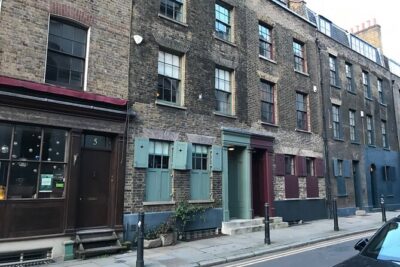
German Language : Original Jack the Ripper Tour
Read our review →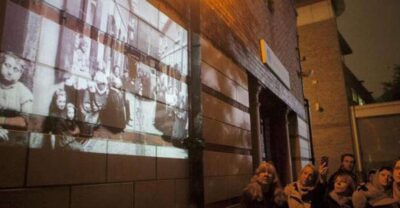
Jack the Ripper Walking Tour – Ripper Vision Tours
Read our review →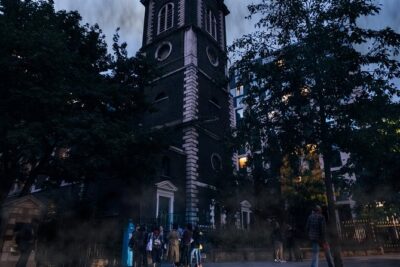
Ultimate Jack the Ripper : Guided Tour of London
Read our review →
Browse the lists this tour appears in