

Reviewed · HIDDEN LONDON WALKING TOURS
Hidden Gems Tour of the City of London
London’s oldest quarter is not a museum district. It is a working financial center built over Roman streets, medieval churches, royal prisons, fire-scarred ruins, and modern towers. This small-group walk follows that layered story from St Paul’s Cathedral toward the Tower of London, with stops at places many people pass without noticing.
I like the way the tour joins major sights to less obvious ones, especially the Roman Mithraeum and All Hallows by the Tower. I also like the compact group limit of 20, which should make it easier to hear guide Nick and ask questions. The main consideration is pace: in just over two hours, you will see many sites from outside or through brief visits rather than explore them fully.
Key points to know before booking
- Roman Londinium is the main thread: The walk explains how Roman settlers shaped the oldest part of London.
- The route covers major landmarks and quieter corners: Expect St Paul’s, Guildhall, the Bank of England, Leadenhall Market, and the Tower of London.
- The Mithraeum visit is included: You can see the remains of an ancient Roman temple without paying a separate admission fee.
- Garden at 120 adds a modern viewpoint: Allow 20 minutes for wide city views from this free viewing platform.
- Nick leads the tour: His approach combines facts, stories, and overlooked details that can be easy to miss alone.
- It is good value for a guided orientation: At $24.69, the price is modest, though major attractions and lunch cost extra.
Why this part of London rewards a guided walk
The City of London can feel confusing at first. Its streets are short and oddly angled, its buildings change from medieval churches to glass towers within a few steps, and its most important remains are often below street level or tucked behind modern facades.
That is where a guide earns the fee. You are not simply moving between famous sights. You are learning how Roman Londinium, the medieval city, the Great Fire of 1666, Britain’s financial institutions, and today’s skyline occupy the same small patch of ground.
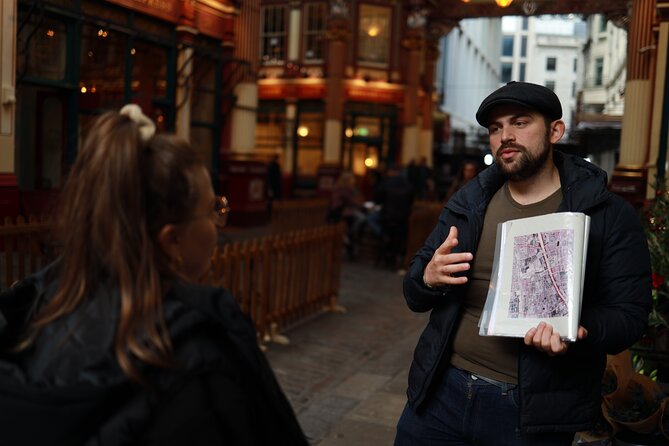
Nick is the named guide associated with this experience. The supplied comments describe him as enthusiastic about London and generous with facts, while also making an effort to include everyone in the group. That matters on a walking tour, where a good explanation can turn an ordinary office street into a memorable stop.
The group is capped at 20 people. That is not a private tour, but it is small enough for a more personal exchange than you usually get on a large city walk. The experience is offered in English, with a mobile ticket, and begins at 1:30 p.m. near The Blackfriar at 174 Queen Victoria Street.
More Hidden London Walking Tours:
- Secret London Tour by Bike
★ 4.8 · 557 reviews - Hidden London Walking Tour
★ 5.0 · 378 reviews - London Soho Food Tour with 7+ Tastings of Delicious Hidden Gems
★ 5.0 · 366 reviews
Starting at St Paul’s Cathedral
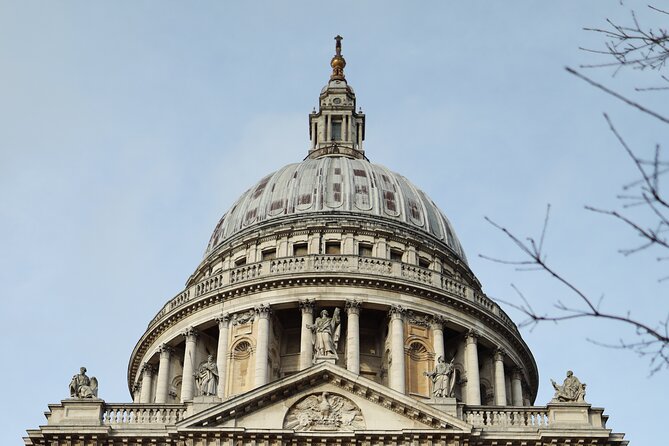
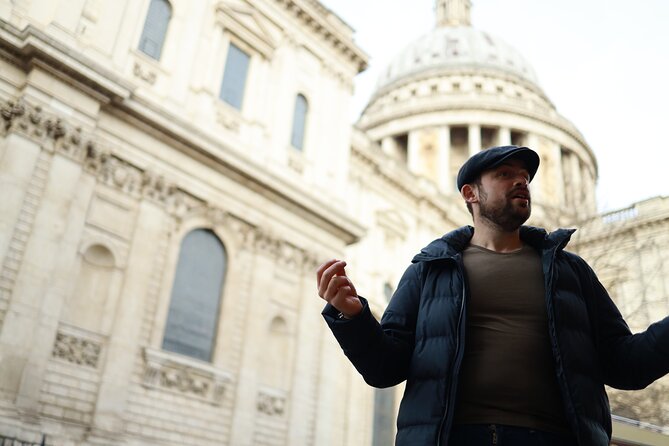
The walk begins with St Paul’s Cathedral, one of London’s clearest visual anchors. You get about 15 minutes here, with admission not included, so treat this as an introduction and photo stop rather than a cathedral visit.
The value is in the setting. St Paul’s sits at the western edge of the City, where the modern streets quickly give way to the older core. Looking at the cathedral with a guide helps place it in the story of London’s rebuilding and civic identity, even if you do not go inside.
If you want to tour the cathedral properly, plan a separate visit. The attraction is not included in the $24.69 price, and 15 minutes is not enough for its interior, galleries, or detailed exhibits. The walk gives you a useful first look, then moves on to smaller sites where the guide can spend more time on local stories.
Guildhall and the civic heart of the City
The next section brings you to Guildhall, the ceremonial and administrative center of the City of London for more than 800 years. It has hosted civic events, medieval feasts, and the long-running business of governing this unusual part of the capital.
This stop helps explain why the City is not simply another London neighborhood. It has its own government, traditions, and ceremonial life, all closely tied to commerce. The building’s grand appearance makes more sense once you understand that it represents both civic power and the independence of the City.
The timing for this stop is not separately listed, so expect it to be a guided exterior explanation or a short pause within the route. That is typical of a walk covering this many locations. You gain a broad understanding of the district, but you should not expect a full tour of every building.
The London Mithraeum and the Roman city below
The London Mithraeum Bloomberg SPACE is one of the most distinctive stops. This underground Roman temple offers a direct link to Londinium, the settlement established by Roman settlers nearly two thousand years ago.
The visit is scheduled for about 15 minutes, and admission is free. That combination makes it an excellent value point in the tour, particularly if Roman London is your main interest. You are not just hearing about the city’s first residents. You are seeing the remains of a place where Roman religious life once took place.
Fifteen minutes is brief, so the guide’s explanation matters. Nick’s role is to connect the remains to the broader street plan and the story of the City above. If you want a longer museum visit, you may need to return independently, but the tour gives you an efficient introduction without adding an admission charge.
More City Tours:
- City Sightseeing London Hop-On Hop-Off Bus Tour & Bookable Extras
★ 4.0 · 1,224 reviews - London: Go City Explorer Pass® – Tickets for 2-7 Attractions
★ 4.3 · 1,111 reviews - London: Speedboat Tour Through Heart of the City
★ 5.0 · 387 reviews - London: Upside Down House Westfield White City Entry Ticket
★ 4.0 · 338 reviews
Bank of England, Mansion House, and the Royal Exchange
The route continues through the financial center, passing the Bank of England, Mansion House, and the Royal Exchange. These buildings can look like grand backdrops to office workers and buses, but each one reveals a different part of London’s civic and commercial life.
The Bank of England has served as Britain’s central bank for more than 300 years. Its neoclassical exterior gives the guide an opening to discuss banking, economic crises, wars, and industrial change. You are seeing the institution from outside, so the explanation is more important than any interior access.
Mansion House is the official residence of the Lord Mayor of London. Its Georgian design and ceremonial role add another layer to the City’s identity. The building is tied to civic tradition, while the nearby financial institutions reflect international trade and modern money.
The Royal Exchange brings those strands together. Founded by Sir Thomas Gresham in 1565, it was created as a meeting place for merchants and traders. It was rebuilt after the Great Fire and again in the nineteenth century, making it a useful example of how the City repeatedly adapts while keeping its old symbols.
For me, this stretch is one of the strongest parts of the tour. You get architecture, politics, commerce, and urban change in a small area. The tradeoff is that these stops are primarily viewed from the street, so visitors wanting interiors will need separate plans.
The Monument and the memory of the Great Fire
The Monument to the Great Fire of London is another short but meaningful pause. Designed by Sir Christopher Wren, it commemorates the 1666 fire that destroyed much of the City and led to a major rebuilding campaign.
The column also offers views from its summit, but this walking tour does not include admission or a climb. You will still hear why the Monument matters and see how it fits into the rebuilt City. The fire is not treated as a distant disaster here. It explains why so much of central London looks the way it does.
This is a good point to notice the tour’s mix of scale. One moment you are looking at national institutions and monumental buildings. The next, you are hearing about the physical destruction of a compact neighborhood and the decisions that shaped its replacement.
Leadenhall Market, a photogenic pause
Leadenhall Market is one of the walk’s most appealing stops. Its decorative structure and covered passages provide a sharp contrast to the financial towers nearby, and it is an easy place to stop for photographs.
The scheduled visit lasts about 15 minutes, with admission free. That is enough to look around, take pictures, and hear why the market matters, but not enough for a long meal or extended shopping. The tour does not include lunch, so do not arrive expecting a food stop built into the schedule.
I like this part because it gives the route a sense of texture. The City is not only banks, offices, and monuments. Leadenhall shows how commerce, architecture, and daily city life have occupied the same site over time. Its attractive appearance also makes it one of the more camera-friendly pauses.
Garden at 120 and the modern skyline
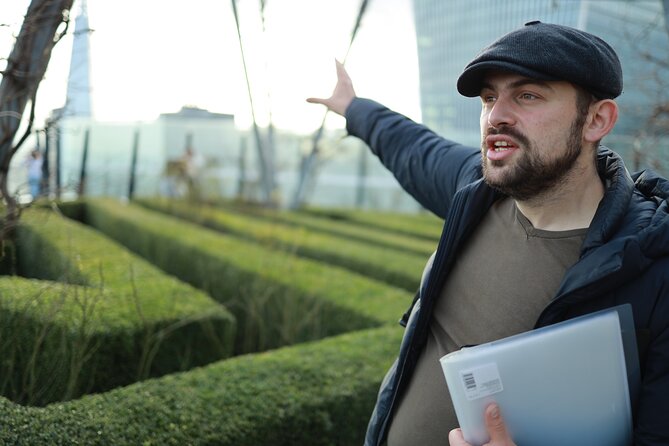
Garden at 120 provides the tour’s clearest change of viewpoint. This free viewing platform gives you panoramic views over London and a chance to read the old City from above.
The stop is scheduled for about 20 minutes, the longest timed pause in the route. That extra time makes sense. You need a moment to take in the skyline, compare historic landmarks with modern towers, and photograph the city without rushing through another narrow street.
This is not just a break from history. From the viewing platform, the layers become easier to understand. St Paul’s, the financial district, and the older streets all fit into a single visual frame. If you prefer tours that mix walking with good photo opportunities, this stop adds real value.
Access and operating details for the platform are not provided, so do not assume it will always be available under every condition. The tour lists it as a free stop, but schedules and access can change at public venues.
All Hallows by the Tower and the final approach
All Hallows by the Tower gives the eastern end of the route a quieter, more reflective stop. It is described as the oldest church in the City of London, with more than 1,300 years of history and a location close to the Tower of London.
Its appeal comes from the evidence held inside, including a Roman pavement and objects connected with the church’s long past. It also survived the Great Fire, adding another link to the disaster discussed earlier at the Monument.
This stop is particularly useful for anyone who likes small historic places more than grand attractions. The church helps show how old London survives in fragments, sometimes inside buildings that do not receive the same attention as St Paul’s or the Tower.
Finishing at the Tower of London
The listed end point is Tower Hill, London EC3N, with the Tower of London as the final major stop. You get about 20 minutes here, but admission is not included.
That makes the ending practical. You receive the story and setting of one of London’s best-known royal fortresses, then you can decide if you want to return for a full visit. The Tower requires much more time than this walking tour allows, especially if you want to see its exhibitions and grounds carefully.
The final stop also gives the route a strong geographic shape. You begin near St Paul’s and finish by the Tower, crossing the oldest part of the City from west to east. The walk is not simply a collection of attractions. It is a lesson in how London expanded, burned, rebuilt, traded, worshipped, and modernized within a tight urban area.
Pace, cost, and who will enjoy it
At $24.69 per person, this is a reasonable price for a 2-hour-20-minute guided walk, especially with a group limit of 20 and free admission to the Mithraeum and Garden at 120. You are paying mainly for the route design and Nick’s interpretation, not for entry to major attractions.
The value is strongest if you are new to London, interested in Roman history, or want to understand the City beyond the usual postcard stops. It also suits returning visitors. Several comments describe long-time London residents discovering places they had walked past for years, which is a useful sign that the route is not limited to first-time sightseeing.
You should wear comfortable shoes. This is a walking tour, and the route includes several stops rather than one concentrated attraction. Most people can participate, and service animals are allowed. The experience is near public transportation, though the exact transport plan is not specified.
The tour is booked, on average, 33 days ahead. That does not guarantee every date sells out, but it is sensible to reserve early if your London schedule is fixed. Free cancellation is available up to 24 hours before the start time. Changes or cancellations inside that window are not accepted for a refund.
Should you book the City of London walk?
Book it if you want a guided introduction to Roman Londinium, civic London, and the City’s changing architecture without paying for several separate attractions. The route is especially useful when you want context, good photo stops, and places you might not find on your own.
Skip it if your priority is going inside St Paul’s Cathedral, climbing the Monument, or spending hours at the Tower of London. Those admissions are not included, and the short stops are designed to orient you rather than replace full visits.
For most visitors, I would use this as an early London experience, then return to one or two favorite sites afterward. The combination of Nick’s storytelling, the small group size, the Mithraeum, Leadenhall Market, and the Garden at 120 gives you a thoughtful look at the oldest part of the capital for a modest price.
FAQ
How long is the Hidden Gems Tour of the City of London?
The tour lasts approximately 2 hours and 20 minutes.
Where does the tour start?
It starts at The Blackfriar, 174 Queen Victoria Street, London EC4V 4EG.
What time does the tour begin?
The scheduled start time is 1:30 p.m.
Where does the tour finish?
The end point is Tower Hill, London EC3N, near the Tower of London.
Is admission to St Paul’s Cathedral included?
No. The St Paul’s Cathedral stop lasts about 15 minutes, and admission is not included.
Is admission to the Tower of London included?
No. The Tower of London stop lasts about 20 minutes, and admission is not included.
Is the London Mithraeum included?
Yes. The London Mithraeum Bloomberg SPACE is listed as a free admission stop and receives about 15 minutes on the tour.
What should I bring or wear?
Wear comfortable shoes because this is a walking tour. The experience is offered in English, uses a mobile ticket, allows service animals, and can accommodate most participants.
Just added around London
- Up at The O2:Twilight Climb with Guided Tour with Panoramic Views★ 5.0 · 50 reviews
- Private Chauffeur-London Heathrow from/to Southampton Cruise Port★ 5.0 · 9 reviews
- Kensington Palace VIP Garden Tour with Royal High Tea★ 4.5 · 71 reviews
- Up at The O2: Sunset Climb with Guided Tour with Panoramic Views★ 5.0 · 110 reviews
- Secrets of the London Underground Small Group Walking Tour★ 4.5 · 38 reviews
- Urban Canvas: Exploring Shoreditch’s Vibrant Street Art★ 5.0 · 36 reviews
- Full-Day Self-Guided Paris Tour from London by Eurostar with Seine River Cruise★ 3.5 · 22 reviews
- Ultimate introduction to photography in Central London★ 5.0 · 19 reviews
Hidden London Walking Tours, compared.

London Soho Food Tour with 7+ Tastings of Delicious Hidden Gems
Read our review →
Private London Tour with a Local: Custom Highlights & Hidden Gems
Read our review →
Highlights & Hidden Gems With Locals: Best of London Private Tour
Read our review →
Secret Gardens of the City of London Private Tour
Read our review →
Covent Garden’s Hidden Gems: A Self-Guided Walking Tour
Read our review →Browse the lists this tour appears in