
Reviewed · LONDON WALKING TOURS
Burnings, Butchery & Black Death: A Walking Tour of London’s Bloody Past
London’s darker past is often reduced to Jack the Ripper, but this walk takes a wider and more interesting view. In about two hours, you move from a fourteenth-century plague pit and a medieval monastery to execution stories, Victorian sewage, wartime damage, and the Great Fire of 1666. The setting is the old City of London, where a quiet alley or church wall can carry centuries of trouble.
I like two things in particular: the small maximum group of 15, which makes it easier to hear guide Tom, and the way the tour finds history hiding in plain sight. You also finish near Ely Place and the tucked-away Ye Olde Mitre pub. The main drawback is the grim subject matter. This is not a gentle sightseeing stroll, and the walk depends on good weather.
Key points at a glance
- A thousand years in two hours: The route links medieval religious sites, plague history, public punishment, Victorian sanitation, and the Great Fire.
- Tom brings the past to street level: Expect clear storytelling, humor, local knowledge, and answers to questions about the area.
- Small groups matter: With no more than 15 people, you should be able to hear the guide at busy City of London stops.
- The route avoids the usual Jack the Ripper script: Its stories range from William Wallace and the Knights Hospitallers to bomb damage and ghost hysteria.
- Ten substantial stops: The walk includes Smithfield Market, St Bartholomew’s Church, Holborn Viaduct, and the old River Fleet.
- Good value at $27.73: The price works well if you want focused history and several unusual sights rather than a broad overview of London.
London’s grisly past begins at the Charterhouse
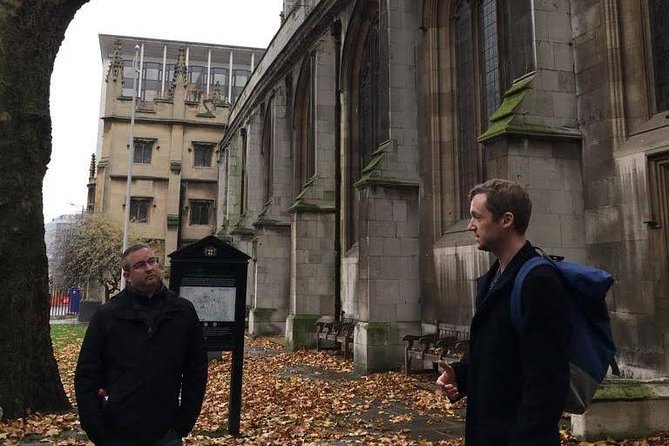
The walk starts on Aldersgate Street, close to Barbican, and quickly turns toward the Charterhouse. This former monastery is tied to a fourteenth-century plague pit, giving the tour its first sharp reminder that London’s history was not lived at a comfortable distance.
The Charterhouse is a useful opening stop because it sets the tone. You are not simply looking at grand monuments. You are tracing the practical problems of a crowded medieval city: disease, death, religion, and the way London dealt with its dead.
You spend about 10 minutes here. That is enough time for a strong introduction, but not enough for a full visit to every site along the route. Think of the tour as an outdoor history lesson, with the streets providing the setting.
More London Walking Tours:
- Magical London: Harry Potter Guided Walking Tour
★ 4.7 · 22,044 reviews - London: The Original Jack the Ripper Walking Tour
★ 4.7 · 7,833 reviews - Tour for Muggles The Ultimate Harry Potter Walking Tour in London
★ 5.0 · 4,684 reviews
Smithfield Market and the city’s working heart
Next comes Smithfield Market, a meat market with roughly 1,000 years of history. Its importance is easy to understand: this was a place where food, trade, animals, workers, and waste all met in one crowded part of London.
The market adds a useful change of scale. The Charterhouse points toward plague and religious life, while Smithfield shows the city as a working place. Tom can connect the market’s long life to the larger story of London’s growth and the pressures created by a dense urban population.
This is also one of the places where a guide makes a real difference. On your own, you might register the market as an old building or a busy commercial area. With context, you begin to see it as part of London’s long struggle to feed itself, manage disease, and control public space.
St John’s Gate and the Knights Hospitallers
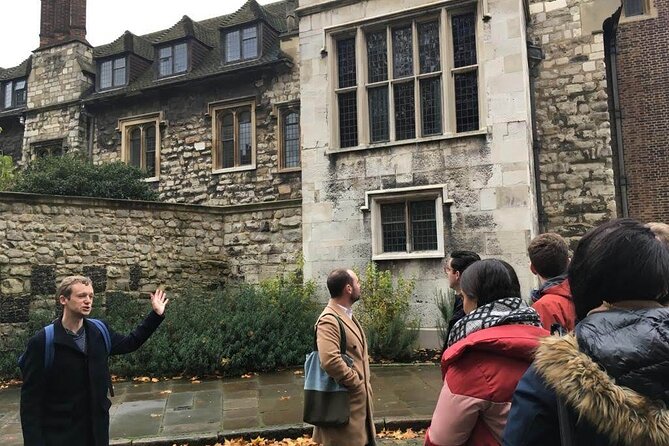
St John’s Gate takes you into the world of the medieval Knights Hospitallers. The site was home to a religious military order, a detail that adds another layer to the walk’s story of faith, violence, and care.
The stop is short, but it helps connect London to a wider medieval world. Religious institutions were not just places of worship. They could provide medical care, organize land and labor, and hold serious power.
This is one of several moments when the tour moves beyond blood and punishment. Its subject is not simply death. It is the way institutions shaped daily life, from hospitals and religious orders to markets and municipal works.
Cloth Fair, a quiet lane with a loud past
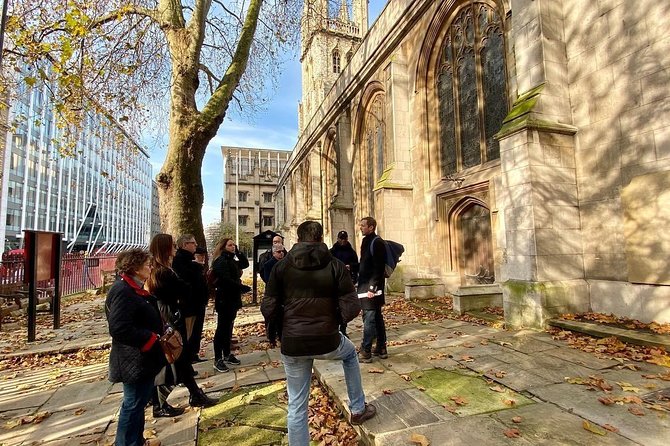
Cloth Fair is the sort of place you could pass without noticing. Its narrow scale and quiet mood make the stories feel especially unexpected. The stop is built around the contrast between the peaceful lane you see now and the noisy, difficult past associated with it.
The walk is strongest when it uses these contrasts. London often hides its age behind ordinary streets. You do not need a famous viewpoint to learn something useful. A short alley can reveal how people lived, worked, gathered, and suffered in earlier centuries.
Tom’s style is important here. The experience works best when the guide can tell a story without turning every stop into a lecture. His approach, as described by the tour details, combines facts with humor and room for questions.
A different sort of day out in London altogether:
- From London: Harry Potter Warner Bros Studio Tour
★ 4.7 · 26,588 reviews - London: Westminster to Greenwich River Thames Cruise
★ 4.5 · 22,836 reviews - London: Madame Tussauds London
★ 4.6 · 20,915 reviews - Stonehenge, Windsor Castle, and Bath from London
★ 4.5 · 18,662 reviews
William Wallace’s memorial in the City
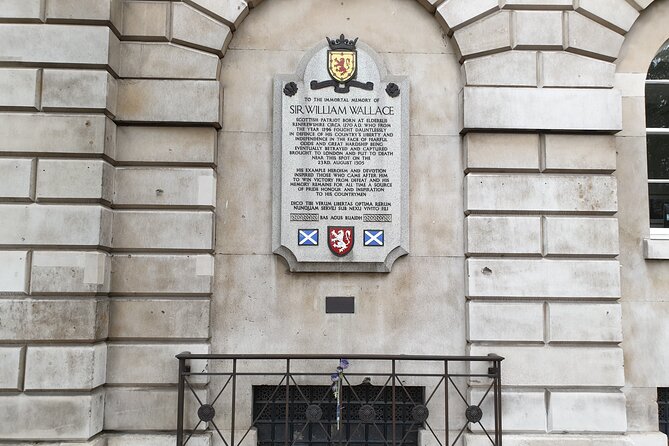
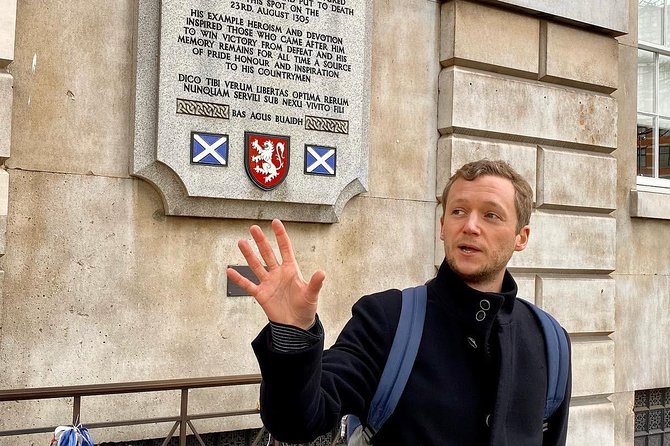
The William Wallace Memorial is an unexpected stop on a London walking route. Wallace, known to many people through the film Braveheart, was a Scottish figure, yet his memorial here offers a chance to separate popular culture from the historical record.
This is a good example of the tour’s broad reach. You are not being led through one narrow period or a single crime story. Instead, the route uses scattered sites to show how London has absorbed national politics, executions, religion, war, film history, and public memory.
If you know Wallace mainly from the movie, listen closely to how the stop handles the difference between legend and history. That sort of correction is one of the pleasures of a good city walk. It gives you a better sense of how stories are shaped over time.
St Bartholomew’s Church and hospital history
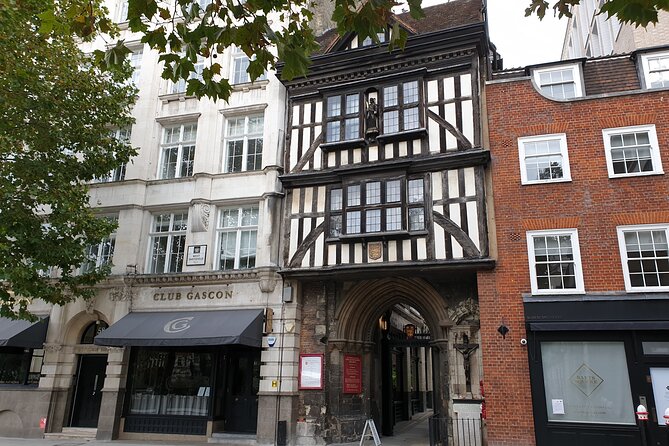
Church of St Bartholomew the Great is one of the major stops. It is London’s oldest surviving parish church, and admission is included in the tour.
The church gives you a chance to move from outdoor viewing into a historic interior. Its age and survival make it more than a pretty church visit. It shows how religious buildings can outlast the institutions and neighborhoods around them.
Nearby, St Bartholomew’s Hospital adds another important part of the story. It is described as the oldest surviving hospital in the country. Together, the church and hospital show how this part of London became linked with healing, care, religion, and death.
The tour allows about 10 minutes at each listed stop, so do not expect a long, quiet church visit. The benefit is range. In a single morning or afternoon, you see several sites that would be hard to connect without a local guide.
The Golden Boy and the Great Fire of 1666
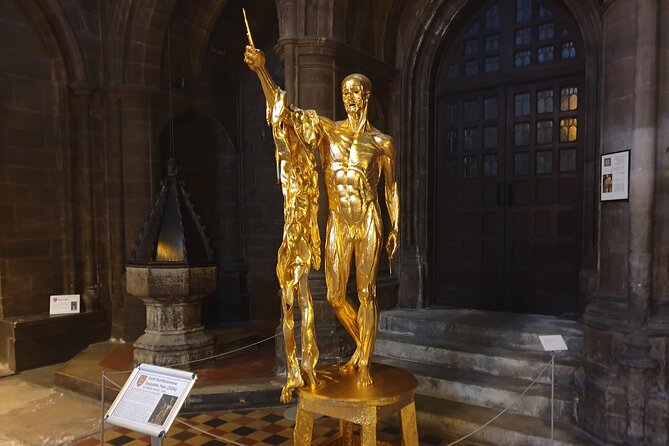
At the Golden Boy of Pye Corner, the story shifts to the Great Fire of 1666. This marker identifies the point where the fire finally stopped, making it one of the route’s clearest links to a major event in London’s past.
The site also connects to eighteenth-century ghost hysteria. That unusual detail keeps the stop from becoming a standard Great Fire explanation. London’s reaction to disaster included not only rebuilding and memorials, but also fear, rumor, and stories about the supernatural.
I like this stop because it shows how cities remember catastrophe. A small marker can carry an event that changed the shape of London. It also makes a useful point about historical memory: the end of a disaster can become as memorable as its beginning.
Holborn Viaduct and the lost River Fleet
Holborn Viaduct brings you into Victorian London, when the River Fleet was the city’s largest open-air sewer. The modern road and bridge conceal much of that earlier reality, so this is another point where the guide’s explanation gives the place its meaning.
The stop helps you understand how London’s infrastructure changed. Rivers and streams were gradually covered or redirected as the city expanded. What seems like a normal road can sit above an old watercourse with a far less pleasant past.
This is also a practical reminder that the tour is about urban problems, not just famous people. Disease, sewage, overcrowding, and waste shaped London as much as kings and churches did. For me, that makes the route more useful than a walk built only around grand architecture.
Ye Olde Mitre and the route’s best pause
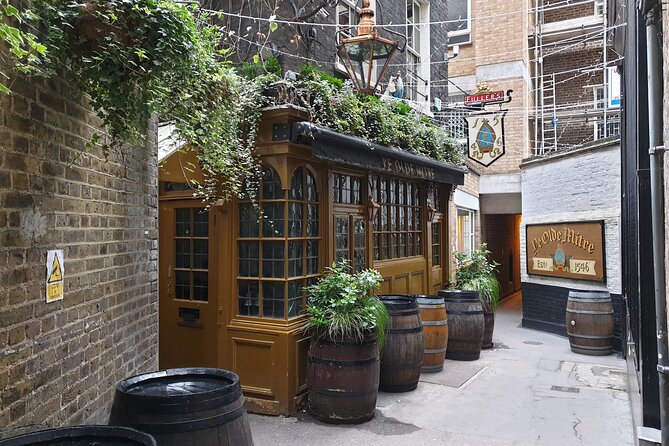
Ye Olde Mitre is a tucked-away pub reached down an alleyway. It is the sort of place that benefits from local knowledge because you might not notice it while moving through the wider streets.
The pub is the final stop on the route, and it gives the walk a welcome change of mood. After stories of plague, executions, fire, and sewage, an atmospheric old pub offers a natural place to pause and continue the conversation.
Food and drinks are not listed as included, so plan to pay for anything you order. The walk itself ends on Ely Place, around the corner from Farringdon Station, rather than promising a pub meal as part of the ticket. Still, the pub is a useful recommendation if you want to stay in the area after the tour. Cheese toasties and pork pies have been singled out as good choices, though you should treat that as a suggestion, not part of the package.
A tour that keeps away from the usual London script
Many London history walks return to the same few stories. This one takes a different route. The subject is still dark, but the focus spreads across plague, medieval orders, market life, Scottish history, the Great Fire, ghost fears, Victorian sanitation, hospitals, and wartime bomb damage.
The references to Blitz damage and filming locations add extra texture as you walk. These are not the main subject, but they help connect older history with the London you see today.
Tom is repeatedly described as clear, humorous, approachable, and well informed about the local area. That matters because the route contains many short stops. A less engaging guide could make ten minutes at each site feel like a string of facts. Tom’s ability to answer questions and relate old events to modern life appears to be one of the strongest reasons to choose this particular walk.
What the $27.73 price gets you
At $27.73 per person, this is reasonably priced for a two-hour guided walk in central London. You are paying for the guide’s preparation and storytelling, not for a long list of paid admissions. Most stops are free, while admission to St Bartholomew’s Church is included.
The value depends on how you like to see a city. If you want major interiors, long museum visits, or a broad tour of London’s famous landmarks, this will feel narrow. If you want a concentrated look at one historic district, the price is easier to justify.
You also get access to places that are easy to miss. The route packs a lot into a small area, which saves you from spending a day crossing London between unrelated sights. The small group limit adds value too. A maximum of 15 people is far more manageable than a large crowd when you are standing beside a busy street or listening in a narrow lane.
Timing, meeting point, and practical comfort
The tour lasts about two hours and begins at Underground Ltd on Aldersgate Street in the Barbican area. It ends on Ely Place, around the corner from Farringdon Station, so you finish in a useful transport location.
Wear comfortable shoes and check the forecast. The experience requires good weather, and bad weather can lead to a new date or a full refund. Free cancellation is available up to 24 hours before the start time, but changes or cancellations inside that window are not accepted.
The tour is offered in English and uses a mobile ticket. Service animals are allowed, and the route is near public transportation. Most people can take part, but this remains a walking tour with ten stops, so you should be comfortable being on your feet for roughly two hours.
Who should book this walking tour?
I would choose this for someone who has already seen the major London sights and wants a more local, less predictable view of the City. It also suits first-time visitors who enjoy history and want to understand how ordinary streets connect to major events.
The subject matter is best for adults and older children who are comfortable with stories about plague, death, public punishment, disease, and poor sanitation. If you prefer cheerful royal history or polished architectural tours, this may feel too grim.
Book it if you value strong guiding and unusual locations more than extensive time inside each attraction. Skip it if bad weather is likely, you dislike walking, or you want a tour focused on one period only. At $27.73, the walk earns its price through the range of stories, the small group, and Tom’s ability to make overlooked corners of London worth your attention.
FAQ
How long is the Burnings, Butchery & Black Death walking tour?
The tour lasts approximately two hours.
Where does the tour start?
It starts at Underground Ltd on Aldersgate Street in the Barbican area of London, postcode EC1A 4JA.
Where does the tour finish?
The tour ends on Ely Place, around the corner from Farringdon Station.
How many people can join the tour?
The group has a maximum of 15 people.
Is admission to the sights included?
The tour is included, and admission to the Church of St Bartholomew the Great is included. The other listed stops are shown as free admission.
Can I cancel for a full refund?
Yes. You can cancel at least 24 hours before the experience start time for a full refund. If poor weather cancels the tour, you will be offered another date or a full refund.
Just added around London
- Couple’s photo: Romantic photoshoot in London★ 4.8 · 22 reviews
- London: “Queen” Highlights Walking Tour★ 4.3 · 48 reviews
- London: Private Tour with Locals – Highlights & Hidden Gems★ 5.0 · 8 reviews
- Luxury Private Tour in London with Lunch★ 5.0 · 7 reviews
- London 1- or 2-Hour Professional Photo Shoot★ 4.9 · 6 reviews
- London: Private Black Cab Night Tour with Hotel Pick Up★ 5.0 · 11 reviews
- London: Christmas Lights Tour – With Christmas Music★ 4.8 · 9 reviews
- London: Private Pub Tour★ 4.5 · 4 reviews
London Walking Tours, compared.

Magical London: Harry Potter Guided Walking Tour
Read our review →

Tour for Muggles The Ultimate Harry Potter Walking Tour in London
Read our review →
Harry Potter Movies Walking Tour (Kids Go Free)
Read our review →
Changing of the Guard Guided Walking Tour in London
Read our review →
The Great British Rock and Roll Music Walking Tour
Read our review →
Jack the Ripper Walking Tour – Ripper Vision Tours
Read our review →Browse the lists this tour appears in