
Reviewed · EAST END AND SHOREDITCH TOURS
Walking Tour around Spitalfields in the East End of London
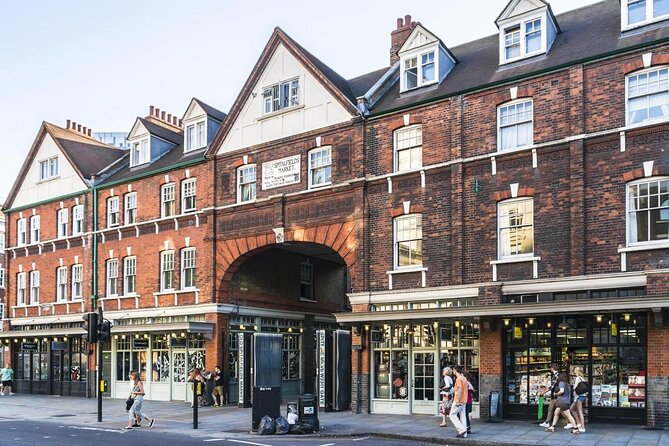
Spitalfields is where London’s layers sit close together. In two hours, you move from Nicholas Hawksmoor’s grand Christ Church to Jewish East End history, an ancient market, a former brewery, and a building that changed from Huguenot chapel to synagogue to mosque. The tour ends with tea and cakes in an 18th-century drawing room, a fittingly gentle finish.
I like the five-person limit, which gives the guide room to stop, answer questions, and point out small details you could easily miss alone. I also like the personal stories, especially the research into people who lived and worked here. The main drawback is simple: you need to walk and stand for two hours, and the tour depends on decent weather.
Key points about the Spitalfields walk
- Start at Christ Church Spitalfields: Begin beside Nicholas Hawksmoor’s masterpiece of English Baroque.
- Follow many layers of East End life: The route covers Jewish immigration, markets, breweries, religious buildings, and Georgian homes.
- Expect a very small group: A maximum of five people allows for conversation rather than a speech delivered to a crowd.
- Look beyond famous facades: The tour focuses on the purpose of buildings and the people connected with them.
- Finish with period tea: Sit in an 18th-century drawing room and enjoy tea and cakes made from a 1720 recipe.
- Allow for a steady walk: This is not a sit-down sightseeing trip, and it is not suitable if you cannot comfortably walk or stand for two hours.
Why Spitalfields makes a fine London walking tour

Central London can give you grand monuments in quick succession, but Spitalfields asks you to slow down. Its interest lies in the way one building or street can carry several different stories. Here, religious change, immigration, commerce, poverty, and redevelopment all meet within a compact East End area.
I like tours that explain why a place looks the way it does. This one is built around that question. You are not simply shown an old church, market, or row of houses. You hear what each place was for, who used it, and how its role changed.
The small group matters. With no more than five people, the guide can keep the pace personal and adjust explanations to the group. That makes a difference in a district filled with small clues. A large party might pass a doorway or plaque quickly. Here, you have a better chance to stop and ask about it.
The experience is offered in English and begins at 2:00 p.m. at Christ Church Spitalfields on Commercial Street. It lasts about two hours and returns to the meeting point. Since much of the value comes from looking closely at buildings and streets, bring comfortable shoes and dress for London weather.
More East End and Shoreditch Tours:
- Jack The Ripper Tour in London’s East End
★ 4.5 · 718 reviews - Shoreditch Street Art Tour London
★ 5.0 · 481 reviews - Gangster Tour of London’s East End Led by Actor Vas Blackwood
★ 5.0 · 389 reviews
Christ Church and the grand opening scene
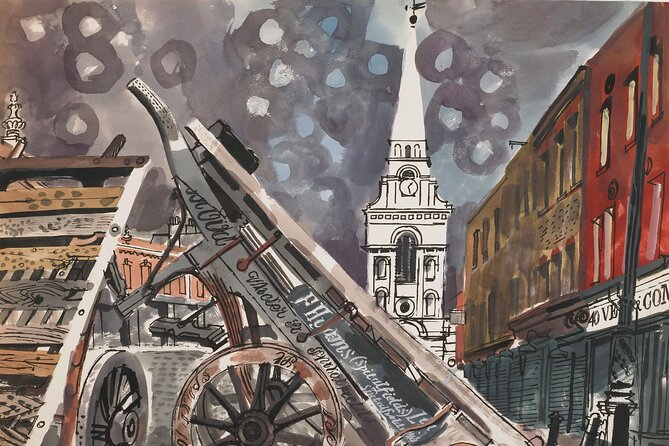
The tour begins with Nicholas Hawksmoor’s Christ Church Spitalfields, an imposing work of English Baroque architecture. Its scale gives you an immediate sense of the area’s changing importance. Before the walk gets into smaller streets and individual lives, you have a major architectural landmark to set the scene.
This is a smart starting point. Christ Church provides a strong visual contrast with the more modest buildings and working spaces that follow. I would pay attention to the church before the guide begins, then use the explanation to understand how it fits into Spitalfields rather than treating it as an isolated monument.
The tour is not presented as a church-only architecture walk. That is good news if you want more than dates and design terms. The building is one part of a broader story about the East End, and the route quickly moves into the people and institutions that shaped the district.
The Jewish East End, told through individual lives
One of the most affecting sections concerns an institution that served Jewish immigrants from Eastern Europe, including people from the area now known as Ukraine. The emphasis is on the people whose lives were tied to that institution and the needs it met.
That approach gives the subject a human scale. Immigration history can become a list of dates and groups, but personal stories help you understand what it meant to arrive, settle, worship, work, and seek support in a new part of London.
The tour’s guide has carried out personal research into individuals who lived in Spitalfields. That detail is important. It means the experience is not limited to famous names or grand buildings. You get the chance to hear about ordinary residents, and those stories may be the part you remember longest.
I would especially value this section if you have already seen London’s major sights and want a closer look at how neighborhoods were shaped by migration. It also helps explain why Spitalfields cannot be reduced to its present-day restaurants, shops, and restored facades.
An ancient market and the everyday business of the East End

The route also tells the story of the ancient market. Markets are easy to take for granted when you see them as shopping areas, but their purpose reaches further. They organize work, trade, food, movement, and public life.
Here, the guide helps you read the market as part of Spitalfields rather than as a standalone stop. You learn how the market fits into the district’s long commercial story and why it has remained such a strong marker of local identity.
The market section should appeal to you if you enjoy places where history is still tied to daily use. The experience is not only about old stones. It connects the past with a setting that remains part of London life.
One practical point: market areas can be active and distracting, so stay close to the guide. The small group makes this easier, but you will get more from the stop if you listen for the explanation instead of treating it as free time.
More London Walking Tours:
- Magical London: Harry Potter Guided Walking Tour
★ 4.7 · 22,044 reviews - London: The Original Jack the Ripper Walking Tour
★ 4.7 · 7,833 reviews - Tour for Muggles The Ultimate Harry Potter Walking Tour in London
★ 5.0 · 4,684 reviews - London Jack The Ripper Guided Walking Tour
★ 5.0 · 3,131 reviews
A medieval survival and the Priory of St Mary Spital
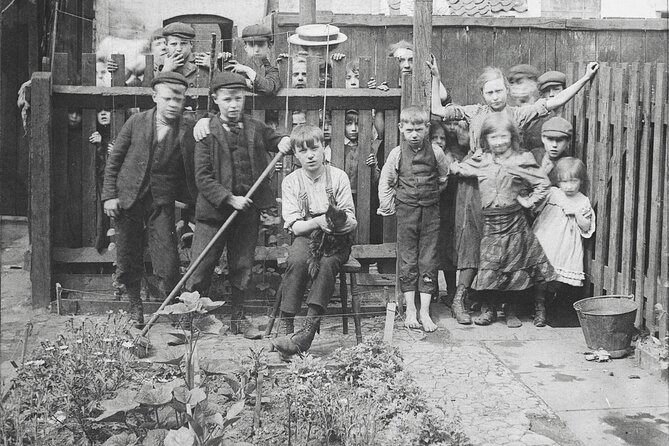
Another stop reveals the purpose of an astonishing medieval survival. The exact name of the structure is not given in the tour details, so the guide’s explanation is especially important. Rather than viewing it as a curious leftover, you learn why it exists and what role it once played.
That is the kind of stop I appreciate on a walking tour. A surviving fragment can look meaningless without context. Once you know its original purpose, it becomes evidence of how the area worked in the medieval period.
The walk also visits the site of the Priory of St Mary Spital. The priory gives Spitalfields its name and adds an earlier layer to a neighborhood often associated with later industries and immigrant communities. The visit helps connect the modern district with its religious and charitable past.
You should expect interpretation rather than a large preserved complex. The value is in understanding the site and its place in the district’s story. If you prefer fully restored interiors and dramatic ruins, this part may feel restrained. If you enjoy seeing how a city’s past survives in fragments, it should be rewarding.
The brewery story, told through two women
The brewery section takes a different route into local history. Instead of focusing only on the business, the guide tells its story through the lives of two women who worked there.
That choice gives the stop a useful balance. A brewery can easily become a story about production, ownership, and buildings. Following two workers brings attention to the human side of the enterprise and to the people whose labor kept it going.
I like this kind of storytelling because it broadens the idea of who belongs in history. The famous owner or architect may be easier to name, but workers often reveal more about the daily life of a place.
You will not be taking a brewery tour in the usual sense. The stop is part of a neighborhood walk, so expect historical interpretation rather than brewing demonstrations or tastings. The appeal is the story behind the site and the way the guide links it to wider changes in Spitalfields.
Commercial Street and the argument over its future

The tour tells the story of the famous thoroughfare and the continuing controversy over its future. This gives the walk a present-day edge. Spitalfields is not frozen in the past, and streets with strong historic character still face decisions about how they should change.
That discussion is useful because it makes you look at the street with two questions in mind. What has been preserved, and what may be altered? What does a neighborhood owe to its past, and how should it serve people now?
You may find this section particularly helpful if you are interested in urban change. The guide can point out that preservation is not simply about saving old buildings. It also involves business, residents, public space, and the character of a street.
The subject may feel less tidy than a traditional sightseeing stop. There is no single neat answer to a dispute about a neighborhood’s future. That is part of its value. The tour invites you to notice that Spitalfields remains a lived-in part of London, not a museum set.
One building, three religious identities
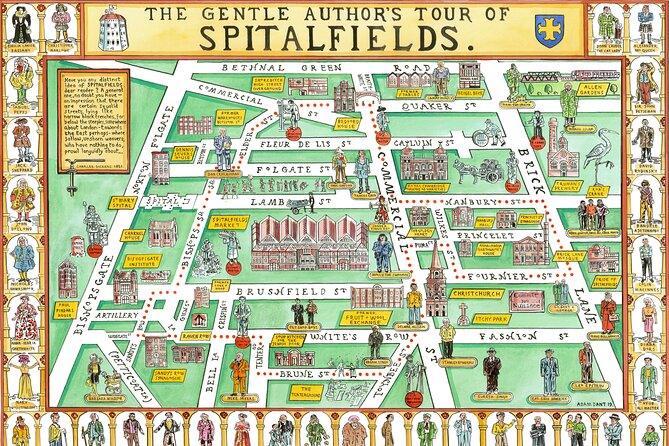
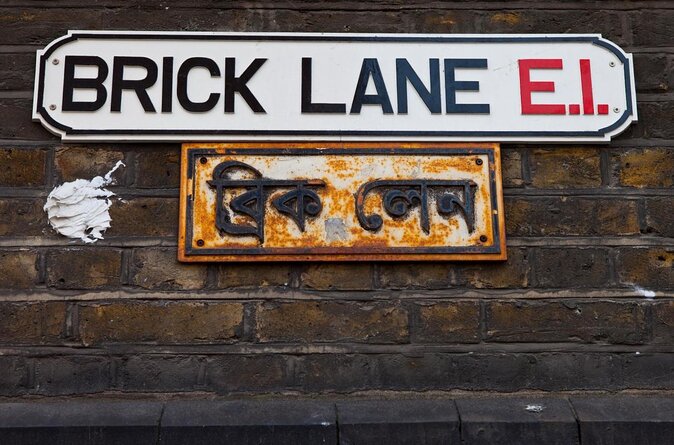
One of the most striking stories concerns a building that began as a Huguenot chapel, later became a synagogue, and then became a mosque. That sequence neatly captures Spitalfields as a place shaped by successive communities.
The building’s changing use is more than an architectural curiosity. It shows how religious spaces can be adapted as neighborhoods change. One structure can hold the memory of several communities, each leaving its own mark on the area.
This should be a highlight for anyone interested in London’s religious and immigrant history. It also gives you a practical way to understand the district. Instead of seeing separate communities as unrelated chapters, you see how they occupied the same streets and sometimes the same buildings.
The stop is likely to reward close attention to the building itself, but the explanation is what gives it meaning. Without the story, you might simply pass another old facade. With it, the building becomes a concise history of Spitalfields.
Eighteenth-century houses and a herbalist’s garden
The walk continues to fine eighteenth-century houses, another reminder that Spitalfields has never had just one social identity. The houses add a domestic and architectural layer to the churches, markets, institutions, and workplaces already covered.
I would look for the details that make these homes different from grander central London residences. The point is not simply that they are old or attractive. Their arrangement, scale, and survival help show how the area developed and who lived there.
You also visit the herb garden of Nicholas Culpeper, a seventeenth-century herbalist. A garden stop changes the pace of the walk. After churches, markets, and streets, you get a more tangible sense of the plants and remedies associated with Culpeper’s work.
The garden is not presented as a long botanical visit, so do not expect a full horticultural program. Its role is to connect a person, a period, and a practical tradition. It is a small stop, but it adds texture to the route.
Tea in a townhouse drawing room
The final stop is the most unusual part of the experience. You put your feet up in an eighteenth-century drawing room overlooking Christ Church Spitalfields and enjoy tea and cakes baked to a 1720 recipe. The visit lasts about 30 minutes, and admission is included.
This ending works because it changes the mood. A two-hour walking tour can leave you full of facts but ready for a rest. Sitting down in a period room gives you time to reflect, ask a final question, and enjoy a simple local-style treat.
The tea is also a good value point. At $90.28 per person, this is not a cheap introductory walk. You are paying for a private-feeling group of up to five, a guide-led route with substantial historical interpretation, and a seated finish with tea and cakes included.
I would not choose this tour mainly for the food. The tea is a pleasant extra, not a meal. Its real value is the way it completes the experience and avoids the abrupt ending common to many walking tours.
Is $90.28 a fair price?
The price makes most sense if you care about depth and group size. A standard city walk may cost less, but it may also have a larger group and less time for questions. Here, the five-person maximum gives the guide room to focus on the details of Spitalfields and respond to your interests.
The route also covers a lot in two hours: Baroque architecture, Jewish immigrant history, a market, medieval remains, a priory site, brewery workers, a disputed thoroughfare, religious change, eighteenth-century houses, Culpeper, and a period tea. That is a substantial amount of ground and subject matter.
Still, you should be clear about what you are buying. This is not a broad tour of all London, and it does not promise entry to a long list of major attractions. It is a concentrated neighborhood experience. If you already plan to spend time in Spitalfields, the added context can make your own wandering much more rewarding.
The 100 percent recommendation rate and 5 rating from 131 ratings suggest a strong level of satisfaction, but your enjoyment will depend on your interests. People who want a fast list of famous sights may find the personal stories and careful stops too slow. I think the price is reasonable for a small, story-led tour if Spitalfields is high on your list.
Who should book this walk?
I would choose this tour if you like social history, architecture, religious change, and the small details of old neighborhoods. It suits visitors who have already seen central London or who want an afternoon away from the usual royal and museum circuit.
It is also a good choice for anyone who prefers conversation to a large group lecture. The guide can spend more time on the subjects that catch your attention, and the route’s many stories give you plenty to ask about.
The tour is less suitable if you want a relaxed, mostly seated outing. You will walk and stand for about two hours, and the experience requires good weather. Service animals are allowed, public transportation is nearby, and most people can take part, but the physical requirement should guide your decision.
Book at least a day ahead if your plans are firm. You can cancel for a full refund up to 24 hours before the start time. If poor weather or an insufficient number of bookings causes cancellation, you will be offered another date or experience, or a full refund.
Should you book the Spitalfields walking tour?
Book it if you want London told through buildings and individual lives rather than through a checklist of landmarks. The strongest features are the five-person group, the guide’s personal research into residents, the building that changed from chapel to synagogue to mosque, and the thoughtful tea-room ending.
Skip it if you cannot comfortably walk and stand for two hours, or if you prefer a large sightseeing tour with a faster pace. For the right audience, $90.28 buys a focused, human-scale look at one of London’s most layered districts, with a memorable cup of tea at the end.
FAQ
Where does the Spitalfields walking tour begin?
The tour begins at Christ Church Spitalfields, Commercial Street, London E1 6LY, UK.
What time does the tour start?
The start time is 2:00 p.m.
How long does the tour last?
The walking tour lasts approximately two hours. The final townhouse visit includes 30 minutes in an eighteenth-century drawing room with tea and cakes.
How large is the tour group?
The tour has a maximum of five people.
Is tea and cake included?
Yes. At the end of the tour, tea and cakes baked to a 1720 recipe are included, along with admission to the townhouse drawing room.
Can I cancel for a full refund?
Yes. You can cancel at least 24 hours before the local start time for a full refund. Cancellations or changes made less than 24 hours before the start time are not refunded or accepted.
Just added around London
- Up at The O2:Twilight Climb with Guided Tour with Panoramic Views★ 5.0 · 50 reviews
- Private Chauffeur-London Heathrow from/to Southampton Cruise Port★ 5.0 · 9 reviews
- Kensington Palace VIP Garden Tour with Royal High Tea★ 4.5 · 71 reviews
- Up at The O2: Sunset Climb with Guided Tour with Panoramic Views★ 5.0 · 110 reviews
- Secrets of the London Underground Small Group Walking Tour★ 4.5 · 38 reviews
- Urban Canvas: Exploring Shoreditch’s Vibrant Street Art★ 5.0 · 36 reviews
- Ultimate introduction to photography in Central London★ 5.0 · 19 reviews
- Full-Day Self-Guided Paris Tour from London by Eurostar with Seine River Cruise★ 3.5 · 22 reviews
East End and Shoreditch Tours, compared.


Gangster Tour of London’s East End Led by Actor Vas Blackwood
Read our review →
East End Street Art Tour and Spray Painting Workshop
Read our review →
PRIVATE London Food Tours – Borough Market, Soho, East End
Read our review →
Private East End Food Tour: 7 Tastings with Bagels & Fish & Chips
Read our review →

Food & Drink walking tours In London. Discover the East End of London.
Read our review →Browse the lists this tour appears in