
Reviewed · JACK THE RIPPER TOURS
Jack the Ripper – What About the Women?
The most important thing about this tour is its point of view. Instead of turning Jack the Ripper into the main character, it puts Martha Tabram, Polly Nichols, Annie Chapman, Mary Jane Kelly, Elizabeth Stride, and Catherine Eddowes back at the center of their own stories. You hear about their work, homes, hardships, and the society that failed to protect them.
I like two things right away: the walk connects the murders to real Victorian housing and poverty, and it shows you the East End as a living place rather than a stage set for crime tales. Guides Cecily and Ellie are praised for clear, thoughtful storytelling, with Cecily especially good at making the subject accessible to families and people who do not speak English as a first language.
The main consideration is that this is a serious two-hour walk with frequent stops and a difficult subject. It avoids grisly pictures and graphic detail, but the stories still involve murder, poverty, addiction, and trauma. Wear comfortable shoes, and bring a coat for the evening.
Key points to know before you book
- The women come first: The tour focuses on the victims’ lives, not on glorifying Jack the Ripper.
- A real East End walk: You pass Whitechapel Road, Brick Lane, Old Spitalfields Market, Petticoat Lane, St Botolph’s Aldgate, and Mitre Square.
- Fact-based storytelling: Cecily and Ellie explain Victorian society, poverty, migration, and the myths built around the murders.
- A family-friendly tone: There are no gruesome pictures, and the guide avoids spelling out graphic murder details.
- Small-group format: The maximum group size is 20, which helps during street-side stops and questions.
- Good evening value: At $34.28 per person for about two hours, you are paying for a guided history walk with a clear social purpose, not just a crime story.
Why this Jack the Ripper tour feels different
Most Jack the Ripper walks make the killer the star. This one asks a better question: who were the women before they became names in a murder file?
That change matters. The women are often reduced to a few labels, and the East End is presented as a foggy maze of pubs, alleys, and danger. Here, you get a wider picture. The guide talks about working-class housing, dosshouses, workhouses, spikes, addiction, migration, women’s limited choices, and the charities still working in the area today.
The result is closer to a social history walk than a traditional true-crime outing. You still visit places linked to the murders, but the goal is to understand the people and the conditions around them. If you want a suspenseful hunt for clues about the killer, this may feel too restrained. If you want to know how ordinary women lived in Victorian London, it offers much more.
The experience has a maximum of 20 people. That is not a private tour, but it is small enough to keep the group together on busy streets and make it possible to ask questions. Cecily and Ellie are the named guides associated with the experience. Their style is warm and clear, with an emphasis on facts rather than wild theories.
More Jack the Ripper Tours:
- London: The Original Jack the Ripper Walking Tour
★ 4.7 · 7,833 reviews - London Jack the Ripper Guided Tour with Ripper-Vision
★ 4.5 · 4,840 reviews - London: Jack the Ripper Small Group Tour
★ 4.7 · 3,159 reviews
Starting at Aldgate with Martha Tabram and Polly Nichols
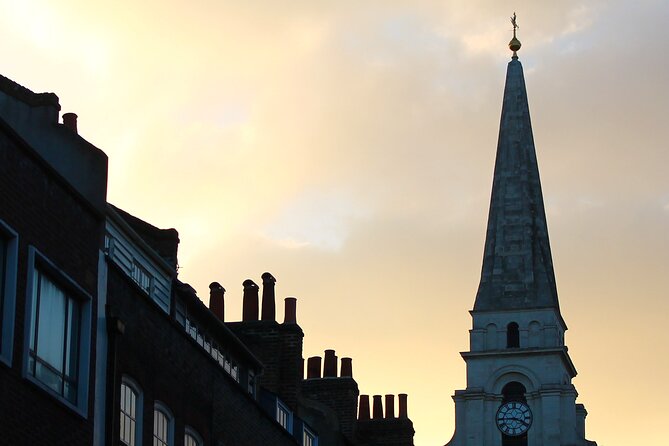
The meeting point is outside Aldgate station on Aldgate High Street. Starting here is practical because the station is easy to find and the area is well served by public transportation. The tour begins at 6:30 pm, so you see East London after daylight fades and shops and pubs take on a different feel.
The first stop covers Whitechapel Road and introduces Martha Tabram and Polly Nichols. You also get the basic setting for the entire walk: what life was like for working-class residents of the Victorian East End.
This part is valuable because it avoids treating poverty as scenery. You hear about dosshouses, workhouses, spikes, and other forms of accommodation used by poor people. These words describe hard choices and limited shelter, not picturesque old London. The discussion helps explain why women could be exposed to danger while trying to find a bed, earn money, or get through a difficult night.
The guide also points out charities that still work in the area. That small detail links the past to the present without pretending the East End is frozen in 1888. You are looking at a modern neighborhood shaped by layers of need, work, migration, and community action.
Allow about 20 minutes here. The first stop sets the tone, so do not expect a quick list of murder facts. You are being asked to understand the lives around the crimes.
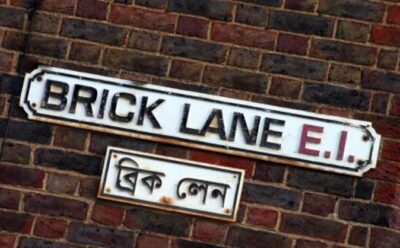
Brick Lane, Polly Nichols, and the East End’s changing identity
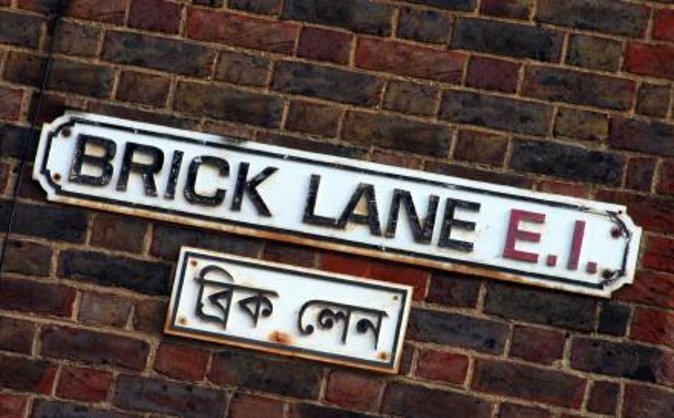
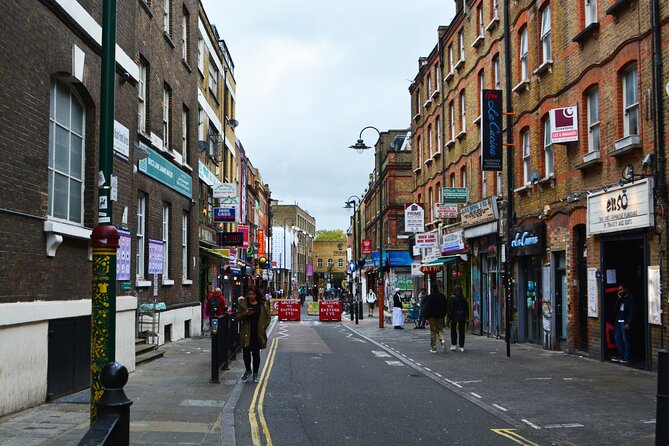
At Brick Lane, the group stops near the former site of the pub where Polly Nichols spent her final night. The subject turns toward her life and the problems of alcohol and addiction in Victorian London.
This is one of the tour’s more useful shifts. Rather than using the pub only as a dramatic crime location, the guide places it within the social problems of the period. Addiction is discussed as part of the world these women lived in, not as a cheap way to assign blame.
The stop then moves to Brick Lane Mosque, where you learn about immigration into the East End and the area’s cultural diversity. Brick Lane is especially well suited to this discussion because the street carries visible reminders of changing communities. The tour uses the setting to show that Whitechapel has never been a single-story neighborhood.
The Brick Lane section lasts about 15 minutes. It is brief, but it broadens the walk beyond the murders. You begin to see the East End as a place shaped by arrivals, work, religion, food, trade, and changing identities.
You also get a useful reminder that the Victorian East End was not only a place of misery. It was crowded and poor in many areas, but it was also full of people building lives under difficult conditions. That balance keeps the walk from turning the neighborhood into a horror prop.
Spitalfields, Annie Chapman, and the Ten Bells
The route continues toward Spitalfields Market and the former Truman Brewery. The brewery was once described as the largest in the world, a striking fact that helps you picture the scale of business and employment in this part of London.
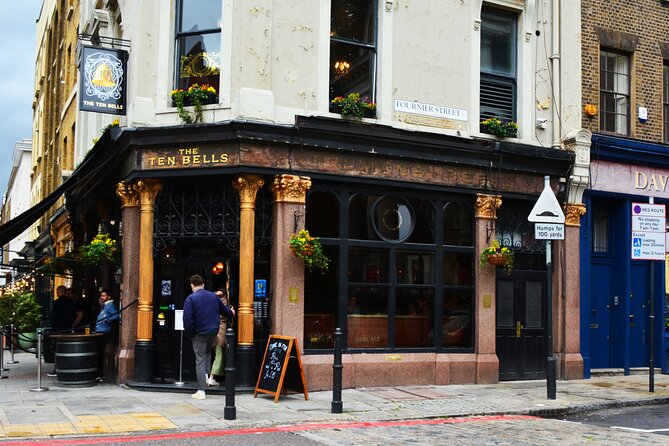
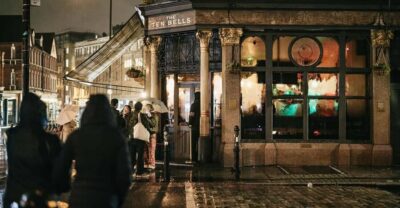
Nearby is 29 Hanbury Street, the site where Annie Chapman was found on the morning of September 8. The tour then turns to the Ten Bells pub and the story of Annie’s life and personal losses.
This is where the human focus becomes especially strong. You do not simply hear where a body was discovered. You learn about the woman who lived before that moment and about the heartbreak she endured. The guide keeps the attention on Annie rather than using her death as a shock point.
The Ten Bells also brings in the way public memory can distort the past. The pub was once renamed the Jack the Ripper pub, but the name was changed back to the Ten Bells after pressure from the Reclaim the Night movement. That detail gives the stop a modern edge. It shows how the way we name places can either keep attention on a murderer or return dignity to the women he killed.
The stop itself is about 10 minutes. You should expect outdoor storytelling near active streets and businesses, not a long indoor presentation. The setting is atmospheric, but the value comes from the guide’s explanation rather than from dramatic staging.
A different sort of day out in London altogether:
- From London: Harry Potter Warner Bros Studio Tour
★ 4.7 · 26,588 reviews - London: Westminster to Greenwich River Thames Cruise
★ 4.5 · 22,836 reviews - Magical London: Harry Potter Guided Walking Tour
★ 4.7 · 22,044 reviews - London: Madame Tussauds London
★ 4.6 · 20,915 reviews
Old Spitalfields Market and the contrast of Victorian London
Old Spitalfields Market opened in 1887, the year of Queen Victoria’s Golden Jubilee and one year before the Whitechapel murders began. The guide uses the market to show the sharp contrasts of the Victorian era.
This is a smart location for that point. A market suggests trade, movement, goods, and opportunity. Yet only a short distance away, many people lived in severe poverty. Victorian London could display great wealth and deep hardship at the same time, often within the same neighborhood.
The walk then heads to Crispin Street to see the former site of a refuge for working-class people that actually worked. That phrase captures the practical spirit of the tour. You are not shown only failures and misery. You also hear about places and efforts that gave people some support.
Across the street is the former site of Mary Jane Kelly’s residence. She was the last of the women linked to the murders and remains the most mysterious figure in the story. The guide discusses her life without pretending that every gap in the historical record can be filled.
This section lasts about 15 minutes. Old Spitalfields Market is also the stated end point of the experience, at 65 Brushfield Street, although the route description continues with later East End locations and finishes near Mitre Square. Confirm the exact end point with your guide on the day, especially if you have a dinner booking or a tight evening plan.
Petticoat Lane and the old textile district
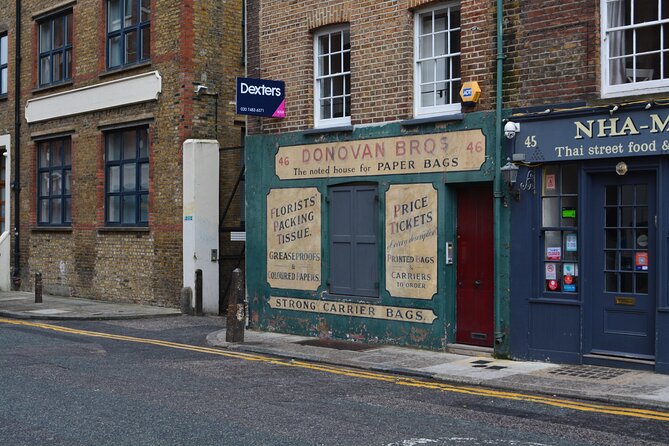
The stop at Petticoat Lane Market is short, about five minutes, but it adds useful economic context. The area was once the heart of the East End textile industry.
That matters because work shaped everything else. Jobs, lodging, migration, street life, and family survival were all tied to trade and manufacturing. A quick look at this former textile center helps you imagine the working neighborhood beyond the murder cases.
Do not expect a long market visit or shopping break here. This is a location stop, not a retail excursion. The benefit is the connection between the street you see and the working life that once filled it.
St Botolph’s Aldgate, Elizabeth Stride, and Catherine Eddowes
At St Botolph’s without Aldgate, the guide introduces Elizabeth Stride, who came from Sweden. Her story includes traumatic beginnings in Gothenburg and later experiences in London.
This section shows that the East End was shaped by movement across borders as well as movement within London. Elizabeth’s background gives the tour another way to discuss how women arrived in the city, what they faced, and how little protection was available to those living on the margins.
The final story concerns Catherine Eddowes, a woman from Wolverhampton whose body was found in Mitre Square. The guide presents her as a person with character and a distinct life, not just as the name attached to a crime scene.
This final portion lasts about 25 minutes and brings the tour to its most reflective point. You hear about the women one by one, but the larger subject is the way poverty, unstable housing, addiction, limited work, and public indifference could combine to make women vulnerable.
The location near Mitre Square also shows how much the modern city has changed. You are not walking through a preserved Victorian set. You are moving through a functioning part of London, with old traces mixed into present-day streets.
How the guides handle a difficult subject
The strongest feature of the experience is the tone. Cecily and Ellie focus on the women and the society around them instead of treating the murders as entertainment.
Cecily is especially noted for speaking clearly and offering information in a way that works for people with hearing difficulties or for those who are not native English speakers. That does not replace checking the group’s position in a noisy street, but it is useful to know if clear delivery matters to you.
The guides also answer questions and offer suggestions for local restaurants, pubs, and shops. Those recommendations can help you extend the evening in the same neighborhood rather than rushing away after the walk.
This is not a tour built around shocking photographs. There are no grisly pictures, and the murder details are not presented in graphic terms. Families with mature children may find the tone suitable, including those around the ages of 12 and 15, though you should decide based on your own child’s comfort with murder and poverty.
Price, pace, and practical value
At $34.28 per person, the tour is reasonably priced for a two-hour guided walk in central London. You are paying for a guide who supplies context, keeps the group moving, and connects scattered sites into one coherent story.
The value is strongest if you would otherwise spend time trying to locate the places yourself and sort fact from myth. Many sites have changed, and some are simply ordinary streets today. Without a guide, you may see the locations but miss the links between them.
The walk includes several stops where you can pause, and the total time is about two hours. Still, it involves steady movement through East London. Comfortable shoes are sensible, and an evening coat or waterproof layer is wise because the experience depends on good weather.
The mobile ticket is convenient, and confirmation is provided at booking. Service animals are allowed, most people can take part, and the tour operates near public transportation. The group is capped at 20 people, and the experience is offered in English.
Free cancellation is available up to 24 hours before the 6:30 pm start time for a full refund. Cancellations or changes within 24 hours are not accepted for a refund. Poor weather or failure to reach the minimum number of participants can lead to a new date or a full refund.
Who should book this East London walk?
I would choose this tour if you want history with a human focus. It suits readers of Hallie Rubenhold’s The Five, people tired of the usual killer-centered treatment, and anyone interested in Victorian working life, women’s history, migration, or urban poverty.
It also works well for families with older children who can handle serious subjects but do not want graphic crime scenes. The small group and clear delivery make it easier to stay engaged than on a large, theatrical walking tour.
You may want something else if you are looking for a fast-paced mystery, a ghost story, or a detailed investigation into Jack the Ripper’s identity. This walk does not promise certainty where the historical record is unclear, and it does not make the killer the star.
Should you book it?
Book it if you want the women remembered as complete human beings, not footnotes to a famous criminal. The route gives you Whitechapel, Brick Lane, Spitalfields, Petticoat Lane, St Botolph’s Aldgate, and Mitre Square, but the real subject is the society that shaped their choices and failed to keep them safe.
At $34.28, the tour offers good value for a thoughtful two-hour introduction to East London. Go with comfortable shoes, an open mind, and realistic expectations about the subject. You will leave with less interest in the legend of Jack the Ripper and more reason to remember the women.
FAQ
Where does the tour begin?
The tour begins at Aldgate High Street, London EC3N 1AH, outside Aldgate station.
What time does the tour start?
The start time is 6:30 pm.
How long does the walking tour last?
The tour lasts approximately two hours.
Where does the tour end?
The stated end point is Spitalfields Market at 65 Brushfield Street, London E1 6AA. The route also finishes close to Mitre Square after discussing Catherine Eddowes, so confirm the final meeting location with the guide if you have evening plans.
Is the tour graphic?
The tour does not use grisly pictures or graphic descriptions of the murders. It does cover murder, poverty, addiction, and trauma, so the subject remains serious.
Can I cancel for a full refund?
Yes. You can cancel at least 24 hours before the experience start time for a full refund. Cancellations or changes made less than 24 hours before the start time are not refunded.
Just added around London
- Up at The O2:Twilight Climb with Guided Tour with Panoramic Views★ 5.0 · 50 reviews
- Private Chauffeur-London Heathrow from/to Southampton Cruise Port★ 5.0 · 9 reviews
- Kensington Palace VIP Garden Tour with Royal High Tea★ 4.5 · 71 reviews
- Secrets of the London Underground Small Group Walking Tour★ 4.5 · 38 reviews
- Urban Canvas: Exploring Shoreditch’s Vibrant Street Art★ 5.0 · 36 reviews
- Up at The O2: Sunset Climb with Guided Tour with Panoramic Views★ 5.0 · 110 reviews
- Ultimate introduction to photography in Central London★ 5.0 · 19 reviews
- Full-Day Self-Guided Paris Tour from London by Eurostar with Seine River Cruise★ 3.5 · 22 reviews
Jack the Ripper Tours, compared.
London Jack the Ripper Guided Tour with Ripper-Vision
Read our review →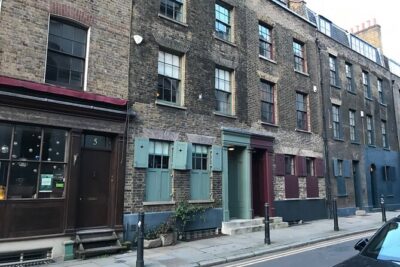
German Language : Original Jack the Ripper Tour
Read our review →
Jack the Ripper Walking Tour – Ripper Vision Tours
Read our review →
Ultimate Jack the Ripper : Guided Tour of London
Read our review →
Browse the lists this tour appears in