Reviewed · LONDON WALKING TOURS
Roman London Private Walking Tour
Roman London is not one grand ruin waiting in a single square. It is a wall under an office block, a bathhouse below a city street, a temple beneath a modern building, and a Roman road hiding in plain sight. This private walk with guides such as Stephen Liddell or Kevin helps you connect those scattered clues.
I like the way the tour reaches places you would likely miss alone, including the Roman amphitheatre, the remains near St Vedast, and the underground Temple of Mithras. I also like the private format, which lets you ask questions and set the pace. The drawback is the walking: you may cover several miles over three to four hours, with few chances for a proper rest.
Key points to know before booking
- Roman ruins beneath modern London: See walls, baths, a temple, an amphitheatre, and fragments of Roman streets hidden under today’s City of London.
- A true private tour: Only your group takes part, so the guide can answer questions and adjust the conversation to your interests.
- Hotel pickup by Tube: A guide can meet you at a Central London hotel and help you reach the starting point by public transport.
- A long urban walk: Comfortable shoes and water matter, especially if you want to keep up with the full route.
- Strong guide-led storytelling: Stephen and Kevin bring in Roman, medieval, Norman, wartime, and modern London along the way.
- Temple access needs planning: Entry to the London Mithraeum is included, but guaranteed access at busy times requires advance booking.
Why this walk reveals a different London
The City of London is compact, but it packs centuries into a small area. Roman Londinium, the medieval city, the Blitz, Victorian commerce, and today’s glass towers all occupy the same streets.
That makes this tour more interesting than a simple march from one ancient wall to another. You might look up at the Gherkin, turn into a narrow passage, and find a Roman memorial. A church may contain an old archway. A modern development may preserve a fragment of the city wall below ground.
The guides also bring in later London. Their stories can move from Roman engineering to medieval churches, the Great Fire, the Blitz, Dickens, Shakespeare, and the modern City. If you want only dates and archaeological labels, this may feel wide-ranging. If you want to understand how London kept building over its earlier selves, that range is a major benefit.
More London Walking Tours:
- Magical London: Harry Potter Guided Walking Tour
★ 4.7 · 22,044 reviews - London: The Original Jack the Ripper Walking Tour
★ 4.7 · 7,833 reviews - Tour for Muggles The Ultimate Harry Potter Walking Tour in London
★ 5.0 · 4,684 reviews
Starting beneath St Paul’s Cathedral
The walk begins around 9:30 a.m. near Panyer Alley, close to St Paul’s Cathedral. Pickup can be arranged from a Central London hotel, followed by a Tube journey to the meeting area. Transportation to and from the attractions is not included, so you should expect to pay your own public transport fare.
St Paul’s is an effective opening point. The cathedral occupies a place with much older religious connections, and the tour explains the Roman association with a temple dedicated to Diana. You do not enter St Paul’s as part of this experience, and its admission fee is not included, but the setting gives you a quick lesson in how sacred sites can retain importance over many centuries.
Nearby, the Church of St Vedast Alias Foster offers an early surprise. The first Roman remains are tucked away from the main street, along with something older. The stop is brief, only around five minutes, but it sets the tone: you need a guide who knows where to look.
Following the Roman wall through alleys and bomb sites
At Noble Street, you see a section of Roman wall whose discovery was linked to wartime bombing by the Luftwaffe. The damage exposed parts of old London that had been covered by later construction. It is a striking reminder that modern destruction sometimes revealed ancient remains.
The route continues toward Cripplegate Street, one of the old Roman gates. Nearby sections of the wall are well preserved, and the guide explains how the defensive circuit once enclosed the city. You will see the wall again at several points, including places where a visitor might expect nothing older than an office, road, or parking area.
This part of the walk is especially useful because the Roman wall does not appear as one continuous monument. You see fragments, altered sections, and pieces incorporated into later buildings. The guide’s job is to make those scattered remains part of one understandable city plan.
Guildhall and the Roman amphitheatre
Guildhall is the historic center of the City of London Corporation. Its square looks formal and civic today, but the Roman connections are close at hand. The exterior visit is short, and entry to some parts is not included, so do not expect a long indoor tour of the building.
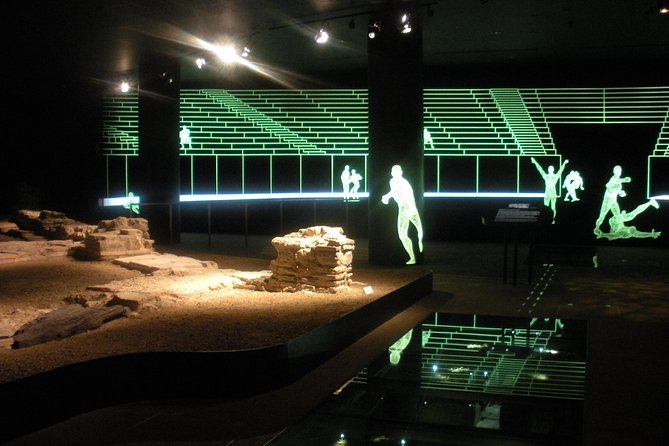
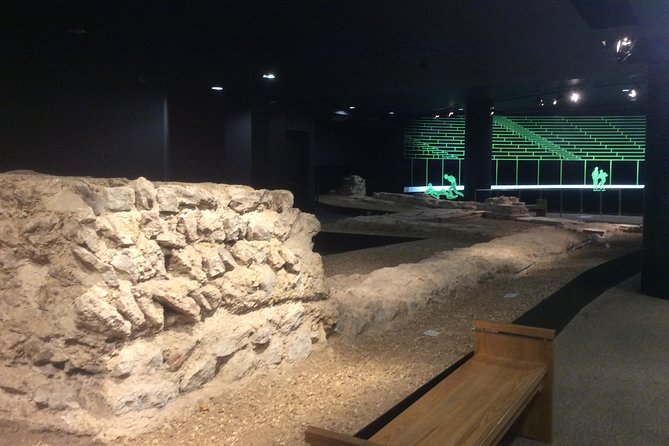
The major stop here is London’s Roman amphitheatre. Beneath the current streets, you can stand where gladiatorial contests took place. The amphitheatre was discovered only a few decades ago, and the preserved remains give the Roman city a human scale that a wall alone cannot provide.
This is one of the strongest parts of the experience. A wall tells you where the city ended. An amphitheatre suggests how people gathered, watched spectacles, and spent leisure time. Admission is included, and the visit lasts around 25 minutes.
The route also passes the old official residence of the Lord Mayor of London. This is one of several points where the walk moves beyond Roman remains and shows how the City continued to function as a place of power.
A different sort of day out in London altogether:
- From London: Harry Potter Warner Bros Studio Tour
★ 4.7 · 26,588 reviews - London: Westminster to Greenwich River Thames Cruise
★ 4.5 · 22,836 reviews - London: Madame Tussauds London
★ 4.6 · 20,915 reviews - Stonehenge, Windsor Castle, and Bath from London
★ 4.5 · 18,662 reviews
Bank, the Royal Exchange, and Leadenhall Market
At the Bank of England, the guide places you near the heart of old Roman London. The buildings here are imposing, but the point is not simply their architecture. It is the relationship between today’s financial center and the ancient settlement beneath it.
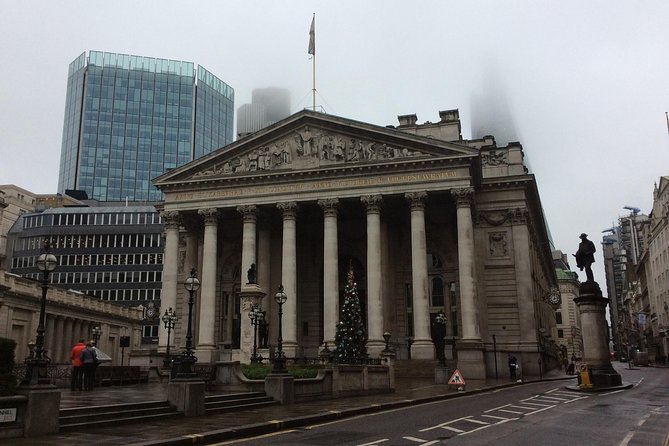
The Royal Exchange provides another strong visual comparison. Its grand stone frontage can make you think of imperial Rome, even though the current building belongs to a much later period. The tour uses such contrasts well, linking London’s commercial life across time without pretending that every modern building is Roman.
Leadenhall Market adds atmosphere and a useful archaeological connection. The Victorian market was built over its Roman predecessor, and you may see a section of the earlier remains. The stop lasts around 15 minutes and works as a good place to pause for a look around, though it is still part of a walking route rather than a meal break.
You then pass 30 St Mary Axe, better known as the Gherkin. Beneath this famous modern landmark is an unexpected Roman memorial. Nearby, the Tomb of the Unknown Roman Girl offers a more personal reminder of the people who lived in Londinium. The memorial is brief, but it gives the Roman period a human face.
Aldgate, Vine Street, and Emperor Trajan
At Aldgate Square, the Roman gate remains buried below the newly landscaped park. You can trace the route of the wall and understand the position of the old entrance, even without seeing a large exposed gate.
Vine Street adds another archaeological stop. It is connected with London’s newest museum and includes sections of Roman wall and artefacts. This is the sort of location that rewards a local guide because it is easy to walk past without knowing what lies nearby.
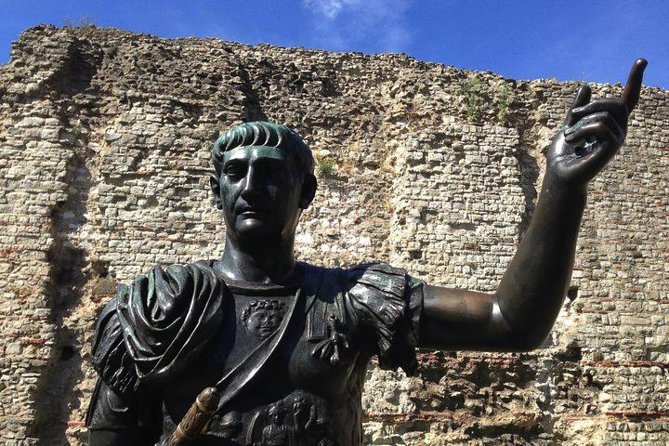
Outside the Tower of London, you see a statue of Emperor Trajan. The Tower itself is not the focus of this tour, and you should not expect an interior visit. Still, the location helps show how the Roman and later defensive histories of London overlap.
The route then reaches more sections of London Wall. Since the wall appears in several places during the walk, this later stop gives you another chance to compare how different portions have survived. Some sections are displayed openly, while others are integrated into modern surroundings.
All Hallows by the Tower and St Dunstan in the East
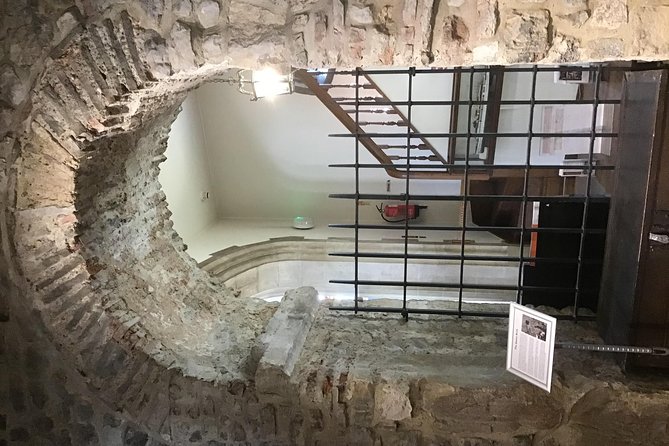
All Hallows by the Tower is one of the more layered stops. Inside and around the church, you can see the oldest archway in London along with the remains of a Roman house. Entry is included, and the visit takes about 15 minutes.
This is where the tour’s wider historical reach becomes clear. Roman remains sit alongside a much later church, and the guide can explain how religious buildings and city streets changed around them.
St Dunstan in the East is not strictly Roman, but it may be one of the most memorable places on the route. Its ruined church has become a quiet garden among the City’s buildings. The stop is a change of pace after walls, roads, and commercial centers.
I would not book the tour solely for St Dunstan in the East, but I would welcome the pause. It adds beauty and breathing room to a route that can otherwise feel dense with information.
Roman baths, London Bridge, and the Great Fire
The Billingsgate Roman Bath House marks the location of Roman baths in London. The visit is short, around five minutes, and admission is not included. Since the stop concerns a location rather than a large museum visit, the guide’s explanation matters more than the amount of exposed stone.
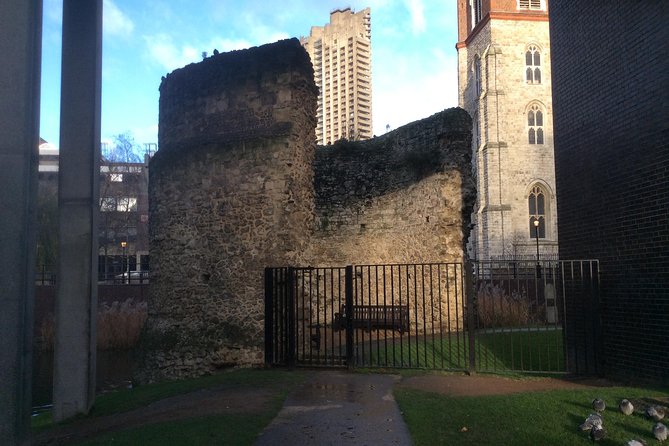
At St Magnus the Martyr, you find what may be the only remaining part of the original Roman London Bridge. The church itself is included, and this stop helps you picture how the Roman settlement connected to the river and its crossing.
The Monument to the Great Fire of London shifts the story forward by many centuries. You stand near the place where the fire began and see material that helps show what Roman Londinium may have looked like 2,000 years ago. The Monument is not included as an interior visit, but the location makes a useful link between Roman London and one of the city’s defining later disasters.
These stops show why this tour is not only for Roman specialists. You get the ancient city, but you also get the layers that followed it. The result is a clearer picture of London as a city repeatedly rebuilt rather than replaced.
The London Mithraeum, the tour’s grand finale
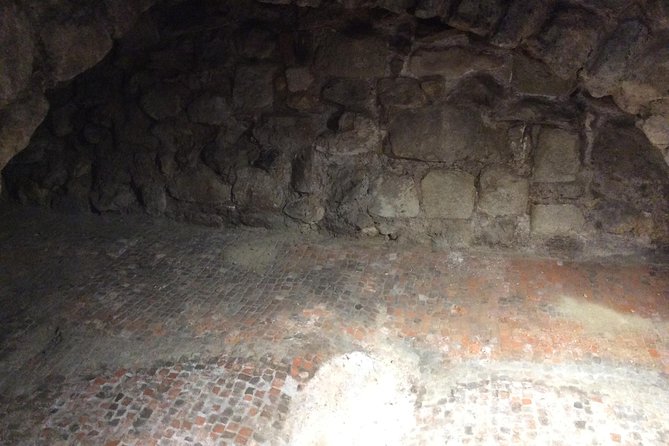
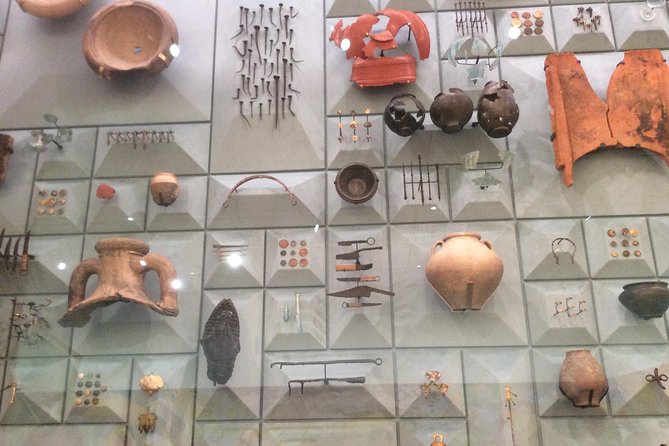
The final major attraction is the London Mithraeum Bloomberg SPACE. You first see hundreds of Roman artefacts before going underground to the former Temple of Mithras.
This is the tour’s most atmospheric archaeological stop. A temple beneath a modern development captures the entire theme of the walk: Roman London is still present, but usually below, behind, or inside the newer city.
Admission is included, but guaranteed temple access during peak periods requires advance booking. That detail matters. Ask about the reservation when you book, particularly if the Mithraeum is the main reason you want the tour.
The walk ends at the Mithraeum, at 12 Walbrook, close to Bank Underground Station. You are still in central London, only a short distance from the starting area, so it is easy to continue sightseeing afterward.
How much walking should you expect?
The stated duration is about three to four hours, but the exact length can vary. One account describes more than seven miles, while another recommends being able to walk for three solid hours without a break. Treat this as an active urban walk, not a gentle stroll.
The pace is generally described as reasonable, but the number of stops means you will spend much of the morning on your feet. Wear your best walking shoes, carry water, and dress for changeable weather. The tour operates in all weather conditions, and smart casual clothing is requested.
There are many short stops of two to ten minutes, mixed with longer visits at the amphitheatre, churches, and Mithraeum. If you need frequent seating or have limited walking ability, ask about the route before booking. A moderate level of physical fitness is recommended.
What the private format is worth
The price is listed at $254.93 per person. That is a serious cost for a walking tour, especially if you are traveling alone. The value improves for a small private group because the price buys a dedicated guide rather than a standard large-group outing.
The private format also matters for this subject. Roman remains are scattered, sometimes obscure, and often hard to interpret without questions. You can ask why a wall survives in one place but disappears in another, or shift the conversation toward Roman engineering, medieval London, the Blitz, or modern architecture.
Group discounts may be available, and the tour is offered in English. The strong point is not the number of admissions included. Several stops are free, while some attractions are not included. The value lies in the route, the access, the guide’s local knowledge, and the time saved hunting for places that are easy to miss.
Guides Stephen Liddell and Kevin receive repeated praise for their storytelling, warmth, and ability to answer questions. Their style appears to be conversational rather than scripted. That suits a private tour, though the amount of information may feel intense if you prefer a short, quiet walk.
Who should book this Roman London tour?
I would choose this experience if you enjoy archaeology, city history, churches, old walls, and the strange details that rarely appear on a first-time London itinerary. It is also a good choice if you want Roman London explained in relation to the medieval, Victorian, wartime, and modern city.
Families with older teenagers may enjoy it, especially those who can manage several hours of walking. The tour has been enjoyed by groups with teenagers, but younger children may find the long sequence of historical explanations tiring.
You should think twice if you want a relaxed sightseeing tour with plenty of sitting, or if your main goal is to visit St Paul’s Cathedral, the Tower of London, or the Monument interiors. Those attractions appear as landmarks along the route, not as full visits.
Free cancellation is available up to 24 hours before the start time. Changes or cancellations inside that window are not accepted for a refund.
Should you book it?
Book this tour if you want to see Roman London in fragments and connections, not just admire one famous ruin. The Roman amphitheatre, the wall, the bathhouse, the possible bridge remains, and the Temple of Mithras create a strong route, while the guide fills in the gaps between them.
The decision comes down to stamina and interest. For a history-minded visitor who values a private guide and can walk several miles, the price can be worthwhile. For a casual sightseer or anyone needing a slow pace, choose a shorter experience and visit the Mithraeum separately.
FAQ
Where does the Roman London tour start?
The tour starts at Panyer Alley, London EC2V 6AA, near St Paul’s Cathedral. The stated start time is 9:30 a.m.
Can the guide collect me from my hotel?
Yes. Pickup can be arranged from any Central London hotel, not only specific listed hotels. The guide then travels with you by Tube to the starting point.
Where does the tour end?
The tour ends at the London Mithraeum Bloomberg SPACE, 12 Walbrook, London EC4N 8AA. It is beside Bank Underground Station and close to the starting area.
How long does the tour last?
The tour lasts approximately three to four hours.
Is this a private experience?
Yes. Only your group takes part in the tour.
Is transportation included?
Transportation to and from the attractions is not included. If you use the hotel pickup option, you travel to the starting point by public transport.
Is admission to the London Mithraeum included?
Yes, admission to the London Mithraeum Bloomberg SPACE is included. Guaranteed access to the temple during peak periods requires advance booking.
Is the Roman amphitheatre included?
Yes. Admission to London’s Roman Amphitheatre is included, and the visit lasts about 25 minutes.
How physically demanding is the walk?
A moderate level of physical fitness is recommended. You should be prepared to walk for about three hours or more, and some accounts describe a route of more than seven miles.
What happens if I need to cancel?
You can cancel for a full refund up to 24 hours before the experience start time. Cancellations or changes made less than 24 hours before the start time are not accepted for a refund.
Just added around London
- Kensington Palace VIP Garden Tour with Royal High Tea★ 4.5 · 71 reviews
- Up at The O2:Twilight Climb with Guided Tour with Panoramic Views★ 5.0 · 50 reviews
- Private Chauffeur-London Heathrow from/to Southampton Cruise Port★ 5.0 · 9 reviews
- Up at The O2: Sunset Climb with Guided Tour with Panoramic Views★ 5.0 · 110 reviews
- Secrets of the London Underground Small Group Walking Tour★ 4.5 · 38 reviews
- Urban Canvas: Exploring Shoreditch’s Vibrant Street Art★ 5.0 · 36 reviews
- Ultimate introduction to photography in Central London★ 5.0 · 19 reviews
- Full-Day Self-Guided Paris Tour from London by Eurostar with Seine River Cruise★ 3.5 · 22 reviews
London Walking Tours, compared.

Magical London: Harry Potter Guided Walking Tour
Read our review →

Tour for Muggles The Ultimate Harry Potter Walking Tour in London
Read our review →

Harry Potter Movies Walking Tour (Kids Go Free)
Read our review →
Changing of the Guard Guided Walking Tour in London
Read our review →
The Great British Rock and Roll Music Walking Tour
Read our review →