
Reviewed · LONDON MUSIC AND ROCK TOURS
Private Rock ‘n’ Roll Music Tour of Central London
The most fun part of this private London walking tour is the way ordinary streets turn into rock-and-roll evidence. A theatre doorway, a pub, a bookshop, and a dusty plaque each carry a story about the Beatles, David Bowie, the Rolling Stones, Pink Floyd, and punk.
I like the small private format, which lets you stop the guide and ask questions instead of following a fixed script. I also like the unusual stops, from the former Bag O’Nails club where Paul McCartney met Linda, to the alley containing the Trident Studios plaque. The main drawback is pace: 17 stops in about three hours means much of the tour happens outside, with short visits rather than long interior explorations.
- The Beatles’ rooftop concert: See 3 Savile Row, the former Apple headquarters and site of the Beatles’ final live performance.
- David Bowie’s London: Recreate Ziggy Stardust album-cover photos on Heddon Street and hear about Bowie’s retirement of the character at Hotel Café Royal.
- A private guide named Michael: Michael is praised for keeping the walk entertaining while sharing a large store of rock stories.
- Soho’s club circuit: Follow the Marquee Club, The Ship, Trident Studios, and the former Bricklayers Arms pub.
- A strong final stop: Denmark Street ties together the Beatles, Rolling Stones, Sex Pistols, Elton John, and Bowie.
- Good value for a group: The $205.67 price covers up to 15 people, so the cost per person falls sharply when shared by several friends or family members.
From Beatlemania at the London Palladium
The tour begins outside the London Palladium on Argyll Street, a fitting place to start. This famous theatre hosted major music acts and was linked to Sunday Night at the London Palladium, one of Britain’s best-known television programs.
Your guide explains how Beatlemania took hold here. The Rolling Stones also appeared at the theatre, but they refused to follow the usual custom at the end of a performance. That small detail gives you a sense of the evening’s tone: this is not only a list of famous names, but a collection of odd decisions, backstage behavior, and moments when music culture began to change.
You spend about 10 minutes here, with no admission ticket required. The theatre is mainly an exterior starting point, so you should not expect a backstage visit or a performance inside.
The BBC, John Peel, and Pink Floyd’s first steps
At Broadcasting House, you look at the BBC headquarters and hear how radio helped shape British popular music. A wing is named for John Peel, the influential DJ and music champion.
The BBC supported many artists, but its relationship with rock and pop was not always easy. Some records were banned from the airwaves, and your guide uses this stop to explain how broadcasters helped decide what the public could hear.
The route then touches a former university building that was once the London Polytechnic. In September 1962, Roger Waters, Nick Mason, and Richard Wright enrolled there to study architecture. They rehearsed in a basement tea room as a band called Sigma 6. Syd Barrett later joined, and Pink Floyd began to take shape.
This is one of the tour’s best details because it connects a plain academic building with the early lives of musicians who would later fill arenas. It also gives the tour some variety. You are not only following concert halls and clubs; you are seeing the places where musicians studied, worked, and rehearsed before success arrived.
More London Music and Rock Tours:
- London: The Great British Rock and Roll Music Walking Tour
★ 4.9 · 1,783 reviews - The Great British Rock and Roll Walking Tour
★ 5.0 · 1,371 reviews - London: ABBA Voyage Express Bus and Optional Concert Ticket
★ 4.6 · 1,065 reviews
Carnaby Street and the look of swinging London
Carnaby Street brings the tour into the fashion side of music. In the 1960s, the street became associated with the bold clothes worn by bands such as the Small Faces, The Who, and the Rolling Stones.
Your guide explains that the flamboyant style had roots in the 1950s, rather than appearing from nowhere in the decade that made Carnaby Street famous. You also hear about music promoter and manager Don Arden, an important figure in the period.
This stop works best if you care about the link between sound and appearance. Bands were selling a complete identity, and clothing helped separate the new generation from what came before. The stop lasts about 10 minutes and is free to view from the street.
Nearby Kingly Street takes you to the former site of the Bag O’Nails. In the 1960s, the club attracted the Jimi Hendrix Experience, The Who, The Animals, and Tom Jones. It was also where several musicians met their future wives, including Paul McCartney, who met Linda in 1967.
The building itself may not offer a grand museum experience, but the location matters. You are standing where musicians gathered socially, not just where they performed under stage lights.
Ziggy Stardust on Heddon Street
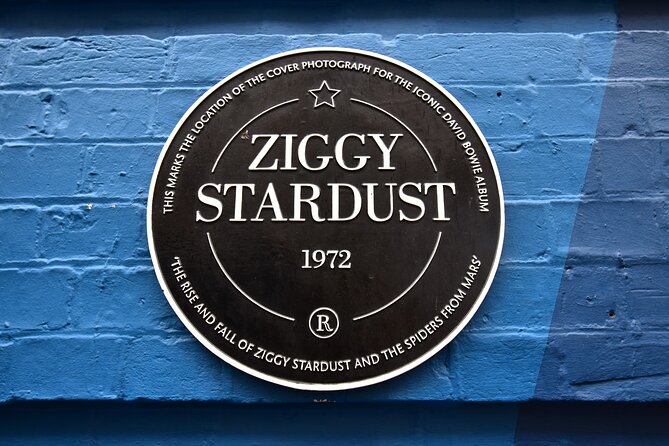
Heddon Street is one of the most photographable stops. It provided the setting for the front and back cover photographs of The Rise and Fall of Ziggy Stardust and the Spiders From Mars.
The guide tells the story of the photo session, which took place on a cold, wet January night in 1972. You get a chance to recreate the famous images, making this more active than simply looking at a plaque.
The stop is especially useful for Bowie fans, but you do not need to know every album to enjoy it. The photos show how strongly London streets became part of a performer’s public identity. Bring a phone or camera if you want to copy the poses, though the tour information only promises the chance to recreate the pictures, not professional photography.
The Beatles at 3 Savile Row
At 3 Savile Row, you see the former office of the Beatles’ Apple organization and the site of the famous rooftop concert in 1969. The performance appeared in Let It Be and later became a central part of Get Back.
This was the Beatles’ final live performance, and the building drew fans from around the world when the Apple office operated there. Your guide also discusses some of the interesting visitors connected with the office.
The power of this stop comes from its ordinariness. The rooftop is part of a working London building, not a preserved concert stage. You are looking at the place where the Beatles played their last public show, while everyday city life continues below.
For Beatles fans, this may be the emotional high point of the walk. It is an exterior visit, so the value lies in the guide’s storytelling and your own knowledge of the film footage.
More Private:
- The Premier Classic London: Private 4-Hour Tour in a Black Cab
★ 5.0 · 2,737 reviews - Stonehenge Inner Circle Private Tour from London with Bath Visit
★ 5.0 · 1,909 reviews - London: Tower of London Entry & Beefeater Private Audience
★ 4.4 · 1,441 reviews - Private Tour: Black Taxi Tour of London
★ 5.0 · 1,153 reviews
Eric Clapton, Bowie, and the changing Soho circuit
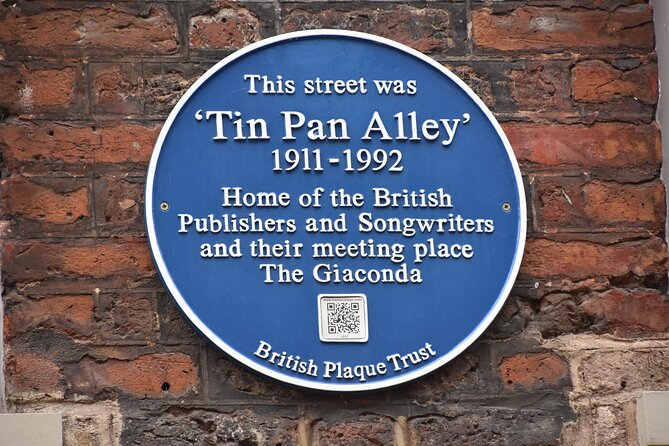
At Cordings, a clothing shop on Piccadilly, you hear about Eric Clapton’s long connection with the business. As a teenager, he window-shopped there and hoped one day he could afford its clothes. Years later, he became a regular customer, invested in the company, and served as its design director.
It is a neat reminder that rock stories are not limited to guitars and clubs. Clothing, money, taste, and public image all shaped these musicians’ careers.
Hotel Café Royal adds another Bowie chapter. The building began as a café in 1865, and in 1973 Bowie held a lavish event there to retire Ziggy Stardust. The story later inspired a Ziggy Stardust cocktail bar inside the hotel.
You spend roughly 10 minutes at each of these locations. They are exterior-focused stops, but they add useful context to the Bowie material you saw on Heddon Street.
The Marquee Club, The Ship, and Trident Studios
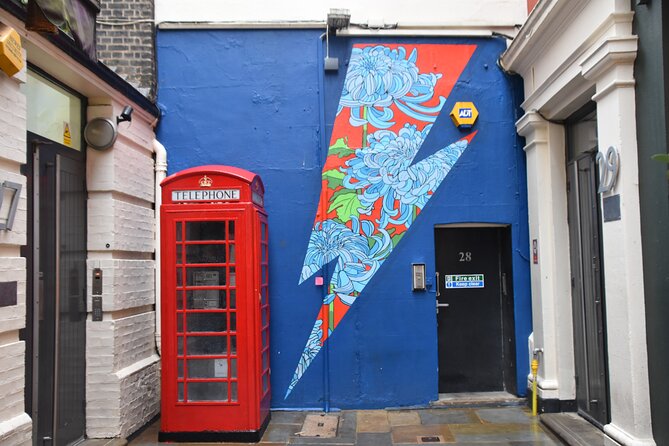
Wardour Street was once home to the Marquee Club, a major venue that operated for 26 years. The club helped launch the early careers of The Who, David Bowie, and many other performers.
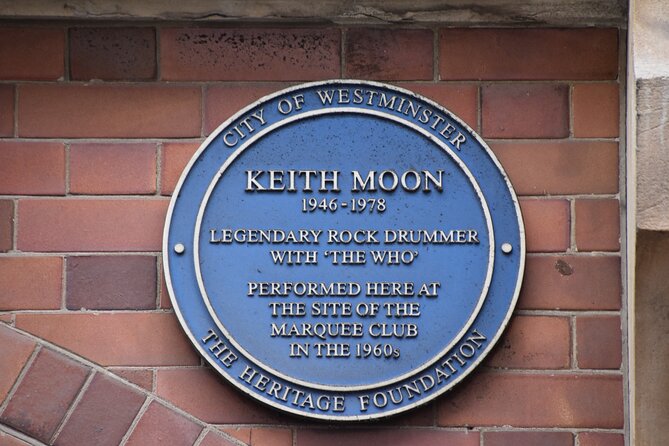
The guide also explains the plaque to Keith Moon over a doorway. It is a small marker, but those are often the details that reward careful looking. The club itself is gone, so you need the guide to reconstruct what made the venue important.
At Sounds of the Universe record shop, you stand on the former site of the Bricklayers Arms pub. The Rolling Stones held their first rehearsal there. The current shop gives you a direct connection to London’s continuing record culture, even though the original pub has disappeared.
The Ship pub became a gathering place after the Marquee lost its alcohol licence. Music fans went there, and performers followed. The stop focuses on the drinking habits and drunken antics of rock figures, so it has a lighter, less polished feel than the Beatles and Bowie sites.
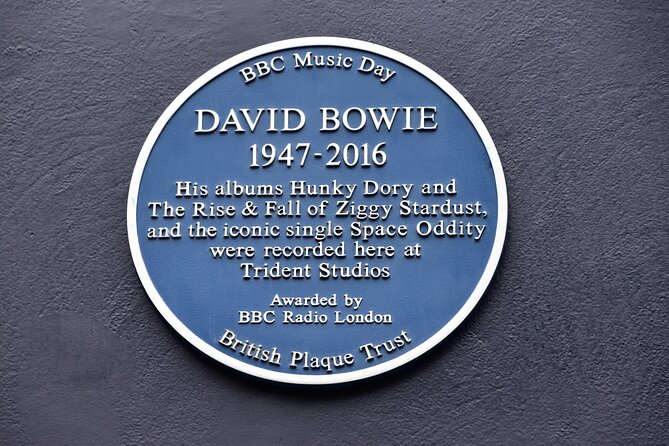
A short walk takes you to the Trident Studios plaque in a small alley. Between 1968 and 1981, the studio was used by David Bowie, the Beatles, Queen, Elton John, the Rolling Stones, and Black Sabbath.
This is one of my favorite kinds of stop: easy to miss, but loaded with significance. The plaque does not replace a studio tour, and you should not expect to enter the recording rooms. Still, the list of artists shows how much music was made in this small part of Soho.
Paul McCartney’s publishing business and Ronnie Scott’s
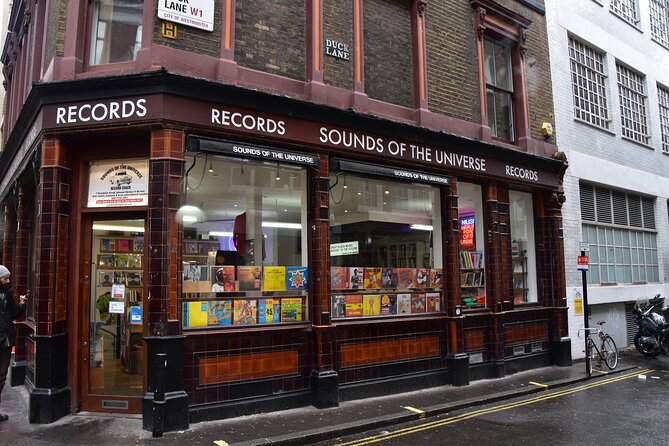
Soho Square is home to MPL, or McCartney Publishing Limited. Here, the guide explains how Paul McCartney’s music publishing business helped make him the richest of the Beatles.
This stop broadens the story beyond live music. Song rights and publishing can be as important as record sales, and McCartney’s business life is a useful counterpoint to the more familiar tales of clubs and concerts.
Ronnie Scott’s Jazz Club on Frith Street has hosted many famous performers since Ronnie Scott moved the club there in 1965. You hear about notable appearances, including a surprising Lady Gaga performance and Jimi Hendrix’s final performance.
The club is not included as an admission visit, so you see the exterior and hear the story from outside. That is typical of the tour. You are tracing locations across central London, not entering every venue.
Brian Epstein, the Sex Pistols, and Denmark Street
At the ODEON Covent Garden, you learn how Beatles manager Brian Epstein bought a theatre in 1966. His plans, the artists who appeared there, and the idea of reviving the spirit of the 1960s make this a curious stop for anyone interested in music business and performance venues.
Foyles Bookshop occupies what was once a university building. The Sex Pistols played their first gig there, and the guide explains why manager Malcolm McLaren booked the band mainly for student events in the early days. You also hear where Steve Jones obtained the band’s guitars.
The final destination is Denmark Street, one of the most important music streets in 20th-century British culture. It is now known for guitar shops and music venues, but its earlier connections are wide-ranging.
The Beatles’ first music publishing deal was made here. The Rolling Stones recorded their first album on the street. The Sex Pistols rehearsed and caused trouble here, and John Lydon drew rude pictures on a wall that were reportedly still visible when the tour details were prepared.
You also hear about Denmark Street’s role in the early careers of Elton John and David Bowie. Ending here makes sense because the street connects musicians, instruments, publishers, rehearsal rooms, and recording work in one compact area.
What the three-hour format means
The tour lasts about three hours and includes around 17 stops. Most stops take between five and 10 minutes, while Sounds of the Universe receives about 15 minutes.
That schedule keeps the walk moving, but it also means you should expect short explanations at many sites. You will not get a long museum visit, a complete concert-history lecture, or extended time inside clubs and studios. Instead, the guide links many places into one story.
The route runs from the London Palladium to Denmark Street. It crosses central London streets and Soho, so comfortable shoes and a moderate level of fitness make sense. The tour is offered in English, uses a mobile ticket, and is available only to your own group.
A private guide makes the format more flexible. Michael, who guided one reported booking, was especially good at keeping the stories moving and answering questions. One account even notes an unexpected snatch-and-grab crime seen during the walk. That incident was not part of the tour, of course, but it illustrates that you are moving through active city streets rather than a sealed historic site.
Is $205.67 good value?
The price is $205.67 per group of up to 15 people. For one or two people, that is a fairly expensive walking tour. For a family or group of friends, the calculation changes quickly. Ten people would pay about $20.57 each, and 15 people would pay about $13.71 each.
The price includes guiding fees, and the private arrangement means you are not paying to join a large public group. You can ask about a favorite band, linger over a Beatles question, or request more detail about punk, Bowie, jazz, or recording studios.
I would judge the value by your interest level. If you simply want a general London walk, this is too specialized. If your group already talks about albums, venues, and musicians, the concentration of sites can make the cost worthwhile.
The tour has a five-star rating from seven reviews, with particular praise for Michael’s entertaining stories and broad command of the subject. That is a small sample, so I would treat it as encouraging rather than conclusive. The strongest reason to book is the private access to a guide who can shape the conversation around your interests.
Who should book this walk?
I would choose this tour for Beatles fans, Bowie fans, classic-rock listeners, and anyone interested in the connection between music, fashion, publishing, and London nightlife. It also suits a group that wants something more focused than a standard city sightseeing tour.
You should be comfortable spending about three hours on foot and viewing many locations from outside. The tour is less suitable if you want to enter historic venues, listen to live music, or visit a large exhibition.
Service animals are allowed, and the route is near public transportation. The tour requires moderate physical fitness. Free cancellation is available if you cancel at least 24 hours before the start time, which gives you some flexibility when planning your London days.
Should you book the Central London rock tour?
Book it if you want the stories behind the streets, not just a photograph in front of a famous building. The best moments are the small links: Paul McCartney meeting Linda at the Bag O’Nails, Pink Floyd rehearsing in a basement tea room, Bowie retiring Ziggy Stardust at Café Royal, and the Beatles playing their final concert at 3 Savile Row.
Skip it if your interest in rock music is casual or if you prefer indoor attractions. But for a music-loving group, this private walk packs a remarkable number of names and turning points into three hours, with enough freedom to ask questions and follow your own interests.
FAQ
Where does the tour begin?
The tour begins outside the London Palladium at 8 Argyll Street, London W1F 7TF.
Where does the tour finish?
The tour finishes on Denmark Street, London WC2H.
How long does the tour last?
The tour lasts approximately three hours.
Is this a private tour?
Yes. Only your group participates, with a maximum group size of 15 people.
What language is the tour offered in?
The tour is offered in English.
Is admission to the attractions included?
The guiding fees are included. Most listed stops are viewed from outside and have no admission ticket. Admission is not included at Ronnie Scott’s Jazz Club, the ODEON Covent Garden, and Denmark Street.
Who might enjoy this tour?
It is suited to music lovers interested in the Beatles, David Bowie, the Rolling Stones, Pink Floyd, the Sex Pistols, and London’s historic music venues.
Is the tour physically demanding?
A moderate level of physical fitness is recommended because this is a central London walking tour lasting about three hours.
Can I cancel for a full refund?
Yes. You can cancel at least 24 hours before the experience start time for a full refund. Cancellations made less than 24 hours before the start time are not refunded.
Just added around London
- Kensington Palace VIP Garden Tour with Royal High Tea★ 4.5 · 71 reviews
- Up at The O2:Twilight Climb with Guided Tour with Panoramic Views★ 5.0 · 50 reviews
- Private Chauffeur-London Heathrow from/to Southampton Cruise Port★ 5.0 · 9 reviews
- Up at The O2: Sunset Climb with Guided Tour with Panoramic Views★ 5.0 · 110 reviews
- Secrets of the London Underground Small Group Walking Tour★ 4.5 · 38 reviews
- Urban Canvas: Exploring Shoreditch’s Vibrant Street Art★ 5.0 · 36 reviews
- Ultimate introduction to photography in Central London★ 5.0 · 19 reviews
- Full-Day Self-Guided Paris Tour from London by Eurostar with Seine River Cruise★ 3.5 · 22 reviews
London Music and Rock Tours, compared.
The Great British Rock and Roll Music Walking Tour
Read our review →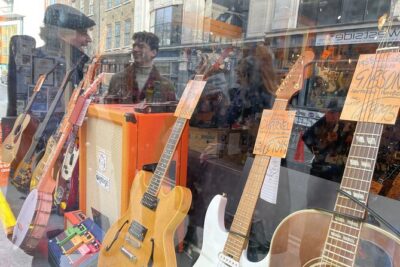
ABBA Voyage Express Bus and Optional Concert Ticket
Read our review →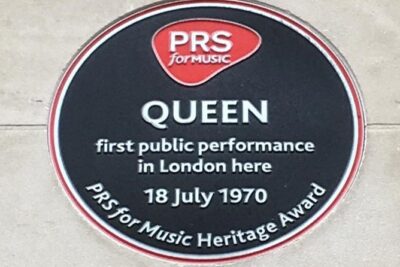
Browse the lists this tour appears in