

Reviewed · HIDDEN LONDON WALKING TOURS
London’s Hidden Gems and Secret History Private Guided Tour
London’s old City is full of places most sightseeing routes skip: legal courtyards, candlelit pubs, Roman paving, a church crypt, and narrow lanes with wonderfully odd names. This private walk with Richard of Richards Tours connects those spots into one lively story, from Temple to Monument.
I like the small private format, since Richard can spend more time on Dickens, Roman London, the law courts, or literary connections that catch your interest. I also like the route’s variety: one moment you are in an ancient church crypt, and the next you are standing outside the Bank of England or a pub barely changed since the 17th century.
The main consideration is the walking. The route lasts about 3 to 4 hours and uses passageways, alleys, streets, and market areas. The advertised price is $267.48 per group up to 1, so this makes the most sense if you value a personal guide and can fill the time with subjects you care about.
Five things to know before you book
- Dickens is woven through the walk: You visit Ye Olde Cheshire Cheese, the George and Vulture, and places tied to A Christmas Carol and The Pickwick Papers.
- The route leaves the main tourist trail: Temple’s Inns of Court, Hanging Sword Alley, St Bride’s crypt, and Cornhill’s unusual details are the real draw.
- Richard shapes the talk around you: He can spend less time on topics that do not interest you and more time on literature, architecture, law, or London’s older layers.
- You finish beside the Monument: The tour ends near Monument Underground Station, with the option to climb its 311 steps at your own expense.
- Expect a proper city walk: Most stops are short, but the whole route covers a lot of ground and includes places where seating or facilities may be limited.
Why this London walk feels different
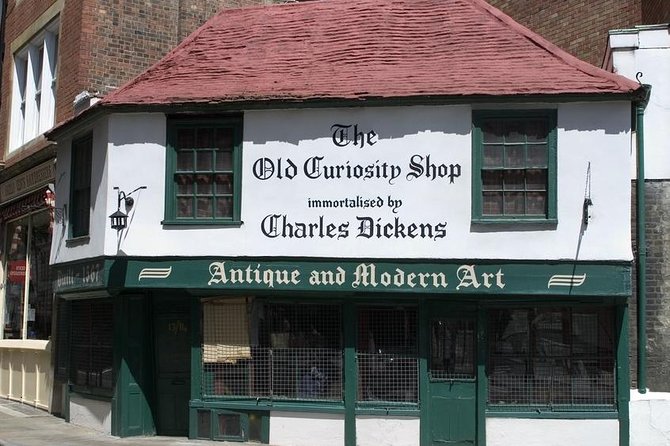
Many London tours move from one famous landmark to the next. This one works by accumulation. A narrow alley leads to a church. A church crypt reveals Roman paving. A pub opens a window onto Dickens. Then a market or financial building adds another layer to the same old streets.
That approach suits you if you have already seen the obvious sights or if you want London to feel less like a checklist. The route crosses the old City of London, where some street patterns reach back to Roman times. You are not simply being shown old buildings. You are being helped to connect streets, writers, executions, fires, markets, churches, and modern finance.
Richard is the guide named in the supplied tour details and the personal accounts. The strongest praise centers on his ability to tell stories and adjust the walk to the group. One especially useful detail is that he can move quickly through subjects that do not interest you and spend longer on the ones that do. That matters on a private tour, where the value comes from conversation rather than a fixed speech.
The tour starts at 10:00 a.m. The published meeting point is Embankment Station, while the tour information also says hotel pickup and drop-off are included. Confirm the exact pickup arrangement when you book, since those two details do not describe the same starting procedure.
More Hidden London Walking Tours:
- Secret London Tour by Bike
★ 4.8 · 557 reviews - Hidden London Walking Tour
★ 5.0 · 378 reviews - London Soho Food Tour with 7+ Tastings of Delicious Hidden Gems
★ 5.0 · 366 reviews
Temple and the Inns of Court
The first substantial stop is the Honourable Society of the Middle Temple, reached from Temple Station and the surrounding legal quarter. This is one of the best reasons to choose this experience. The Inns of Court are working legal institutions, not just preserved museum scenery, and they are easy to miss if you stay on the main roads.
Richard points out the old courtyards, alleys, taverns, and buildings tied to London’s legal world. You also hear about the place where Shakespeare first performed Twelfth Night, the fountain that inspired Charles Dickens, and the English headquarters of the Knights Templar.
The stop lasts about 45 minutes and has no admission charge. That is a generous opening section, and it gives the guide time to explain how this part of London developed. You may also visit a tea shop that has sold tea for more than 300 years, a small detail that adds character without requiring a formal attraction ticket.
This section is best for you if you enjoy places that still feel connected to their original use. It is less suited to anyone who wants a quick march toward major landmarks. The charm here lies in the lanes, courtyards, and stories between the headline sights.
St Bride’s crypt and the layers beneath Fleet Street
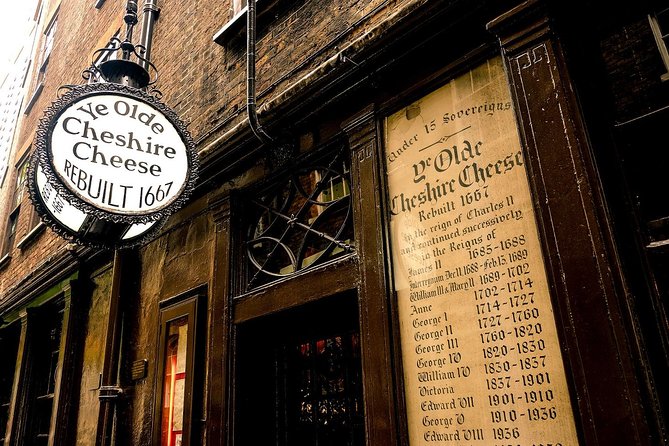
The route then slips through older passageways, including Hanging Sword Alley, before reaching St Bride’s Church. The church is associated with Fleet Street newspapers and is often called the Cathedral of the Press.
St Bride’s has had a hard life. The Great Fire of London damaged it, and Sir Christopher Wren later remodeled the church. During the Second World War, a bomb destroyed the roof. The damage led archaeologists to examine the lower levels more closely, revealing earlier remains.
The 20-minute visit includes the church’s crypt museum, where you can see a hidden medieval chapel, charred material linked to the 1666 fire, and Roman pavements. This is one of the tour’s clearest examples of London’s layers sitting almost on top of one another.
Admission is included here, unlike at some of the other stops. The crypt is also a good change of pace after the outdoor walking. You get a short period indoors, with a chance to focus on physical evidence rather than only listening to stories.
The church has another claim to fame, which Richard explains during the visit. The supplied details do not spell out that point, so do not book this expecting a particular surprise. The value is in seeing the crypt and hearing how fire, war, archaeology, and the newspaper trade shaped the site.
Ye Olde Cheshire Cheese and Dickens after dark
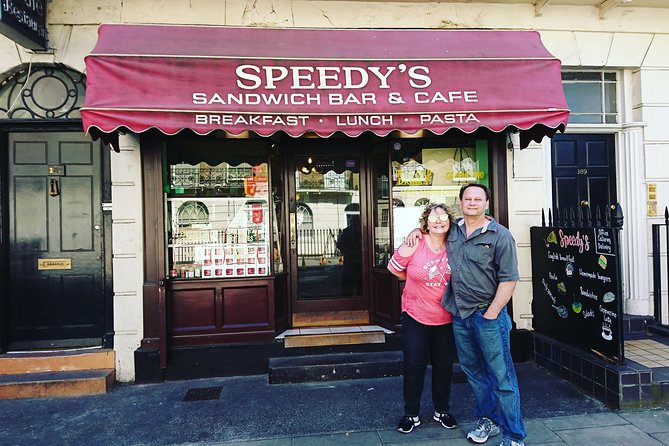
Ye Olde Cheshire Cheese is one of the route’s most atmospheric stops. Its cellars date to the 13th century, while the upper rooms were rebuilt after the Great Fire in 1667. The interior remains heavily wood-paneled and candlelit in character, with a layout that feels far removed from a modern restaurant.
The stop lasts about 20 minutes and has no admission fee. You do not need to treat it as a meal stop. The point is the building, its stories, and its connection to Charles Dickens. Richard talks about the fireplace where Dickens warmed himself, Polly the parrot, the Hellfire Club, and some unusually naughty tiles found in the 1960s.
This is where the tour’s literary thread becomes especially strong. You are not simply told that Dickens visited old London pubs. You are placed in one of the rooms associated with his world and shown how the setting still carries some of its earlier feel.
You should not count on a long sit-down or a drink unless the tour arrangements make that possible. The scheduled time is short, and the experience is built around seeing and hearing rather than dining. Still, this stop can be a highlight if you like old interiors, Dickens, or the small strange details that make a city memorable.
More Historical Tours:
- London Small Group Tour of Historical Pubs
★ 5.0 · 10,422 reviews - Soho Music & Historic Pubs Tour
★ 5.0 · 1,993 reviews - London: Historic Pubs of Central London Walking Tour
★ 4.9 · 1,065 reviews - London: Soho Music and Historic Pubs Walking Tour
★ 4.9 · 836 reviews
Smithfield Market and London’s darker stories
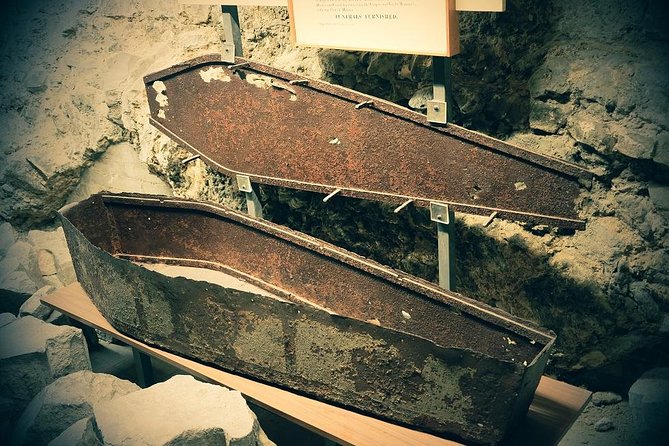
At Smithfield Market, the tone turns grim. This is London’s oldest market still used for its original purpose, selling meat. The market and the surrounding streets also connect to executions, religious persecution, and some of the city’s harshest episodes.
Richard explains how the Great Fire finally stopped in this area. He also covers the executions of people burned during the reign of Bloody Mary and William Wallace, known as Braveheart. Nearby associations include Fagin’s gang and St Bartholomew’s Hospital, where Sherlock Holmes first met Doctor Watson.
That is a lot of material for a 20-minute stop. The benefit is range, but the drawback is that some subjects may receive only a brief treatment. If you have a strong interest in one story, tell Richard early so he can judge where to spend more time.
The area also contains two surviving buildings that escaped the Great Fire of 1666. These details help you picture how unevenly the disaster affected the City. Some streets were swept away, while a few structures survived to show what the older city looked like.
This part works best if you enjoy London’s difficult stories as well as its attractive ones. It is not polished sightseeing, and that is precisely the point.
Postman’s Park and the memorial to ordinary courage

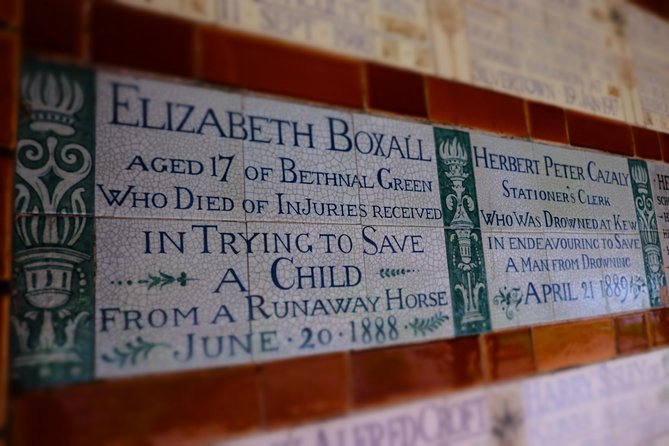
Postman’s Park is a small pause beside the former General Post Office. Postal workers used the park for lunch, giving it the name it carries today. The site was originally a burial ground for St Botolph’s Church.
The scheduled visit is about 10 minutes. Richard brings you to a memorial honoring people who died while saving others. He suggests finding a bench while he explains the story behind this unusual place.
I like this stop because it shifts attention away from kings, writers, and famous buildings. It gives the walk a human scale. You are not looking at another grand monument. You are considering ordinary people whose actions were later remembered on painted tiles.
The short length also makes sense. Postman’s Park is compact, and the memorial is best approached quietly rather than rushed through with a long lecture. If you have mobility concerns, this may be one of the easier moments to pause, although the entire route still requires moderate walking.
Guildhall and the City’s public center
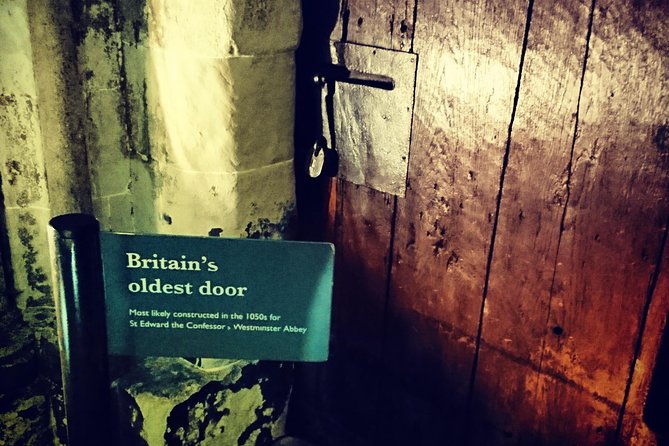
Guildhall brings several periods together in one location. The Romans had an amphitheater here. The Saxons built a hall connected with tax payments. By the medieval period, the name Guildhall was in use.
The present building dates from around 1411, while the crypts are thought to reach back to the 13th century. Guildhall functions as the historic town hall of the City of London, although the City of London Corporation now handles daily administration in modern buildings just to the north.
Richard uses about 10 minutes here to discuss the building and people tried in this location. The visit is more about setting and context than a long indoor tour. You get a sense of how the City’s civic center changed as London grew from Roman settlement to medieval commercial power and then to a modern financial district.
Because the stop is brief, you should not expect a full examination of every architectural detail. Its strength is how neatly it connects to the rest of the route.
Bank of England, Royal Exchange, and Cornhill’s odd corners
The walk continues into the financial heart of the City, sometimes called the Square Mile. The Bank of England, Royal Exchange, and Cornhill are not usually described as secret places, but Richard looks for the details that standard financial-district walks often skip.
You learn why the Bank of England is known as the Old Lady of Threadneedle Street. The Royal Exchange also connects to Charles Dickens and Ebenezer Scrooge. The tour includes the story of the Ghost of Christmas Yet to Come showing Scrooge his colleagues discussing his funeral.
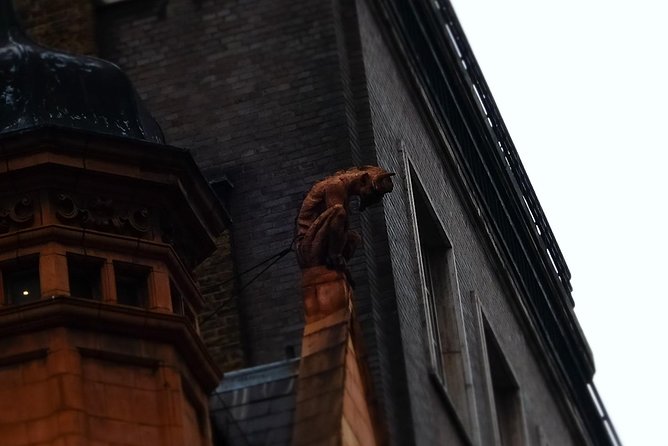
Cornhill’s devils add a more curious note. These unusual figures are the sort of small feature you might pass without noticing, especially if you are focused on office buildings and traffic.
This section lasts about 10 minutes. It is a quick but useful bridge between medieval London and the city’s present financial role. If you are more interested in banking than literature, you can ask Richard to explain the area’s commercial side. If Dickens is your priority, the Scrooge connections give you more to follow.
The George and Vulture, Leadenhall Market, and Dickens’s London
The George and Vulture is linked closely with Dickens and appears more than 20 times in The Pickwick Papers. The interior is described as little changed from Dickens’s time, and the food associated with the writer can still be ordered from the menu.
The stop lasts about 10 minutes. It is not enough time for a full meal, so treat it as a look at a historic chop house rather than a scheduled lunch. The lanes and courts around it are part of the appeal. They provide the kind of tight, atmospheric urban setting that makes the City feel older than its glass offices suggest.
Leadenhall Market follows for about 15 minutes. It occupies the site of a Roman crossroads and is one of London’s oldest and prettiest markets. Its film connections include the Harry Potter movies, while its literary link takes you back to A Christmas Carol, when Scrooge sends a boy to buy the biggest turkey on Christmas morning.
These two stops work well together. The George and Vulture gives you a literary interior. Leadenhall gives you a grander public space with Roman, commercial, and film associations. Neither requires an admission fee, and both are easy to appreciate even if you are not a Dickens specialist.
The Monument and the end of the walk
The final stop is the Monument to the Great Fire of London, near Monument Underground Station. The fire began nearby in 1666 and destroyed about 80 percent of the old City. Richard also points out areas that survived, helping you understand the scale of the disaster without treating it as a single abstract event.
The scheduled stop lasts around 15 minutes. The tour ends here, which is practical if you plan to continue around the City or take the Underground to another part of London.
You can climb the Monument’s 311 steps if you still have the energy. The climb is not included in the tour price, and it is optional. The payoff is a view over London, but you should consider your legs before adding it to an already long walk.
Price, pace, and practical value
At $267.48 per group up to 1, this is not a low-cost orientation walk. Its value depends on how much you use the private format. If you want a fixed route with a broad introductory talk, cheaper group tours may suit you better.
If you care about Dickens, Roman London, the Inns of Court, church archaeology, or the Great Fire, the price becomes easier to justify. You are paying for Richard’s time, local context, and the ability to adjust the emphasis. The strongest useful feature is not the number of stops. It is the chance to ask questions and shape the walk as you go.
The tour runs about 3 to 4 hours. Stops range from 10 to 45 minutes, but the walking between them adds up. Wear comfortable shoes and plan for city streets, alleys, and uneven historic areas. Food and drinks are not included, so you should handle refreshments separately.
The experience is offered in English. A mobile ticket is provided. Service animals are allowed, and the route is near public transportation. Most people can participate, but the operator asks you to mention mobility issues in advance. That is sensible, since moderate walking is part of the experience.
Free cancellation is available up to 24 hours before the start time for a full refund. Changes or cancellations made inside that period are not accepted for a refund.
Who should book this walk?
I would choose it for a repeat London visitor, a Dickens reader, or anyone who prefers old lanes and small discoveries to a parade of famous facades. It also suits a private group that wants to set the pace and ask plenty of questions.
You may want another type of tour if you have limited walking ability, dislike grim stories, or want extended time inside major attractions. This is an outdoor city walk with short visits, not a series of long museum admissions.
My verdict: a strong choice for curious London walkers
Book this tour if you want London explained through its side streets, old pubs, crypts, markets, writers, fires, and working institutions. Richard’s strength is the storytelling, especially when he can follow your interest in Dickens, law, Roman London, or the City’s stranger corners.
Skip it if your main goal is Westminster Abbey, the Tower of London, or a broad first look at London’s famous landmarks. For everyone else, this private route offers a thoughtful way to see how much of the old city remains tucked behind ordinary streets. Just confirm the hotel pickup details, allow plenty of time for walking, and arrive ready to ask for the stories that interest you most.
FAQ
How long does the London’s Hidden Gems and Secret History Private Guided Tour last?
The tour lasts approximately 3 to 4 hours.
Where does the tour start?
The published meeting point is Embankment Station, Embankment Place, London WC2N 6NS. The tour information also includes hotel pickup and drop-off from your London hotel, so confirm the exact arrangement when booking.
Where does the tour end?
The walk ends at Monument Station on King William Street.
What time does the tour start?
The listed start time is 10:00 a.m.
Is this a private tour?
Yes. Only your group participates, and the tour can be tailored to your interests.
Is hotel pickup and drop-off included?
Yes, hotel pickup and drop-off are included in the tour details. Since the listed meeting point is also Embankment Station, confirm how pickup will work for your booking.
Are food and drinks included?
No. Food and drinks are not included.
Can I cancel for a full refund?
Yes, if you cancel at least 24 hours before the experience start time. Cancellations made less than 24 hours in advance are not refunded.
Just added around London
- Up at The O2:Twilight Climb with Guided Tour with Panoramic Views★ 5.0 · 50 reviews
- Private Chauffeur-London Heathrow from/to Southampton Cruise Port★ 5.0 · 9 reviews
- Kensington Palace VIP Garden Tour with Royal High Tea★ 4.5 · 71 reviews
- Up at The O2: Sunset Climb with Guided Tour with Panoramic Views★ 5.0 · 110 reviews
- Secrets of the London Underground Small Group Walking Tour★ 4.5 · 38 reviews
- Urban Canvas: Exploring Shoreditch’s Vibrant Street Art★ 5.0 · 36 reviews
- Ultimate introduction to photography in Central London★ 5.0 · 19 reviews
- Full-Day Self-Guided Paris Tour from London by Eurostar with Seine River Cruise★ 3.5 · 22 reviews
Hidden London Walking Tours, compared.

London Soho Food Tour with 7+ Tastings of Delicious Hidden Gems
Read our review →
Private London Tour with a Local: Custom Highlights & Hidden Gems
Read our review →
Highlights & Hidden Gems With Locals: Best of London Private Tour
Read our review →
Secret Gardens of the City of London Private Tour
Read our review →
Covent Garden’s Hidden Gems: A Self-Guided Walking Tour
Read our review →Browse the lists this tour appears in