
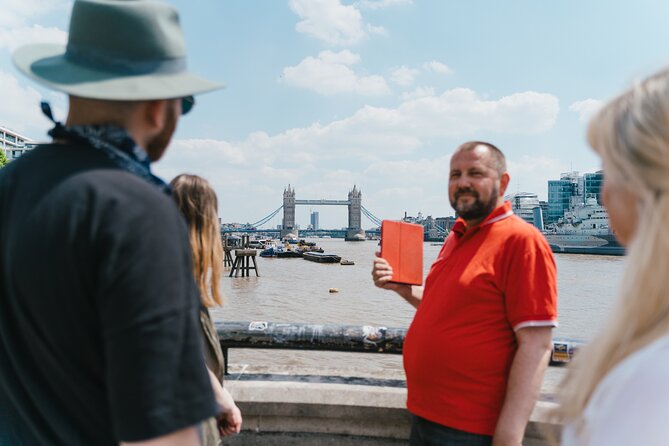
Reviewed · WESTMINSTER AND BIG BEN TOURS
London in One Day: Tour Royal Westminster and the Square Mile
London in One Day tries to do something ambitious: connect royal Westminster with the ancient City of London in one long walk. You begin at Buckingham Palace and finish at the Tower of London, passing Big Ben, Westminster Abbey, St. Paul’s, the Bank of England, London Bridge, and Tower Bridge along the way.
I like the way the tour mixes famous sights with smaller stops such as Dr. Johnson’s House and Ye Olde Cheshire Cheese. I also like the private format, since your group of up to 15 can ask questions and set the pace. The drawback is plain: this is a lot of ground on foot, so you need good fitness and comfortable shoes.
Key points to know
- A full west-to-east walk: Cover royal Westminster, Whitehall, Fleet Street, the City, and the Tower area in about six hours and 15 minutes.
- Private group value: The $514.18 price covers up to 15 people, making the cost more sensible for a family or group than for one or two people.
- Changing of the Guard option: The ceremony is included only when scheduled, usually Monday, Wednesday, or Friday, and can change.
- Many photo stops, few interior visits: The guide takes you to key viewpoints, but admission tickets are not included.
- A useful lunch pause: You get about an hour around Villiers Street, with pubs, cafés, restaurants, and sandwich shops nearby.
- A strong history focus: Royal power, World War II, the Great Fire, journalism, law, religion, and finance all get a place.
From Buckingham Palace to the heart of royal London
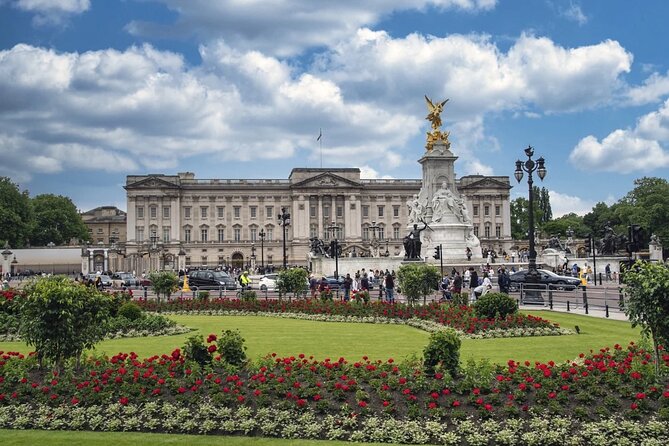
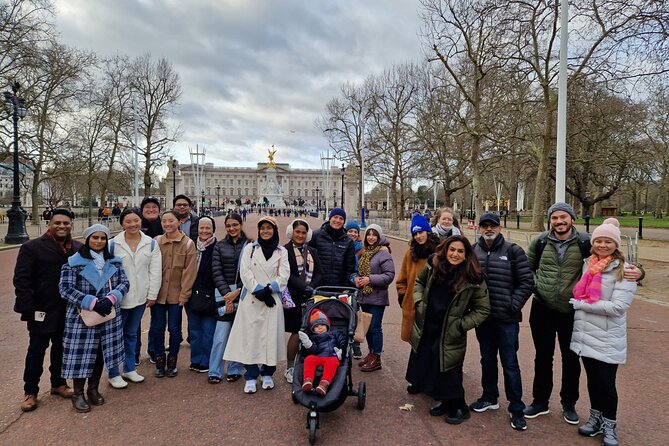
The tour begins at 10 a.m. at the Constance Fund fountain by Diana, Princess of Wales Memorial Walk, close to Buckingham Palace. Your guide positions you for photographs of the palace, the best-known royal residence in Britain and home of the monarchy for nearly two centuries.
You get about ten minutes here, so think of this as a carefully chosen introduction rather than a palace visit. The entrance is not included, and this experience does not take you inside Buckingham Palace. You are here for the setting, the architecture, and the stories tied to the royal household.
If your tour falls on a Monday, Wednesday, or Friday, the route may also include the Changing of the Guard. Your guide uses a tried-and-tested viewpoint intended to give you a clear look at the ceremony. Keep in mind that the schedule can change because of weather, public events, or official royal business. It is a welcome extra, but do not book the tour solely for this one event.
Clarence House and St. James’s Palace follow. At Clarence House, you look through the gates toward the former home of the Queen Mother and current residence of King Charles III and Queen Camilla. At St. James’s Palace, the story shifts to Tudor England. Henry VIII built the palace, and it remains closely linked to the royal court despite being less familiar to many first-time visitors.
The route through St. James’s Park gives your legs a short break from pavement. The park opened to the public under King Charles II and is known for its birds, including swans and pelicans belonging to the King. This is one of the more pleasant portions of the walk, especially if you want a little greenery between grand buildings.
More Westminster and Big Ben Tours:
- London: Westminster to Greenwich River Thames Cruise
★ 4.5 · 22,836 reviews - London: Westminster to Tower Bridge River Thames Cruise
★ 4.5 · 6,127 reviews - Westminster to Greenwich Sightseeing Thames Cruise in London
★ 4.5 · 2,969 reviews
Trafalgar Square and the machinery of government
Trafalgar Square brings you into one of London’s main public gathering places. Nelson’s Column and its four lions provide the classic view, but the square also helps explain how London works as a city. It has been a place for celebrations, protests, public events, and everyday city life.
From there, you head toward Whitehall and Horse Guards Parade. The open space is home to the King’s Life Guard and their horses, and it forms the setting for Trooping the Colour, the monarch’s annual birthday celebration. If the Changing of the Horse Guards happens during your visit, your guide will try to put you in a good viewing position.
You also pass the guarded entrance to Downing Street, where the British prime minister lives and works. You cannot simply walk up to Number 10, but the surrounding walls and gates make this a quick, worthwhile stop for anyone interested in British politics.
The tour then crosses ground above the Churchill War Rooms. You do not enter the museum during this walk, but your guide explains that the rooms below the Treasury were where Winston Churchill directed Britain during World War II. If you have extra time after the tour, this is one of the most useful nearby museums to add, but you would need a separate ticket.
Westminster Abbey and Parliament from the outside
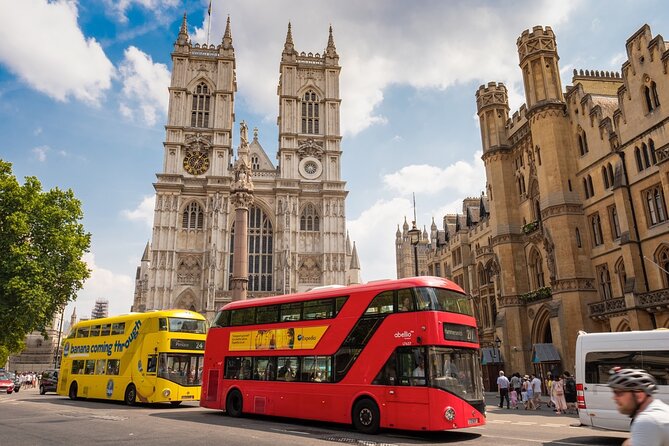
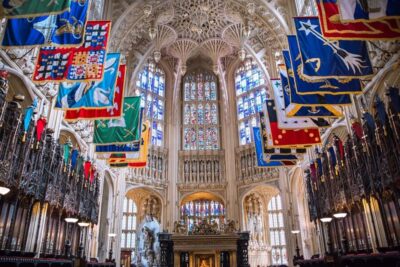
Westminster Abbey is one of the strongest photo stops of the morning. The church has been connected with royal coronations, weddings, funerals, and the burial of monarchs and famous figures for centuries. You get time to study the exterior and hear why the building matters, but admission is not included.
The Palace of Westminster follows, giving you a two-part look at Britain’s political center. The building houses the House of Commons and House of Lords, while Westminster Hall inside is far older than much of the Victorian structure around it. The hall has witnessed trials, coronation banquets, state occasions, and darker episodes in British history.
Again, this is an outside-focused tour. That is useful if you want orientation and context without spending half a day in one attraction. It is less suitable if your main goal is to visit the Abbey, Parliament, or the Churchill War Rooms interiors.
Lunch on Villiers Street and the River Thames
Around midday, you get about an hour for lunch near Villiers Street. This lane has pubs, cafés, restaurants, sandwich shops, and another pub or two, giving you a practical choice of quick food or a sit-down meal.
Lunch is not included, but the guide can suggest places. One review praised guide Maggie for recommending a good lunch stop and pointing out an authentic tea shop later in the day. That sort of local help is valuable in central London, where a convenient-looking restaurant is not always the best use of your money.
You may also have time to visit an old underground cellar or sit in a nearby park. The exact choice depends on your pace and the group’s appetite. Do not treat this as a long, leisurely restaurant break. It is a useful pause in the middle of a demanding walking route.
The Thames then provides a change of scene. You get views of the river and a chance to connect the city’s history with its waterway. The route does not include a river cruise, but this section helps you understand why London grew where it did and how the river connects Westminster, the City, and the eastern end of the route.
More Day Trips from London:
- Windsor Castle, Stonehenge, and Oxford Day Trip from London
★ 4.5 · 5,292 reviews - London: Windsor, Stonehenge, Bath, and Roman Baths Day Trip
★ 4.5 · 5,131 reviews - London: Harry Potter Studio Tour and Oxford Day Trip
★ 4.7 · 5,098 reviews - Oxford, Stratford-upon-Avon, Cotswolds & Warwick Castle Day Trip
★ 4.5 · 2,943 reviews
St. Clement Danes and London’s legal district
After lunch, St. Clement Danes Church offers one of the most thoughtful stops. The Georgian church, designed by Christopher Wren, is now the official church of the Royal Air Force. Damage from World War II bombing has been left visible, giving you a direct reminder that London’s wartime story is not confined to museums.
The Royal Courts of Justice is a very different kind of landmark. Its Neo-Gothic design can look like a medieval palace, yet it houses the High Court and Court of Appeal for England and Wales. You may recognize the building from films and television, including Bridget Jones’s Diary. The guide helps connect the impressive façade with the legal work still carried out inside.
Temple Bar marks the move into the City of London, the old financial and administrative district within the modern city. The boundary has been marked for centuries, and tradition says the monarch must ask permission to enter the City. From here, you walk along Fleet Street, once strongly associated with newspapers and printing, and still linked in popular culture with Sweeney Todd.
This is where the tour becomes less about postcard landmarks and more about London’s layers. You are moving through streets shaped by Roman roads, royal authority, journalism, law, and commerce.
Fleet Street, Dr. Johnson, and the old London pub
Dr. Johnson’s House is a small but memorable stop. The Georgian townhouse was home to Samuel Johnson, whose work produced the first comprehensive English dictionary. The quiet courtyard feels far removed from the traffic and office buildings around it.
Look for the unusual statue celebrating Johnson and his cat. It is the sort of detail easy to miss if you walk through the City alone, and it gives the stop a human touch without requiring a museum visit.
Ye Olde Cheshire Cheese provides the pub stop every long London walk needs. The old establishment has links to writers including Charles Dickens, Arthur Conan Doyle, and P. G. Wodehouse. You are not promised a meal or drink here, but the guide gives you a look at a London institution and explains why pubs are part of the city’s social history.
St. Bride’s Church continues the literary and printing theme. Often called the Journalists’ Church, it has long connections with the newspaper industry. Wren designed the present building after the Great Fire, and its tiered spire is traditionally associated with the shape of a wedding cake.
St. Paul’s and the churches of Christopher Wren
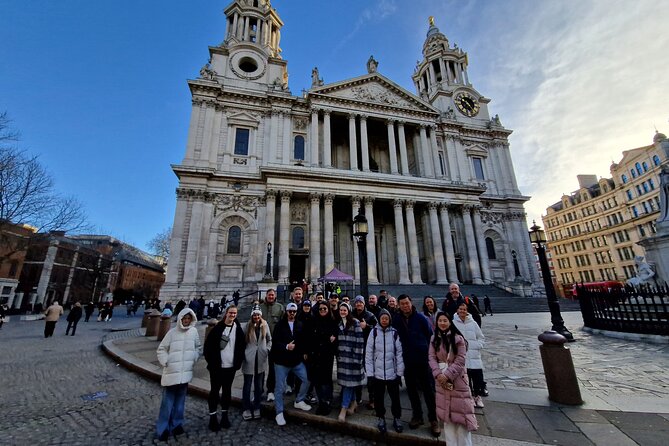
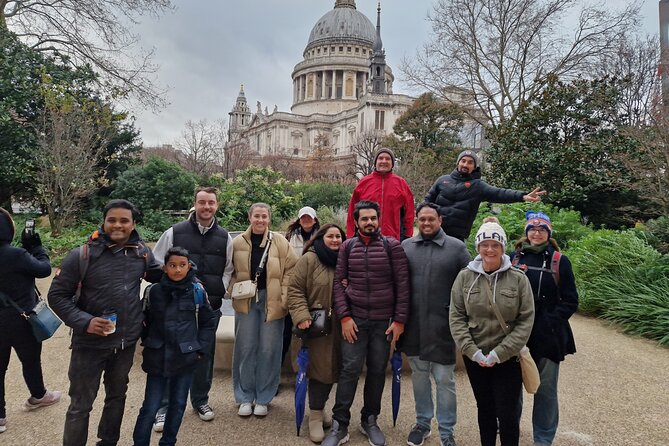
St. Paul’s Cathedral is one of the day’s biggest architectural moments. Wren’s cathedral was completed in the early 1700s and is tied to major events including Winston Churchill’s funeral and the wedding of Prince Charles and Lady Diana Spencer.
The tour takes you to good exterior views rather than inside the cathedral. You can see the dome, the scale of the building, and its place in the City, but the famous interior mosaics, arches, and Whispering Gallery require a separate visit and admission fee.
St. Mary-le-Bow is another Wren church, completed after the Great Fire. Its bells gave rise to the idea of the true Cockney, traditionally someone born within earshot of the Bow Bells. The church also puts you near Cheapside, the site of London’s medieval market and the source of the name used by roads in the area.
These stops are especially useful if you enjoy architecture but do not want every hour spent inside a major church. You get a broad view of Wren’s rebuilding work and a better sense of how the City was reshaped after the 1666 fire.
The Royal Exchange, Mansion House, and Britain’s financial center
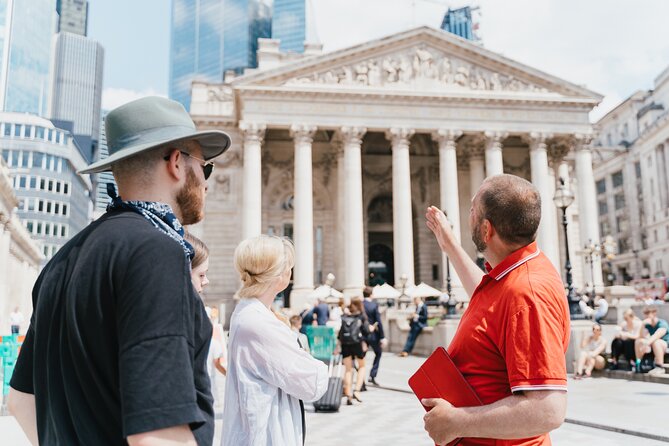
The Royal Exchange introduces London’s commercial past. Queen Elizabeth I authorized the first exchange in the 16th century, while the current neoclassical building opened in 1844. It now contains shops, restaurants, and offices, but its columns and grand frontage still recall the days of merchants and traders.
Mansion House is the official residence of the Lord Mayor of London. Built in the 18th century, it hosts official functions, receptions, and ceremonies. This role differs from that of the mayor of Greater London, and the stop helps clarify the City of London’s unusual government structure.
At the Bank of England, your guide explains the institution’s role in setting interest rates and managing monetary stability. You also stand above vaults said to hold 310 tonnes of gold bars. You will not tour the vaults on this walk, but the detail makes the financial district feel less abstract.
The Monument to the Great Fire of London brings the day’s earlier Wren story back into focus. The column commemorates the 1666 fire and offers a city view from the top for those willing to climb 211 steps. The tour does not include the climb, so consider it an optional follow-up if your legs still have energy.
London Bridge, Tower Bridge, and the final stop at the Tower
London Bridge has carried crossings at this site since Roman times. The current bridge dates from the 1960s, while the medieval bridge inspired the familiar falling-down rhyme. Your guide also points out where you can see the previous bridge, now in another country.
You then pass views of The Shard, Western Europe’s tallest building at 310 meters, and HMS Belfast, the former Royal Navy cruiser now used as a floating museum. Neither attraction is included, but both add useful context to the modern and wartime sides of the Thames.
Tower Bridge is the final major bridge stop. Completed in 1894, it is a working drawbridge with Gothic-style towers and high-level walkways. You may see it open on a summer afternoon, though that is not guaranteed. The guide focuses on views from outside, not entry to the walkways.
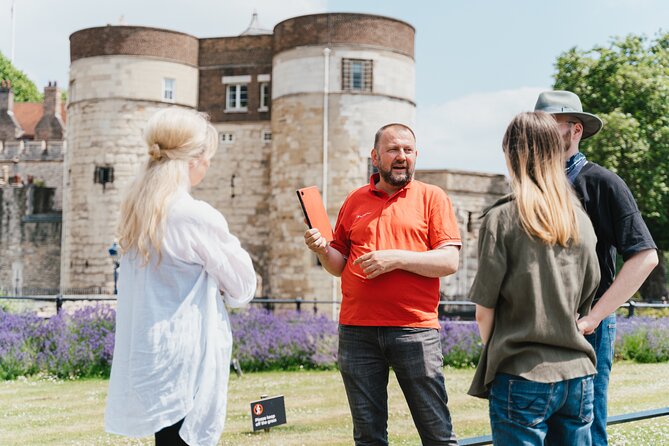
The grand finale is the Tower of London. Founded by William the Conqueror in the 11th century, the fortress has served as a royal palace, prison, treasury, and place of execution. The White Tower, medieval walls, Crown Jewels, and Tower Green all require admission, which is not included in this tour.
Ending at the official Tower ticket office is practical. You can buy a ticket and continue exploring if you still have time and energy, but plan ahead. After six hours of walking, you may prefer to return another day for a proper visit.
Price, pace, and who gets the best value
The price is $514.18 per private group of up to 15. For one person or a couple, that is a high price for a walking tour. For a family or larger group, the math changes considerably, since the same fee covers everyone in your party.
You are paying mainly for planning, guiding, route design, and a private experience. No attraction admissions or lunch are included, so the total cost rises if you add Westminster Abbey, the Tower, St. Paul’s, or the Churchill War Rooms.
The route lasts about six hours and 15 minutes, with roughly an hour for lunch. The listed stop times are short, often around ten minutes, which means the day is built around orientation and storytelling rather than long visits. You should expect a brisk pace and plenty of pavement.
The tour currently has a 5 out of 5 rating from eight reviews. Guide Maggie received particular praise for entertaining stories, useful lunch advice, and a tea-shop recommendation. The most important practical lesson is simple: you will walk a lot. Wear supportive shoes, carry water, and do not schedule another demanding activity immediately afterward.
Confirmation arrives at booking, service animals are allowed, and the route is near public transportation. The activity requires moderate physical fitness. Free cancellation is available up to 24 hours before the start time, while poor weather or an insufficient number of bookings can lead to a new date or full refund.
Should you book London in One Day?
Book it if you want a private, story-led introduction to central London and your group values seeing many landmarks in one day. It is especially good for first visits, families sharing the cost, and anyone interested in royal history, politics, wartime London, churches, journalism, or the City’s financial past.
Skip it if you want deep interior visits, a relaxed pace, or a tour built around one attraction. The route covers a remarkable amount, but it cannot give Buckingham Palace, Westminster Abbey, St. Paul’s, the Tower, and the Churchill War Rooms the time they each deserve.
For the right group, this is an efficient way to get your bearings fast, hear the stories behind the streets, and finish beside the Tower of London. Just bring good shoes and accept that London in one day means a long day on foot.
FAQ
How long does the tour last?
The tour lasts approximately 6 hours and 15 minutes, beginning at 10 a.m.
Where does the tour start and finish?
It starts at the Constance Fund fountain near Diana, Princess of Wales Memorial Walk in London SW1A 1RN. It ends at the official ticket office for the Tower of London at 2 Tower Hill, London EC3N 4EE.
Is the Changing of the Guard included?
The guide can take you to view the ceremony on Mondays, Wednesdays, and Fridays when it is taking place. The schedule may change because of weather, London events, or official royal activity.
Are attraction admission tickets included?
No. Admission tickets are not included for the listed stops, including the Tower of London, Westminster Abbey, St. Paul’s Cathedral, the Churchill War Rooms, and the Monument.
Is lunch included?
No. The tour includes about one hour for lunch near Villiers Street, where you can choose from pubs, cafés, restaurants, and sandwich shops.
How many people can join the private tour?
The private tour is for your group only and can include up to 15 people.
Just added around London
- Kensington Palace VIP Garden Tour with Royal High Tea★ 4.5 · 71 reviews
- Up at The O2:Twilight Climb with Guided Tour with Panoramic Views★ 5.0 · 50 reviews
- Private Chauffeur-London Heathrow from/to Southampton Cruise Port★ 5.0 · 9 reviews
- Up at The O2: Sunset Climb with Guided Tour with Panoramic Views★ 5.0 · 110 reviews
- Secrets of the London Underground Small Group Walking Tour★ 4.5 · 38 reviews
- Urban Canvas: Exploring Shoreditch’s Vibrant Street Art★ 5.0 · 36 reviews
- Ultimate introduction to photography in Central London★ 5.0 · 19 reviews
- Full-Day Self-Guided Paris Tour from London by Eurostar with Seine River Cruise★ 3.5 · 22 reviews
Westminster and Big Ben Tours, compared.
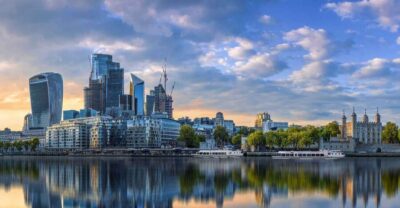
Westminster to Greenwich River Thames Cruise
Read our review →
Westminster to Tower Bridge River Thames Cruise
Read our review →
Westminster to Greenwich Sightseeing Thames Cruise in London
Read our review →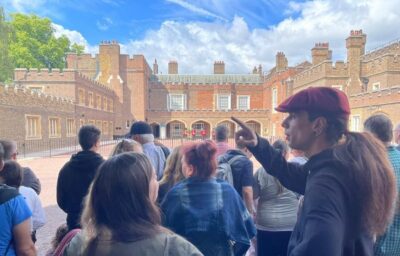
Westminster Abbey, Big Ben & Buckingham Guided Tour
Read our review →
London’s Palaces & Parliament Tour (See Over 20+ London Top Sights)
Read our review →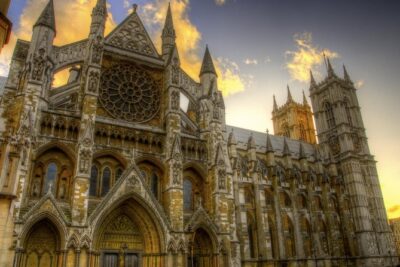
Westminster Guided Walking Tour with Abbey Entry
Read our review →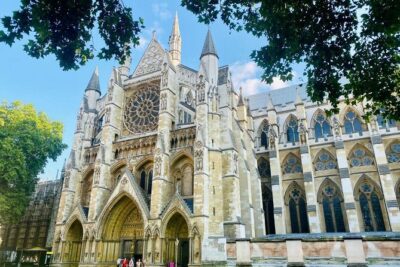
Walking Tour of London Westminster Abbey, Big Ben, Buckingham
Read our review →Browse the lists this tour appears in