Reviewed · TOURS
Charles Dickens Old London – Very Small Group Tour
Charles Dickens’s London comes alive in the narrow courts, old pubs, churchyards, and counting-house corners that inspired his characters. This is not a museum tour with glass cases. You follow Richard through the old City of London, connecting real streets with Scrooge, David Copperfield, and the Pickwick Club.
I like the small group limit of 10, which gives you a fair chance to ask questions and hear the storytelling clearly. I also like the route’s literary range: Fleet Street, the Inner Temple, Ye Olde Cheshire Cheese, St. Paul’s Cathedral, and Leadenhall Market all appear within one morning walk.
The main drawback is price. At $108.32 per person for roughly 2 to 3 hours, this is a premium walking tour, especially since food, drinks, and paid attractions are not included. You are paying for Richard’s guiding and interpretation, not admission tickets.
Key details that shape the experience

- Dickens’s working London: See Fleet Street and the Inner Temple, places tied to his early professional life and later fiction.
- A very small group: The tour is capped at 10 people, allowing more direct attention from Richard.
- Real old taverns: Ye Olde Cheshire Cheese and the George and Vulture add atmosphere that a standard sightseeing walk often misses.
- Strong Christmas connection: Scrooge’s world appears at the Royal Exchange, Leadenhall Market, Brabant Court, and other City locations.
- A practical central route: Start at Temple Station at 10 a.m. and finish near the Monument to the Great Fire of London.
- Free cancellation: You can cancel up to 24 hours before the start for a full refund.
Following Dickens from Fleet Street to the old City
This tour works best if you enjoy places with layers. You are not simply shown a building and handed a date. Richard explains how London’s streets, institutions, pubs, and social life fed Dickens’s imagination.
The walk begins at Temple Station at 10 a.m. and ends near the Monument to the Great Fire of London. The route moves east through central London, from Fleet Street and the Inns of Court toward St. Paul’s, the Royal Exchange, Leadenhall Market, and several smaller courts.
Expect about 2 to 3 hours on foot. The pace includes several short stops, with a longer half-hour visit around Ye Olde Cheshire Cheese. You should wear comfortable shoes and be ready for an outdoor walk through busy city streets and tight historic passages.
Richard is the guide, and his style appears to be a major part of the experience. He brings Dickens into the present without treating the novels like a school assignment. If your group shows interest in other literary figures, the walk may also widen its focus. One private outing with Richard expanded to Sherlock Holmes, Benjamin Franklin, Shakespeare, and other writers and public figures. That flexibility is appealing, though it should not be treated as a guaranteed part of every group departure.
Other London outings people book alongside this one:
- From London: Harry Potter Warner Bros Studio Tour
★ 4.7 · 26,588 reviews - London: Westminster to Greenwich River Thames Cruise
★ 4.5 · 22,836 reviews - Magical London: Harry Potter Guided Walking Tour
★ 4.7 · 22,044 reviews
Fleet Street and the Inner Temple: Dickens at work
Fleet Street is the right place to begin. It has been linked with London’s printed press since around 1500, and it also has strong connections to Dickens. You get about 10 minutes here, enough for Richard to establish why this street mattered to writers, printers, newspapers, and the city’s public life.
The stop is short, and there is no admission charge. That matters because Fleet Street is more about setting the scene than entering a specific attraction. You are looking at the street as a working part of London and learning how its character helped shape Dickens’s view of the city.
The Inner Temple follows, with about 15 minutes in the area. Dickens worked here as a junior clerk, and the Inns of Court later supplied material for David Copperfield, Great Expectations, and Martin Chuzzlewit.
I like this part of the walk because it connects biography and fiction. You see where Dickens began observing the legal world, then consider how those observations became characters, settings, and social criticism. The courts can feel mysterious even without literary connections, with lanes and passages that seem removed from the larger city nearby.
This is also a useful reminder that Dickens was not inventing London from a distance. His books grew from jobs, streets, institutions, and people he saw firsthand.
Ye Olde Cheshire Cheese and Dickens’s tavern London
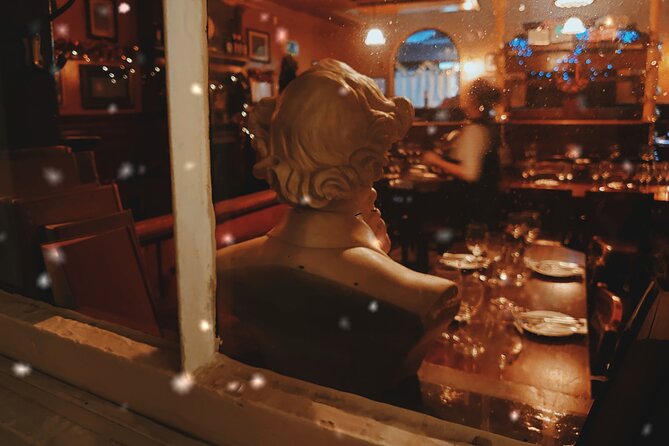
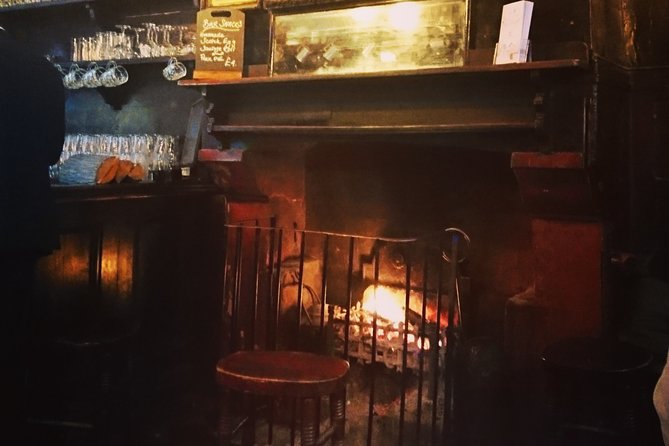
Ye Olde Cheshire Cheese gets the longest scheduled stop, about 30 minutes. Its cellars date to the 13th century, and the tavern was a haunt of Dickens. It was also linked with the Hellfire Club, while David Copperfield drinks here in the novel.
This is one of the tour’s strongest stops for atmosphere. Old taverns can make literary history feel physical. You are no longer picturing a fictional drinking place in the abstract. You are standing in a surviving pub with old cellar spaces and a long connection to London’s social life.
The trade-off is that a historic pub is still a working business. Conditions can be crowded, and the tour price does not include food or drinks. The scheduled time gives you a chance to look around and listen, but it does not turn the visit into a full meal break.
If you want to eat here, ask Richard about timing before ordering. The tour has several more stops, so a long lunch could interfere with the walking schedule.
St. Paul’s Cathedral and the churchyard route
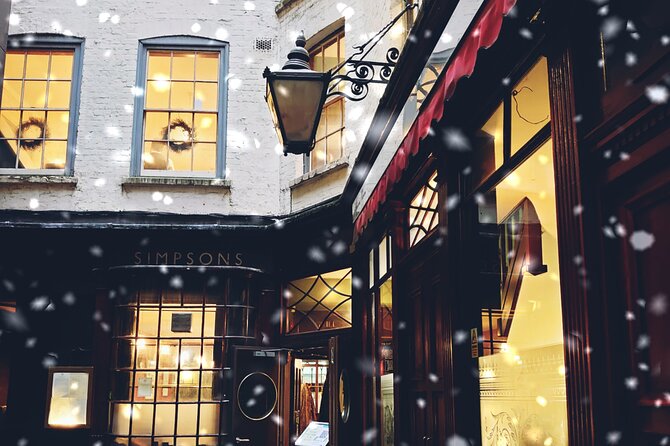
The walk passes St. Paul’s Cathedral, one of London’s major landmarks and the first location mentioned in A Christmas Carol. You also go through the churchyard as the route moves farther into the old City of London.
The itinerary does not promise cathedral admission. Think of this as an exterior and churchyard stop, not a cathedral visit. That distinction is important if you want to tour the interior, climb the dome, or spend time studying the artwork. You would need to arrange that separately.
Still, the stop has value. St. Paul’s gives you a strong sense of scale after the narrower streets and courts. The churchyard helps shift the mood back toward Dickens’s London, where old religious sites, commercial buildings, and cramped lanes sat close together.
A different sort of day out in London altogether:
- London: Madame Tussauds London
★ 4.6 · 20,915 reviews - Stonehenge, Windsor Castle, and Bath from London
★ 4.5 · 18,662 reviews - London: Warner Bros. Studio Tour with Transfers
★ 4.7 · 17,586 reviews - London: Tower Bridge Entry Ticket
★ 4.7 · 15,560 reviews
St Mary Aldermary: a useful rest point
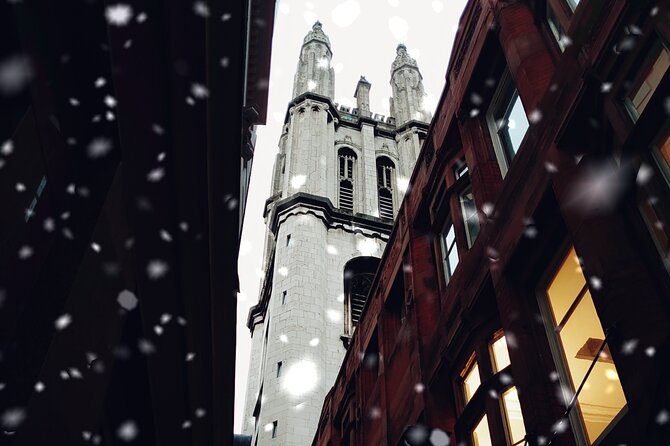
The Guild Church of St Mary Aldermary is an ancient church in the heart of the City. It remains a working guild church and now houses a popular café, making it a practical place for a short rest and refreshment.
The scheduled stop lasts about 10 minutes. Food and drinks are not included, but you may have an opportunity to buy something if timing and opening conditions allow. Do not count on a full café visit. Treat it as a brief pause during the walk.
I like the inclusion of this stop because it gives the route a change of pace. A long walking tour can become tiring when every stop asks you to absorb more information. A short rest helps you keep your attention for the final section, where the route turns strongly toward Scrooge and A Christmas Carol.
The Royal Exchange and Scrooge’s financial world
The Royal Exchange stands beside the Bank of England and is tied to one of the darker scenes in A Christmas Carol. The Ghost of Christmas Yet to Come takes Scrooge there to see his colleagues discussing his funeral.
Richard also explains the Royal Exchange’s civic role. Its steps have traditionally been used for royal announcements. Today, the former trading floor has shops and Champagne bars rather than bankers conducting business.
This stop lasts about 10 minutes and is free to visit. It gives you a quick look at how Dickens used commercial London to show ambition, money, status, and fear. Scrooge’s world is not only about Christmas ghosts. It is also about the people and institutions that measure a man’s worth by business success.
You will not spend long inside the building, and the modern retail setting may feel less atmospheric than the old taverns. The value is in the explanation and the connection to the novel.
Leadenhall Market and the Harry Potter connection
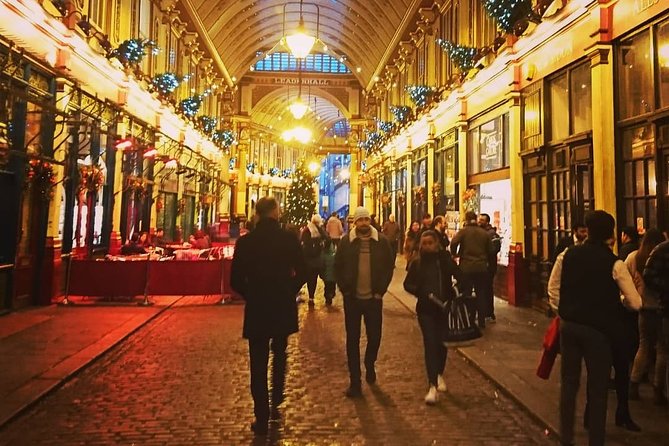
Leadenhall Market is another short stop, around 10 minutes. It appears in A Christmas Carol and has also been used as a filming location for the Harry Potter movies.
That gives this part of the tour two useful entry points. Dickens readers can focus on the market’s place in the old City, while film fans may recognize its architecture from the screen. Even if you have not read Dickens recently, the market helps keep the walk visually varied.
The stop is free, though the market may be busy depending on the time and day. You will have time to look at the structure and hear the literary connections, but not necessarily enough time for a relaxed meal or extended shopping visit.
Coffee houses, the George and Vulture, and Scrooge’s supper
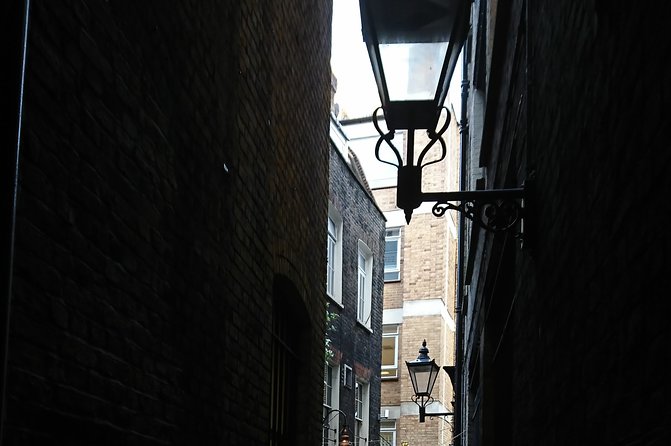
The route then leaves the most familiar sightseeing streets and moves toward places connected with Dickens’s eating and social life. This section focuses on Scrooge’s counting house, the place where he took supper on Christmas Eve, and Dickens’s favorite chop house, the George and Vulture.
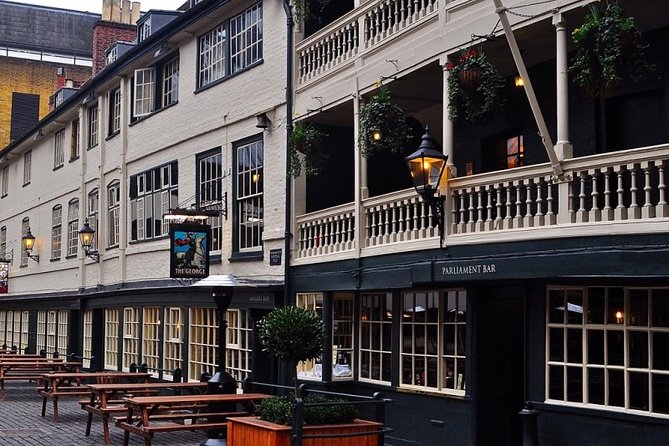
The George and Vulture was the meeting place of the Pickwick Club and appears more than 20 times in The Pickwick Papers. The tour explains why it mattered to Dickens and points out the table associated with his visits. The historic tavern around the corner, Simpsons, is presented as a likely favorite eating place for Scrooge.
This is a particularly good section for readers who want more than the biggest landmarks. You get a sense of Dickens’s London through meals, clubs, work, and routine. The details are human and practical. Writers need places to meet, eat, observe, and talk, and Dickens used these settings in both life and fiction.
Food and drinks are not included. You may see the taverns and hear how they fit into the stories, but you should not assume the tour includes a reserved meal or tasting.
Brabant Court and the question of Scrooge’s house
Brabant Court is the final listed stop, with about 10 minutes devoted to a simple but engaging question: could this small court be the location of Ebenezer Scrooge’s house?
The answer is treated as an investigation rather than a fact handed down without debate. Richard examines the evidence and lets you consider how Dickens may have combined real places, altered details, and invented settings.
I like ending with this kind of question. It keeps the tour from becoming a string of fixed claims. Dickens wrote fiction, but he built it from recognizable London. A narrow court can feel convincing without being proven as the exact address.
The tour then ends near the Monument to the Great Fire of London on Fish Street Hill. This is a useful finish because you are left in the City of London, close to restaurants and other central sights.
What the $108.32 price really buys you
At $108.32 per person, this is not a cheap orientation walk. All the listed stops are free, and there is no included meal, drink, or interior admission to a major attraction.
The price makes more sense if you value a specialist guide and a group capped at 10. Richard’s role is to connect scattered details: Dickens’s early work, the legal district, old taverns, Scrooge’s business world, and the settings behind several novels. A large group would make that harder, especially in narrow courts and noisy streets.
You are also paying for efficiency. In 2 to 3 hours, you see a wide section of the old City without having to research each location or work out the route yourself. For a reader already interested in Dickens, that can be a fair trade.
I would compare it with the cost of a private walk, since the small group may feel close to a personal tour if the departure is not full. A private booking has occurred accidentally in the past, and Richard adapted the conversation to include other literary interests. That flexibility may add value, but the standard product is still a group tour with a maximum of 10 people.
Who will get the most from this walk
You should consider booking if you:
- Read A Christmas Carol, David Copperfield, Great Expectations, or The Pickwick Papers
- Enjoy literary connections tied to actual streets and buildings
- Prefer a small group to a large sightseeing crowd
- Want a guide who can discuss Dickens alongside other writers and famous London figures
- Like old pubs, churchyards, courts, and city history more than formal museum displays
You do not need to be a serious Dickens scholar. The route also works for anyone curious about old London, and Richard’s storytelling can help you follow the novels even if you remember only the broad outlines.
You may want a different experience if you need extensive interior sightseeing, a full meal, or a slow museum-style visit. This is an outdoor walking route with many short stops. It also may not suit you if 2 to 3 hours on foot feels demanding.
Children can participate, but they must be accompanied by an adult. Service animals are welcome, and the tour is near public transportation. Most people can take part.
Booking advice and final verdict
I would book this tour early if Dickens is a major reason for your London visit. It is often reserved well ahead, with an average booking lead time of about 59 days, and the 10-person limit keeps availability tighter than on a standard city walk.
The best practical plan is to read or reread one Dickens work before you go, especially A Christmas Carol. You will recognize more of the connections, but Richard also gives enough context for newcomers. Start at Temple Station, arrive ready to walk, and leave room after the tour for food near Leadenhall Market or the Monument.
The 24-hour cancellation policy is useful: cancel at least 24 hours before the 10 a.m. start for a full refund. Changes or cancellations inside that window are not accepted for a refund.
Book it if you want literary London explained at street level, especially with direct access to a guide in a very small group. Skip it if you mainly want paid attraction interiors or a low-cost way to see landmarks. For the right reader, the old courts, taverns, and Scrooge connections make this a thoughtful use of a London morning.
FAQ
Where does the Charles Dickens Old London tour begin?
It begins at Temple Station, Temple Place, London WC2R 2PH.
Where does the tour end?
The walk ends near the Monument to the Great Fire of London on Fish Street Hill.
What time does the tour start?
The scheduled start time is 10 a.m.
How large is the group?
The tour has a maximum of 10 participants.
Are food and drinks included?
No. Food and drinks are not included in the tour price.
Can I cancel for a full refund?
Yes. You can cancel at least 24 hours before the experience start time for a full refund. Cancellations or changes made less than 24 hours before the start are not accepted for a refund.
Just added around London
- Private Chauffeur-London Heathrow from/to Southampton Cruise Port★ 5.0 · 9 reviews
- Kensington Palace VIP Garden Tour with Royal High Tea★ 4.5 · 71 reviews
- Up at The O2:Twilight Climb with Guided Tour with Panoramic Views★ 5.0 · 50 reviews
- Up at The O2: Sunset Climb with Guided Tour with Panoramic Views★ 5.0 · 110 reviews
- Secrets of the London Underground Small Group Walking Tour★ 4.5 · 38 reviews
- Urban Canvas: Exploring Shoreditch’s Vibrant Street Art★ 5.0 · 36 reviews
- Ultimate introduction to photography in Central London★ 5.0 · 19 reviews
- Full-Day Self-Guided Paris Tour from London by Eurostar with Seine River Cruise★ 3.5 · 22 reviews
Tours, compared.

Magical London: Harry Potter Guided Walking Tour
Read our review →
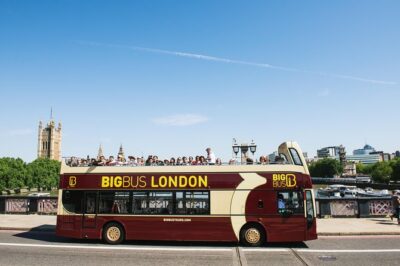
London Big Bus Hop-On Hop-Off Tour with Optional River Cruise
Read our review →
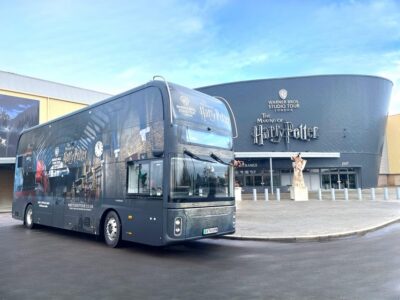
Warner Bros. Studio Harry Potter Tour with Transfers
Read our review →