
Reviewed · LONDON WALKING TOURS
City of London Historical Walking Tour
The most interesting thing here is the City of London’s separate identity. This compact square mile is not simply old London in miniature. It has its own corporation, traditions, rights, and story of resisting royal power. Arjun’s tour follows that story from Celtic roots and Roman rule to the Great Fire, plague, revolution, and the dragon emblem that came to represent the city.
I like the focus on less obvious corners, not just the grand sights you already know from a first London visit. I also like the small group, capped at eight, which gives you room to ask questions and keep a real conversation going. The possible drawback is the amount of information: two and a half hours packed with centuries of history can feel demanding, especially on a cold or wet day. There is no food stop, so eat beforehand.
Key points to know before you book
- The tour explains why the City of London is different from Westminster, politically, historically, and physically.
- Arjun uses stories about power and resistance to connect Roman, Saxon, Viking, Norman, royal, and modern London.
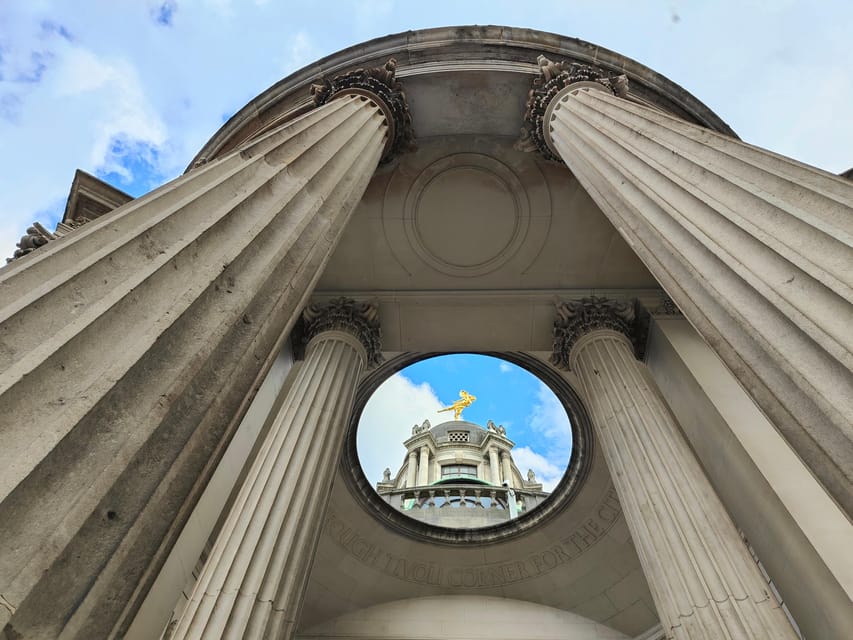
- The route runs from Barbican ruins to the Bank of England, passing Salters’ Hall, Guildhall, the Royal Exchange, and Mansion House.
- A group of up to eight people makes it easier to hear the guide and ask about the details you would otherwise miss.
- The emphasis is on meaning rather than postcard views, including law, trade, citizenship, empire, plague, fire, and the dragon symbol.
- You receive a post-tour PDF, useful if you want to remember the stops and themes afterward.
Why the City of London deserves its own walking tour
Many people use London to mean the whole urban area. This tour asks you to separate the modern city from the ancient City of London, the small financial and civic district at its core.
That distinction matters. Westminster became the seat of royal government, while the City developed its own civic authority and commercial power. The tour uses that contrast to explain why the City became the envy of kings. Its leaders and institutions could support monarchs, challenge monarchs, and protect old rights that gave the district unusual influence.
I find this a useful way to approach London because it replaces a simple sequence of dates with a question: who had power here, and why? The answer changes as you walk. First come the city’s early peoples and Roman foundations. Then come Saxon and Viking influences, Norman rule, royal pressure, trade, law, and finance.
The route also links local places to much larger events. The Magna Carta, democracy, legal authority, and the rise of empire are not treated as distant textbook subjects. They become part of the story of streets, halls, corporations, and institutions inside one square mile.
More London Walking Tours:
- Magical London: Harry Potter Guided Walking Tour
★ 4.7 · 22,044 reviews - London: The Original Jack the Ripper Walking Tour
★ 4.7 · 7,833 reviews - Tour for Muggles The Ultimate Harry Potter Walking Tour in London
★ 5.0 · 4,684 reviews
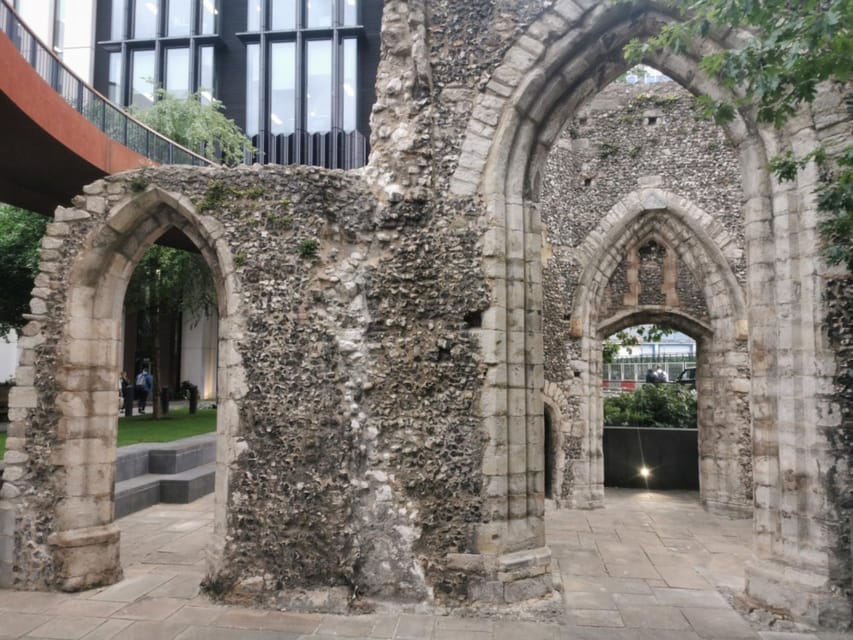
Starting at Barbican and the city’s earliest layers
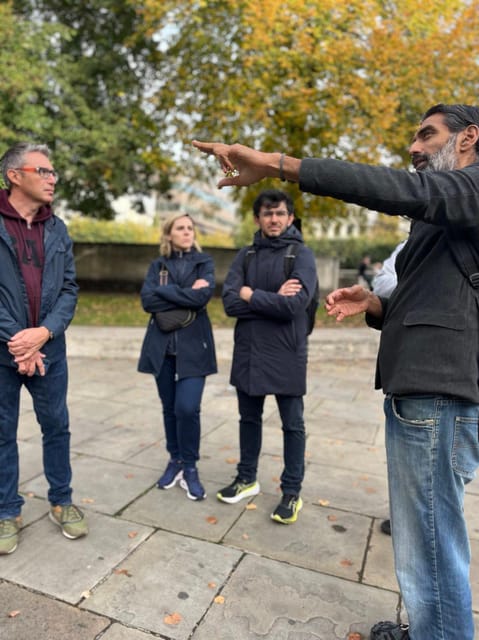
You meet at Barbie Green restaurant, opposite the ruins. The guide is easy to identify by longish hair, a beard, and a felt green dragon on his backpack. That is a useful detail in a busy part of London, especially if you arrive early and are not sure where the group is gathering.
The opening section lasts about 15 minutes. It sets up the city’s origin story and begins the walk through its earliest layers. You will hear about Celtic roots before the Romans, followed by the Roman period and the later arrival of Saxons, Vikings, and Normans.
Do not expect a reconstructed ancient town or a museum-style presentation. The appeal is the way the guide helps you read the remains and streets around you. A site that might look like a fragment of old wall or an ordinary corner can gain meaning once you know how it fits into the city’s changing population and power structure.
The next short sections, around 10 minutes each, continue this early history. That pacing keeps the group moving, but it also means you need to listen closely. If you prefer a slow stop with lots of time for photographs, this may feel brisk. If you like a clear story with regular changes of scene, it works well.
Salters’ Hall and the people behind the city
Salters’ Hall receives a 10-minute explanation on the route. This is one of the points where the walk shifts from broad historical periods to the institutions and communities that helped shape the City.
The tour’s subject is not only kings and famous battles. It also looks at guilds, corporations, trades, and the different peoples who made the city work. That matters because London’s power did not come from the crown alone. It also came from organized civic and commercial groups able to protect their interests over long periods.
You will find this part especially useful if you have already seen the main royal sights and want something less familiar. The focus is not on spectacular architecture at every stop. Instead, the guide draws out why a hall, corporation, or civic custom mattered.
The walking distances between stops are short enough to keep the historical thread intact. Still, this is a city walk, not a seated talk. Wear comfortable shoes and expect normal pavement, street crossings, and outdoor listening.
From royal resistance to Magna Carta
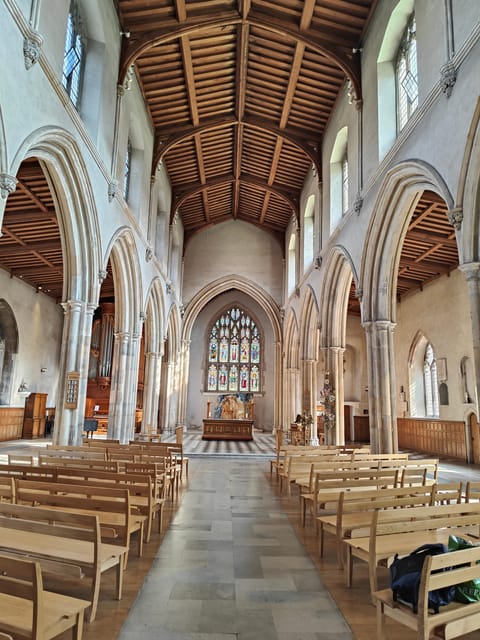
The heart of the tour is the City’s difficult relationship with monarchy. The story is not presented as a simple battle between good citizens and bad kings. The City needed royal favor, yet it also defended its own privileges and resisted attempts to bring it fully under royal control.
That tension helps explain the tour’s treatment of the Magna Carta and England’s legal foundations. The City’s role is tied to the birth of ideas about limits on authority, civic rights, and the obligations of rulers. You will not simply hear that the Magna Carta was signed. You will hear how London’s institutions and political weight fit into the larger struggle over who could make decisions and under what rules.
This is one of the tour’s strongest themes because it gives the City a political identity. It was a place of trade, but it was also a place where organized citizens could negotiate, refuse, lend, petition, and defend privileges.
The next stops receive roughly 10 minutes each, followed by a five-minute guided section labeled simply London. That shorter pause appears to help connect the historic core to the modern city around it. The subject remains the same: how an old civic body survived changing rulers and changing ideas about government.
More Historical Tours:
- London Small Group Tour of Historical Pubs
★ 5.0 · 10,422 reviews - Soho Music & Historic Pubs Tour
★ 5.0 · 1,993 reviews - London: Historic Pubs of Central London Walking Tour
★ 4.9 · 1,065 reviews - London: Soho Music and Historic Pubs Walking Tour
★ 4.9 · 836 reviews
Guildhall and the power of a corporation
Guildhall is given 15 minutes, making it one of the major stops. That time allows the guide to explain the City’s civic structure and its role in public life.
This is also where the tour’s idea of a corporation becomes especially important. The corporation was not just a modern business concept. In the City’s story, organized corporate power helped preserve rights, manage civic affairs, and build influence far beyond the local streets.
The tour connects this civic corporation to the rise of an empire. That is a bold claim, but the value lies in examining the mechanism behind it. Trade needs rules, money, contracts, offices, and institutions. A corporation can turn local privilege into overseas reach when it gains enough wealth and authority.
You should not expect a full course in imperial history during this walk. The tour’s promise is more focused. It shows how the City’s civic and commercial structures helped create conditions for global expansion. That gives you a sharper understanding of London’s financial identity than simply looking at office towers.
Guildhall also helps explain why the City can feel both ancient and intensely modern. You may move from an old civic story to streets dominated by finance, yet the underlying institutions are connected across centuries.
The long middle section: stories rather than landmark collecting
After Guildhall, the tour includes several longer guided sections, including stops of 15 and 25 minutes. These are likely to be the most demanding parts for anyone who wants only quick facts and photographs.
They are also where the guide can develop the major themes properly. The walk covers changing cultures, legends, local identity, and the odd details that often disappear from a standard sightseeing route. You will hear how the City’s character changed through Roman, Saxon, Viking, and Norman periods, then through later political and commercial upheavals.
This is where Arjun’s storytelling style matters. The supplied details describe him as engaging, friendly, and able to bring both the historical and present-day City to life. That does not mean every story is light or comic. It means the information is arranged as a connected narrative rather than a pile of dates.
I would allow your attention to shift between the guide and the surroundings. The pleasure comes from realizing that an unremarkable-looking place can hold a legal, religious, commercial, or political clue. If you have visited London many times, this is likely to be the part that gives you the most new material.
The trade-off is that the route is not built around London’s biggest visual attractions. You will not get a long sequence of famous photo stops. The reward is a better understanding of why the square mile matters.
Royal Exchange and Mansion House: money becomes power
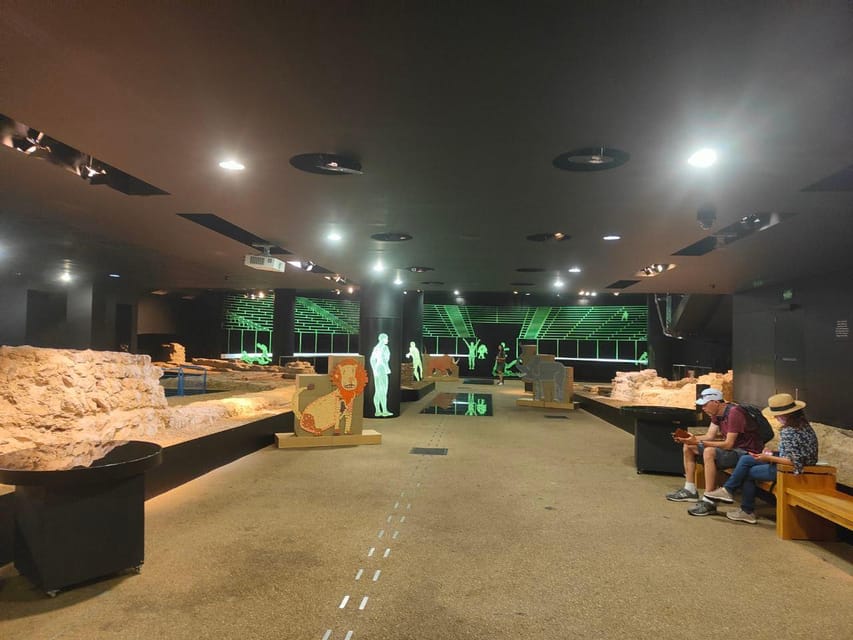
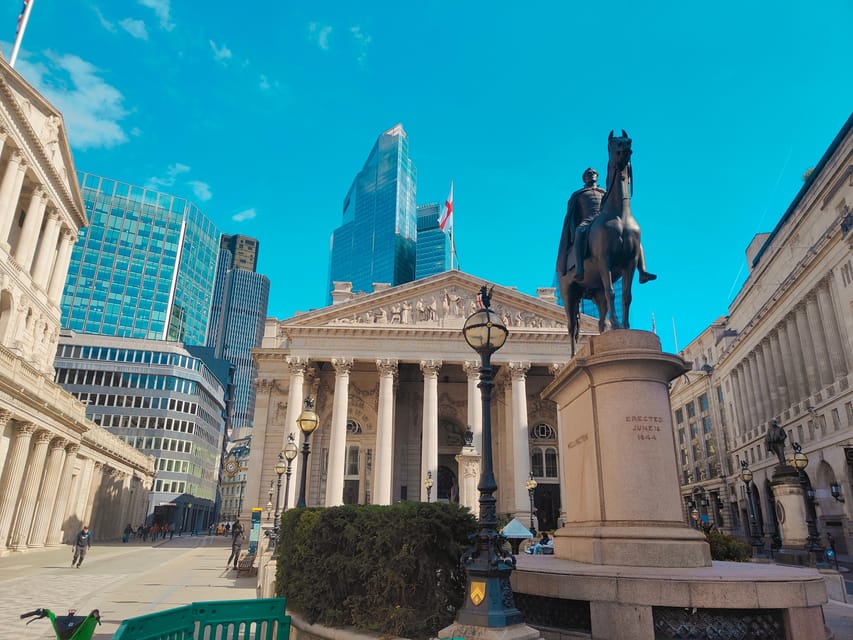
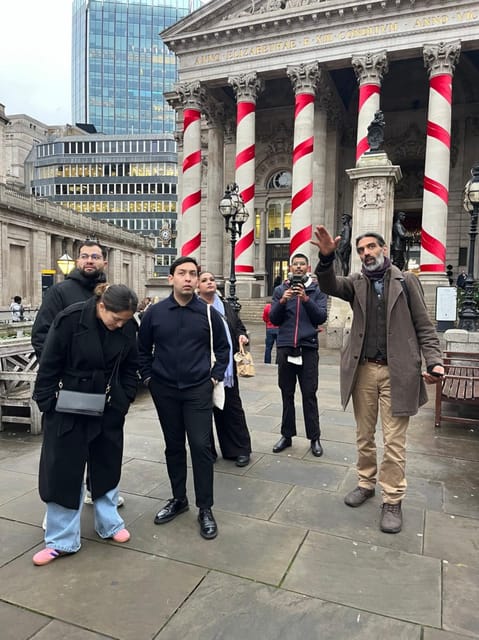
The Royal Exchange receives about five minutes, followed by five minutes at Mansion House. These stops bring the story firmly into the world of finance and civic authority.
The Royal Exchange represents the City’s commercial role. It helps show how buying, selling, credit, and organized trade turned the district into a force that could influence national policy and overseas expansion.
Mansion House brings in the City’s civic leadership. Together, these locations help you see that financial power and civic power were not separate stories. They worked side by side, supported by institutions with long memories and carefully guarded privileges.
The short timings are enough for an explanation, but not for an extended architectural study. If you want to inspect every detail of either building, plan to return independently. On the tour, the priority is the larger argument: the City’s authority grew because commerce, local government, and corporate organization reinforced one another.
This is also a useful point for comparing the City with Westminster. Westminster suggests crown, parliament, and national government. The City suggests merchants, guilds, civic office, and financial influence. Modern London needs both, and the walk shows how that division developed.
Plague, fire, revolution, and the green dragon
The tour ends near the Bank of England after a final set of short stops. By this stage, the story has reached the turbulent 17th century, when the City faced plague, the Great Fire, and revolution.
These events are not included simply as dramatic background. They show how fragile the City could be, and how quickly it had to adapt. Disease threatened its people. Fire destroyed much of the built environment. Revolution changed the relationship between ruler, law, and society.
Against that backdrop, the dragon emblem takes on more weight. The dragon is not merely a decorative symbol on a sign or backpack. In the tour’s telling, it reflects the City’s identity, its old authority, and its ability to rise again after disaster.
The phoenix-like recovery after the Great Fire is a strong closing image, but the tour keeps its attention on rights and privileges as well as rebuilding. The City did not simply recover its buildings. It protected the civic character that allowed it to remain influential for generations.
Finishing at the Bank of England gives the walk a clear present-day endpoint. You end with the connection between old civic power and modern finance still in view.
What $30 buys you in time and access
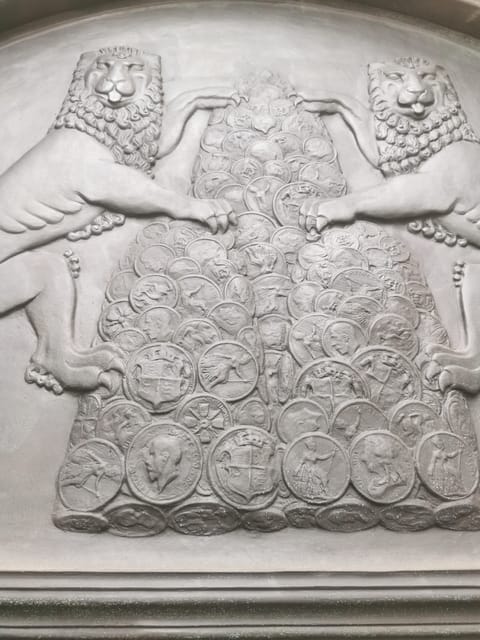
At $30 per person, the tour offers 2.5 hours with a live guide, a small group limited to eight, and a post-tour PDF covering the places and themes. That is a fair price if you value interpretation more than admission tickets or grand interiors.
You are paying for the guide’s ability to connect scattered evidence. Without that explanation, some stops may look ordinary. With it, the route becomes a lesson in how London’s legal, civic, and financial systems developed.
The small group is a real advantage. You can hear the guide more easily, ask questions without holding up a large crowd, and have a conversation while walking. It also suits visitors who want a more personal experience than a standard group tour.
The price does not include food, and nothing is served during the walk. Have something to eat beforehand, particularly if you are booking a later start. The tour is listed as wheelchair accessible, but you should still consider the realities of outdoor city walking and confirm any personal access needs before booking.
Cancellation is flexible up to 24 hours before the start for a full refund, and you can reserve now and pay later. Those policies are useful if your London plans are still shifting.
Who will get the most from this walk
I would recommend it most strongly to repeat visitors, history-minded first-timers, and anyone curious about how power operates behind London’s famous buildings.
It is a good match for you if:
- You want London history beyond the royal palaces and major museums.
- You enjoy civic stories about law, trade, rights, and institutions.
- You prefer a group of eight or fewer.
- You like asking questions as you walk.
- You want to understand the difference between the City of London and Westminster.
- You can give sustained attention to a story lasting two and a half hours.
It may be less suitable if you want only famous landmarks, lots of free time for photographs, or a relaxed stroll with minimal commentary. The route is information-heavy, and the weather can affect your comfort. The positive side is that even people who have lived in or repeatedly visited London can find unfamiliar corners and new connections here.
The tour is conducted in English with a live English-speaking guide. The activity information also says other languages can be arranged if requested in advance, so ask before booking if you need that option.
Should you book the City of London Historical Walking Tour?
Book it if you want to understand why this small district has mattered so much for English law, trade, democracy, and empire. The strongest reason to go is the storytelling, especially the way Arjun connects overlooked places to large historical forces.
The tour is not about ticking off London icons. It is about learning to read the City: its ruins, halls, civic buildings, financial institutions, symbols, and old rights. For $30, that is good value if you want context and conversation rather than a sightseeing checklist.
Bring comfortable shoes, eat first, and dress for outdoor weather. If you can handle a dense two and a half hours, this walk offers a thoughtful explanation of the London beneath the usual London.
FAQ
Where does the City of London Historical Walking Tour begin?
It begins at Barbie Green restaurant, opposite the ruins.
How will I recognize the guide?
The guide has longish hair and a beard, and carries a backpack with a felt green dragon on it.
Where does the tour finish?
The walk finishes at the Bank of England.
How long is the walking tour?
The tour lasts 2.5 hours.
How much does the tour cost?
The listed price is $30 per person.
How large is the group?
The group is limited to eight participants.
Is the tour wheelchair accessible?
Yes, the activity is listed as wheelchair accessible.
Is food included?
No food is served during the tour.
What language is the tour in?
The live guide conducts the tour in English. Other language arrangements may be possible if requested in advance.
What is included after the walk?
You receive a post-tour PDF covering the tour locations and themes.
Just added around London
- London: “Queen” Highlights Walking Tour★ 4.3 · 48 reviews
- Couple’s photo: Romantic photoshoot in London★ 4.8 · 22 reviews
- London: Private Tour with Locals – Highlights & Hidden Gems★ 5.0 · 8 reviews
- Luxury Private Tour in London with Lunch★ 5.0 · 7 reviews
- London 1- or 2-Hour Professional Photo Shoot★ 4.9 · 6 reviews
- London: Private Black Cab Night Tour with Hotel Pick Up★ 5.0 · 11 reviews
- London: Christmas Lights Tour – With Christmas Music★ 4.8 · 9 reviews
- London: Private Pub Tour★ 4.5 · 4 reviews
London Walking Tours, compared.

Magical London: Harry Potter Guided Walking Tour
Read our review →

Tour for Muggles The Ultimate Harry Potter Walking Tour in London
Read our review →
Harry Potter Movies Walking Tour (Kids Go Free)
Read our review →
Changing of the Guard Guided Walking Tour in London
Read our review →
The Great British Rock and Roll Music Walking Tour
Read our review →
Jack the Ripper Walking Tour – Ripper Vision Tours
Read our review →Browse the lists this tour appears in