

Reviewed · HISTORICAL TOURS
City of London History Tour: The Square Mile that Rose to Empire
The most interesting thing about this City of London walking tour is its time span. In roughly two and a half hours, you move from Roman Londinium to the financial district of today, with stops tied to trade, religion, war, local government, and the livery companies that helped shape London. Roman walls, guild halls, churches, and banking institutions all appear in one compact route.
I like the way the tour gets beyond the usual London checklist, and I like its small maximum of eight people. Guide Argun’s informative, educational approach suits anyone who wants more than quick photos of the Bank of England. The main consideration is pace: with 15 stops in 150 minutes, some places receive only five or ten minutes.
Key points at a glance
- Roman London begins the story: Start beside St. Alphage and the Roman wall before moving into the City’s medieval and modern chapters.
- Guilds are a central theme: Salters’ Hall, Brewers’ Hall, Guildhall, and the Royal Exchange explain how trade and civic power grew together.
- The route mixes famous and quiet sights: You see the Bank of England and Mansion House, but also church ruins, gardens, and less familiar memorials.
- Guildhall Art Gallery adds Roman drama: The gallery sits beside the site of the Roman amphitheatre and gives the walk one of its longest stops.
- Small groups help with questions: The tour accepts a maximum of eight people, a useful size for a history-focused walk.
- The route is designed for broad access: It is described as wheelchair and stroller accessible, and most people can participate.
Why the Square Mile tells London’s story so well
The City of London is small in area but large in historical weight. It is the historic center of London and still has its own municipal government, the City of London Corporation. This tour uses that tight setting well. Instead of crossing half the capital, you walk a short distance through layers of Roman, medieval, Tudor, imperial, and financial history.
I find that the City can feel confusing on your own. Modern office towers, narrow lanes, old churches, formal civic buildings, and fragments of Roman construction sit close together. A guide gives those pieces an order. Here, that order begins with the land itself, then moves to defense, religion, guilds, government, commerce, and finance.
The price is $30.69 per person. For a 2.5-hour guided walk, that is a fair price if you want explanation rather than simple orientation. The tour does not include paid admissions, so the cost mainly pays for the guide’s time and interpretation. You are also getting a small group rather than a large crowd, with no more than eight people.
More Historical Tours:
- London Small Group Tour of Historical Pubs
★ 5.0 · 10,422 reviews - Soho Music & Historic Pubs Tour
★ 5.0 · 1,993 reviews - London: Historic Pubs of Central London Walking Tour
★ 4.9 · 1,065 reviews
Starting at St. Alphage and the Roman wall
The walk begins at Barbie Green near London Wall Place, in the Salters Garden area. St. Alphage gives the opening chapter a fitting sense of age. The site connects Roman, Norman, and later London, showing how the same patch of ground could serve different communities over many centuries.
You then reach the Roman city wall. The surviving fort section is described as the oldest part of the wall, and it gives you something solid to look at while the guide explains why Londinium needed defenses. The wall was not just a boundary. It helped protect the city from outside pressure and shaped the limits of London for generations.
The tour also brings in the Celtic people, the indigenous population of the area before Roman control. That context matters. Roman London did not appear in an empty place, and the fortifications make more sense when you consider the people and political tensions around the new settlement.
Expect about 25 minutes across the first two stops, plus the walk between them. If ancient remains are your main interest, these opening sections may feel brief. Their value is that they set up the rest of the route rather than treating the wall as an isolated ruin.
St. Giles Cripplegate and the medieval city
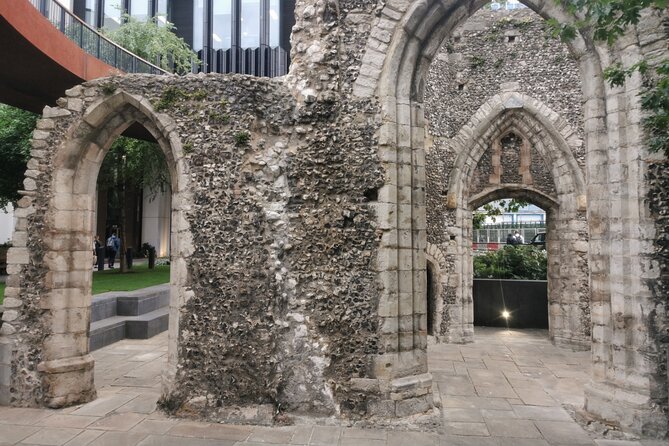
St. Giles Cripplegate is one of the oldest medieval churches in the City, with Norman connections and an earlier Saxon church on the site. The stop lasts about ten minutes, enough for a focused explanation of its origins and place in the old city.
This is one of the tour’s quieter moments. You are not simply moving from one famous building to another. You are seeing how worship and neighborhood life fitted into the City’s structure. The church also helps bridge the gap between Roman London and the medieval world that followed.
The tour’s short timings make the guide especially important here. You should expect a story and a clear explanation, not a long interior visit. That works well if you want an overview of the City’s development, but less well if you prefer to linger at every church.
Salters’ Hall and the power of the livery companies
At Salters’ Hall Garden, the Roman wall returns as a physical reminder of the City’s old defenses. The focus then shifts to the livery companies, once known as guilds. Salters’ Hall belongs to one of the City’s most important companies, ranked ninth among the twelve great livery companies.
This is where the tour’s trade and government theme becomes clear. Livery companies were not just social clubs. They were tied to professions, standards, civic authority, charitable work, and the leadership of the City. Learning about them helps explain why London’s historic center has its own traditions and institutions.
You spend about ten minutes here. That is enough to understand why the company matters, but the subject is broad. If you are fascinated by guild organization, you may wish for more time. Still, this stop gives the route a useful thread that returns at Brewers’ Hall, Guildhall, St. Margaret Lothbury, and the dragon-lined memorial near the end.
More City Tours:
- City Sightseeing London Hop-On Hop-Off Bus Tour & Bookable Extras
★ 4.0 · 1,224 reviews - London: Go City Explorer Pass® – Tickets for 2-7 Attractions
★ 4.3 · 1,111 reviews - London: Speedboat Tour Through Heart of the City
★ 5.0 · 387 reviews - London: Upside Down House Westfield White City Entry Ticket
★ 4.0 · 338 reviews
Brewers’ Hall and St. Mary Aldermanbury Garden
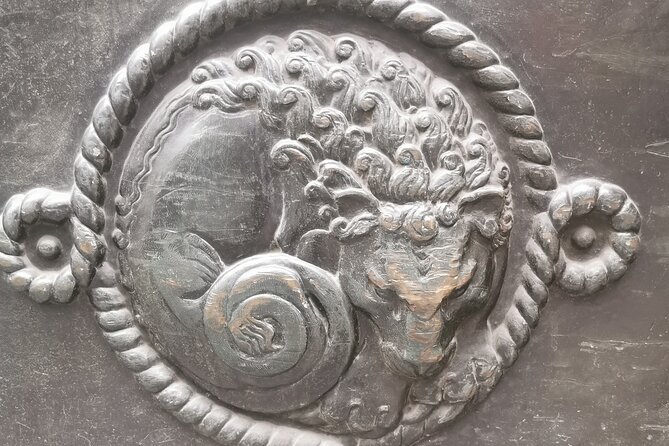
Brewers’ Hall offers a lighter stop, with a look at the livery company associated with brewing and the standards surrounding one of Britain’s oldest drinks. The wording may sound playful, but the point is serious: professional companies helped regulate trade and define who could practice a craft.
You then continue to St. Mary Aldermanbury Garden. The church ruins take their name from the old court or bery of the aldermen, a civic connection that links the site to the City’s governing structure. The garden also contains memorials to Shakespeare and to two notable figures connected with different livery companies.
I like this part of the route because it combines ruins, greenery, literature, and civic memory in one stop. It is also a good reminder that the City is not only about money. Its identity was built by religious institutions, tradespeople, public officials, writers, and military figures.
Guildhall, St. Lawrence Jewry, and Roman entertainment
The route then reaches the City of London itself, the municipal body that governs the historic center. This short stop gives you the basic civic framework before Guildhall, the City’s town hall.
Guildhall has occupied its present site since at least the thirteenth century. The guide connects it to Greek, Roman, Saxon, and Norman influences, along with the myths and stories attached to the building. At 15 minutes, this is one of the more substantial stops, and rightly so. Guildhall is where the themes of power, ceremony, and urban government come together.
Nearby, St. Lawrence Jewry is the official church of the City of London Corporation. Its story includes Saint Lawrence and the cruel sacrifice associated with his Christian faith. You receive only about five minutes here, so think of it as a sharp historical note rather than a full church visit.
Guildhall Art Gallery receives the longest single stop, about 25 minutes. It is located beside the site of the Roman amphitheatre, giving the tour a chance to connect art, archaeology, and public spectacle. This may be the strongest section for anyone who wants a concrete sense of Roman London beyond walls and foundations.
The longer stop also helps balance the rapid pace elsewhere. You have more time to absorb the amphitheatre connection and the gallery setting, although the exact amount of indoor viewing will depend on how the walk is conducted that day.
St. Margaret Lothbury and the meaning of Worshipful
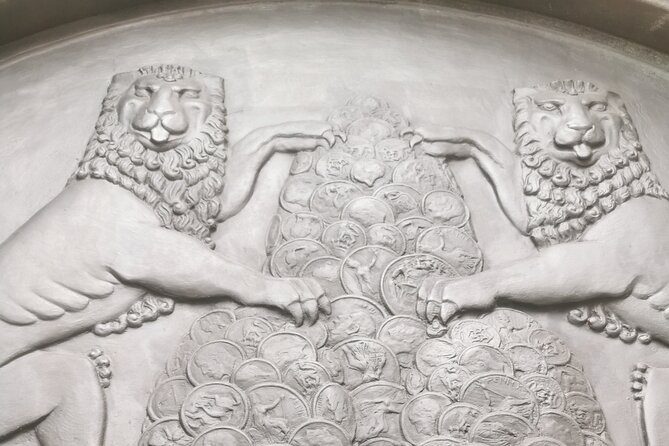
At St. Margaret Lothbury, the discussion returns to the City’s wards and livery companies. The church represents two of those wards, and the guide explains how livery companies came to be called Worshipful companies.
That title can sound mysterious if you encounter it on signs or formal names around the City. This stop gives it a civic and historical explanation. It also shows how churches, wards, and trade organizations overlapped within the old City structure.
The visit lasts about five minutes, so you should expect a concise explanation rather than a detailed architectural tour. Its value lies in connecting several parts of the walk that might otherwise seem unrelated.
The Royal Exchange, Mansion House, and financial power
The Royal Exchange marks the move from medieval trade toward international commerce. It was built as a meeting place for adventurers, and those men went on to shape the wider world. That language points to the bold, risky, and often troubling expansion of English trade and influence.
The exchange is also the place to look up. A golden grasshopper sits on top, and the tour explains why that unusual symbol belongs there. Small details like this make a walking tour worthwhile. They give you something to notice after the guide has moved on.
Next comes Mansion House, the official home of the Lord Mayor of the City of London. The Lord Mayor leads the City’s governance and also acts as an international ambassador for the United Kingdom’s financial and professional services sector.
These stops explain why the City remains a distinct center of power. You see the institutions not as abstract names on a map, but as buildings tied to trade, ceremony, and public leadership.
The dragon circle and the Bank of England
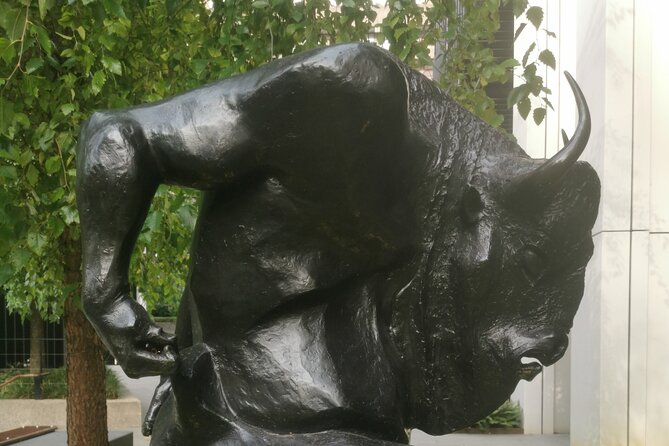
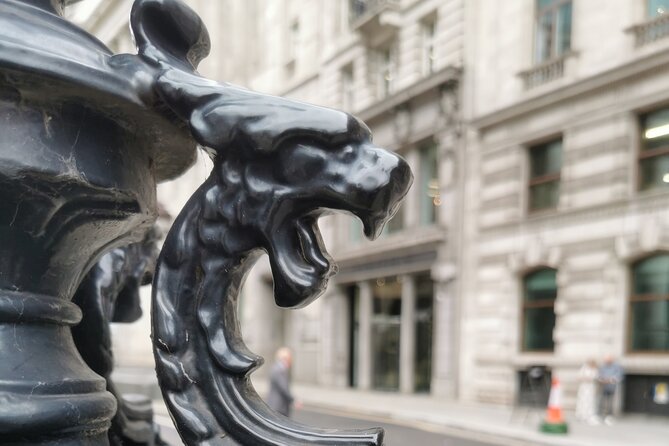
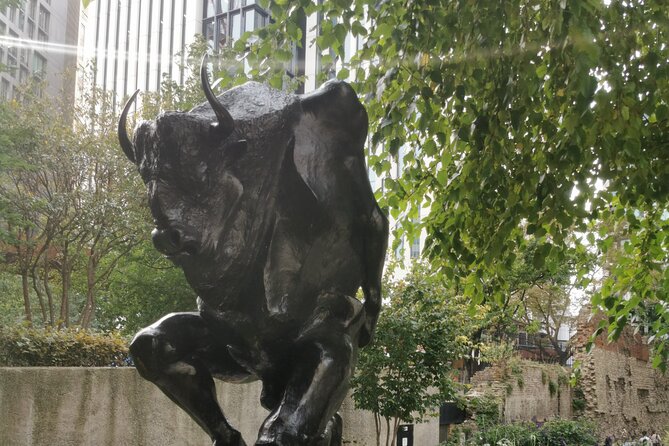
The final section reaches the London Troops War Memorial on Cornhill. Twelve dragon-shaped lamp posts form a circle representing the twelve great livery companies. The guide uses this setting to remember notable figures associated with the area and to return to the story of the Minotaur.
The mythic thread is an unusual touch. It gives the walk a symbolic ending after so much civic and economic history. You finish inside the circle of dragons, a setting that brings the livery companies back into the foreground.
The last major sight is the Bank of England. You look at its long influence, traditional role, and continuing forward direction. A golden statue on top provides another small visual clue with a story behind it.
The tour ends at the London Troops War Memorial, at 1 Cornhill, rather than returning to the starting point. That matters when you plan your day. The endpoint is near the Bank of England and the Royal Exchange, so you finish in a central area with further City sights close by, but you should not expect a loop back to Barbican.
Pace, group size, and access
Fifteen stops in 150 minutes means an average of about ten minutes per location, though the actual timing varies. Guildhall Art Gallery receives about 25 minutes, while several churches and civic landmarks receive five. You will walk between each point, listen outdoors for much of the time, and keep moving.
The maximum group size is eight. I consider that a major advantage for this subject. A small group makes it easier to hear details about guild ranks, church names, Roman defenses, and civic titles. It also gives you a better chance to ask Argun a question without interrupting the flow.
The experience is described as wheelchair and stroller accessible, and most people can participate. Since the route crosses public city streets and includes many separate stops, you should still allow for normal urban walking conditions. No special fitness level is stated, but comfortable shoes remain sensible for a 2.5-hour city walk.
The tour is offered in English and includes a mobile ticket. It is near public transportation, making it practical to reach from other parts of London. Confirmation arrives when you book, and free cancellation is available up to 24 hours before the local start time.
Who should book this City of London walk?
I would choose this tour if you are new to London and want a strong historical framework, or if you have already seen Westminster and the major royal sights and want a different side of the city. It is especially well suited to people who enjoy institutions, old trades, religious history, Roman remains, and the small clues built into city streets.
The tour also suits anyone who prefers a guide-led experience with a clear subject. You are not simply collecting landmarks. You are following the rise of the Square Mile through defense, worship, guild power, commerce, civic leadership, and banking.
I would be more cautious if you want long visits inside every building or a slow photography walk. Several stops are short, and the route covers a lot of ground in a limited time. The tour is best understood as a tightly packed historical overview, with enough detail to help you decide which City sights deserve a later return.
Should you book it?
Book this City of London history tour if you want an informative small-group walk that connects Roman remains with the institutions behind London’s financial district. The strongest features are its off-the-beaten-path stops, the focus on livery companies, the Guildhall amphitheatre site, and the final circle of dragons.
At $30.69, the value is solid for two and a half hours with a maximum of eight people. Just keep the brisk schedule in mind. If you want a broad, well-organized introduction to the Square Mile, this is a smart choice. If you want extended museum time or detailed church interiors, choose a slower experience instead.
FAQ
Where does the City of London History Tour start?
The tour starts at Barbie Green, 2 London Wall Place, Barbican, London EC2Y 5AU, UK.
Where does the tour finish?
It finishes at the London Troops War Memorial, 1 Cornhill, London EC3V 3LN, UK, inside the circle of dragon lamp posts.
How long does the tour last?
The walking tour lasts approximately 2 hours and 30 minutes.
What language is the tour offered in?
The experience is offered in English.
How large is the tour group?
The tour has a maximum of eight people.
Is the tour wheelchair and stroller accessible?
Yes. The experience is described as wheelchair and stroller accessible, and most people can participate.
Just added around London
- Wonderful Westminster Tour & Visit Windsor Castle★ 4.0 · 11 reviews
- Westminster Abbey Guided Private Tour★ 5.0 · 22 reviews
- Priority Access Tour of Westminster Abbey with London Eye option★ 4.5 · 149 reviews
- Enter Buckingham Palace & See The Main Westminster Sights Tour★ 5.0 · 5 reviews
- Warwick Castle Including Return Train Tickets from London★ 4.0 · 9 reviews
- West End Donut Adventure Sweets and Sights in London★ 5.0 · 20 reviews
- Warner Bros Studio Tour London – The Making of Harry Potter with Hotel Pick-up★ 4.5 · 30 reviews
- Warner Bros. Studio Tour London The Making of Harry Potter with return transfers★ 4.5 · 159 reviews
Historical Tours, compared.


Royal Historic Pubs Walking Guided Tour in London
Read our review →
Private Group: Historical Pub Walking Tour of London
Read our review →
Browse the lists this tour appears in