
Reviewed · LONDON WALKING TOURS
Roman Ruins to Blitz Bombings: A Walking Tour of London’s Fiery History
London’s story is written into its streets, and this walk follows the city through several fires, wars, rebuildings, and legends. In about two hours, you move from the Tower of London through the City to St. Paul’s and Fleet Street, seeing how Roman, medieval, Tudor, Georgian, and modern London overlap.
I like the small group of up to 15 and the way guide Tom connects major sights with lesser-noticed places, including Roman remains and free museums nearby. I also like the clear focus: this is for people who want stories and context, not just a quick roll call of famous buildings. The main drawback is the steady walking pace, which may be tiring if you have mobility issues.
Key points before you book
- Roman traces meet wartime ruins: The route links old city remains with St. Dunstan in the East, a church garden shaped by Second World War destruction.
- Tom is the guide to look for: His clear explanations, passion for London, and helpful local suggestions are major strengths of the tour.
- Seven central London stops: You see the Tower of London, the Monument, London Stone, Bank of England, Guildhall, St. Paul’s, and Ye Olde Cheshire Cheese area.
- A small group keeps the walk personal: With no more than 15 people, it should be easier to hear the guide and ask questions.
- The price covers guiding, not admissions: At $27.78 per person, the value comes from the route and interpretation. Tickets to several sites are not included.
- Plan for a real walk: The tour lasts about two hours and ends at Ye Olde Cheshire Cheese on Fleet Street, near Blackfriars Station.
Why this route tells London’s story so well
Many London walks stick to royal pageantry or famous authors. This one uses the City of London as a time line. You begin near the Tower, where royal power and punishment shaped the city, then pass through places connected with churches, trade, finance, disaster, and rebuilding.
That mix gives the walk its appeal. You are not simply moving from one postcard view to another. The guide helps you notice what remains after London has been damaged or rebuilt. A church may survive only as a garden. A stone may carry legends whose truth is hard to prove. A financial institution may occupy a place that has shaped the country for centuries.
Tom’s style appears to suit people who want a tour that is informative without becoming a lecture. He brings facts into the walk, but also answers questions and points out side attractions. His suggestions for other places to visit can help you plan the rest of your time in London.
The route is also useful early in a city visit. You get your bearings in the oldest part of central London, learn which museums and sights deserve more time, and finish near Fleet Street, where you can continue on foot or use public transport.
More London Walking Tours:
- Magical London: Harry Potter Guided Walking Tour
★ 4.7 · 22,044 reviews - London: The Original Jack the Ripper Walking Tour
★ 4.7 · 7,833 reviews - Tour for Muggles The Ultimate Harry Potter Walking Tour in London
★ 5.0 · 4,684 reviews
Starting at the Tower of London
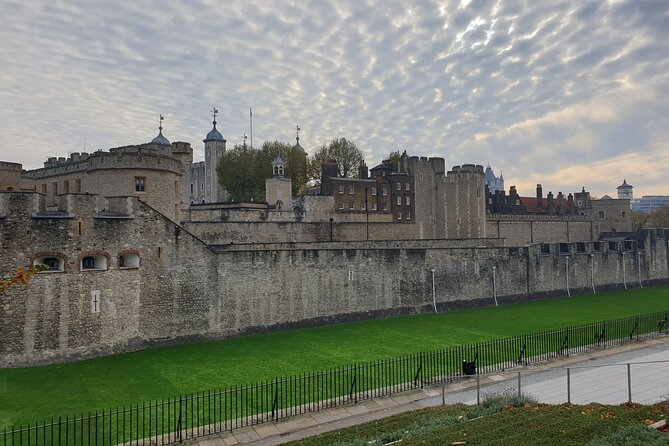
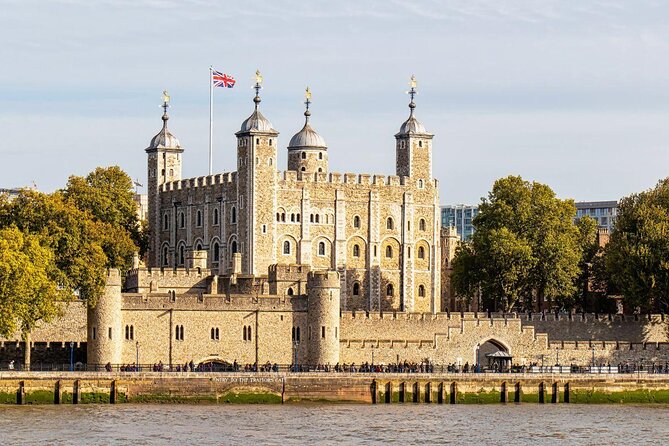
The meeting point is 38 Trinity Square, near the Tower of London. The Tower is described as Europe’s oldest surviving royal palace, so it is a fitting place to begin a walk about power, violence, and change.
You should not expect an interior visit on this tour. Admission to the Tower is not included, and the stop is listed as a short five-minute look. That makes the opening more of an orientation than a full tour of the complex.
Still, the location does important work. The Tower gives you a strong visual introduction to London’s royal past before the walk shifts toward the City’s streets and institutions. If you want to see the Tower’s interiors, allow separate time and buy a ticket independently. Do not count on this walking tour to cover them.
St. Dunstan in the East and the marks of war
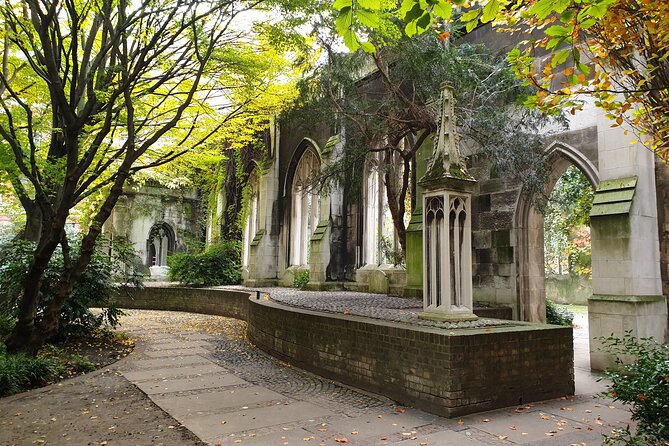
St. Dunstan in the East is one of the most memorable stops because the church’s remains became a garden after destruction in the Second World War. The setting provides a quiet pause in the middle of the City and a direct way to think about how London’s buildings have been lost, reused, and given new life.
The stop is free, and the listed visit lasts about five minutes. That is enough for the guide to explain why the church matters, but you may wish to return later if you want time for photographs or a slower look.
This stop also gives the tour an important change of mood. The Tower introduces royal authority. St. Dunstan shows what happens when war reshapes an old neighborhood. Instead of treating destruction as an abstract date, you see it in the surviving walls and open garden.
The Monument and London’s great rebuilding
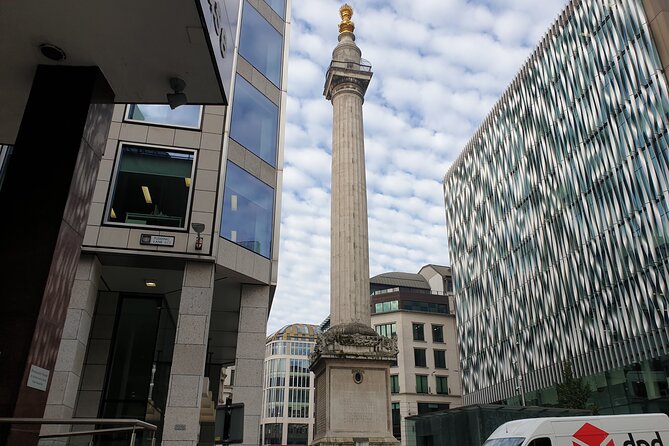
The Monument to the Great Fire of London marks the fire of 1666, one of the key events in the city’s story. It is a natural place to pause and consider how London recovered after a catastrophe that transformed large parts of the city.
Admission to the Monument is not included, and the stop itself is listed as about five minutes. The guide’s role here is to provide the story and explain the meaning of the memorial. If you want to go inside or climb it, you will need to make a separate plan.
I like this part of the walk because it links physical change with city planning. London was not simply old, then new. It was repeatedly damaged and rebuilt, with earlier layers still visible beneath the modern streets. The Monument helps you read the City as a place shaped by disaster as much as by design.
More Historical Tours:
- London Small Group Tour of Historical Pubs
★ 5.0 · 10,422 reviews - Soho Music & Historic Pubs Tour
★ 5.0 · 1,993 reviews - London: Historic Pubs of Central London Walking Tour
★ 4.9 · 1,065 reviews - London: Soho Music and Historic Pubs Walking Tour
★ 4.9 · 836 reviews
London Stone and the useful role of legends
The London Stone is a small but intriguing stop. It is associated with several remarkable legends, and the appeal comes partly from the uncertainty. This is not presented as a grand monument that explains everything. It is a compact object with stories attached to it, inviting you to think about how London creates and preserves its own myths.
Admission is free, and the listed visit takes about five minutes. The stop is especially good for anyone who enjoys the odd corners of urban history. It shows that a city’s identity is not built only from cathedrals and palaces. Sometimes one stone, surrounded by ordinary city life, can carry an outsized place in local memory.
Tom’s conversational approach should work well here. A guide can explain the legends without pretending every tale is proven fact. That balance matters, especially on a history walk where folklore is part of the fun.
The Bank of England and the City’s working heart
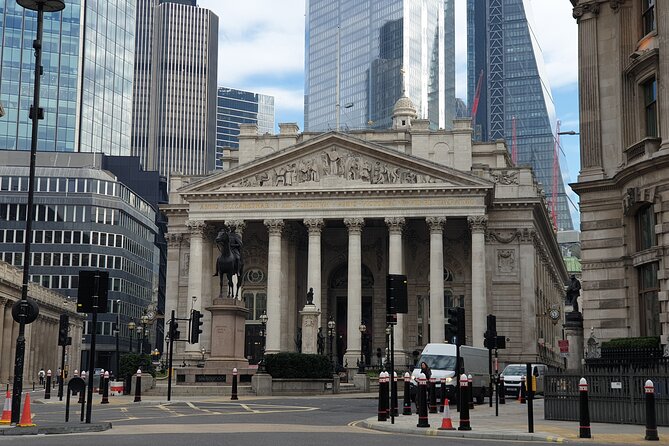
The Bank of England brings the walk into the world of national finance. It is the United Kingdom’s central bank, and its presence helps explain why this district became such an important center of power and commerce.
The museum is listed as a stop, but admission is not included. The tour does not promise an extended museum visit, so treat this as a look at an important institution rather than a substitute for visiting the museum itself.
This stop broadens the story. London’s past is not only about monarchs, churches, fires, and war. Money, banking, and government also shaped the streets you are walking through. If you enjoy seeing how historic places still function in modern life, this part of the route will be particularly useful.
Guildhall and medieval civic London
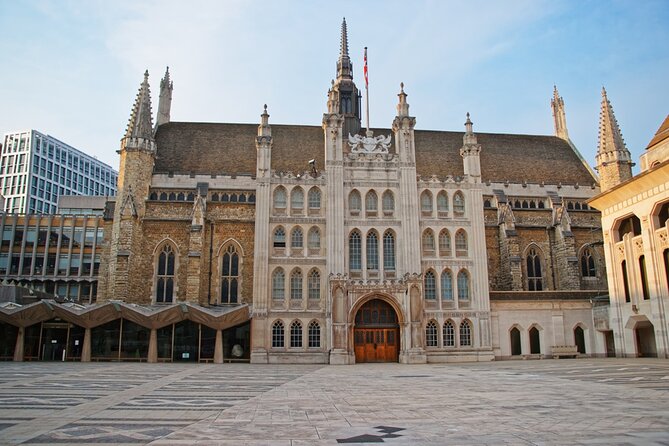
Guildhall is a fifteenth-century hall and the home of the Corporation of London. It represents the city’s civic power, distinct from the royal authority you encountered at the Tower.
Admission is not included, and the tour allows about five minutes here. That short stop is enough to place the building in the larger story, but you should not expect a detailed interior visit as part of the $27.78 tour price.
The value lies in the connection between stops. The Tower shows the Crown. The Bank of England shows finance. Guildhall shows the city’s own government. Together, they give you a more complete picture of London than a route based only on famous monuments.
St. Paul’s Cathedral and Wren’s London
The walk continues to St. Paul’s Cathedral, Christopher Wren’s seventeenth-century cathedral. It is one of London’s defining buildings, and seeing it in the context of the Great Fire and the city’s rebuilding gives the exterior more meaning.
Admission is not included, and the listed stop is about five minutes. This is important when planning your day. You will learn about the cathedral and its place in London’s story, but a full visit inside requires separate time and admission.
I would use the tour as an introduction, then return to St. Paul’s if it interests you. The cathedral rewards a slower visit than a brief stop can provide. The walk helps you understand why it belongs on your list, while a separate entry lets you explore it properly.
Finishing near Fleet Street
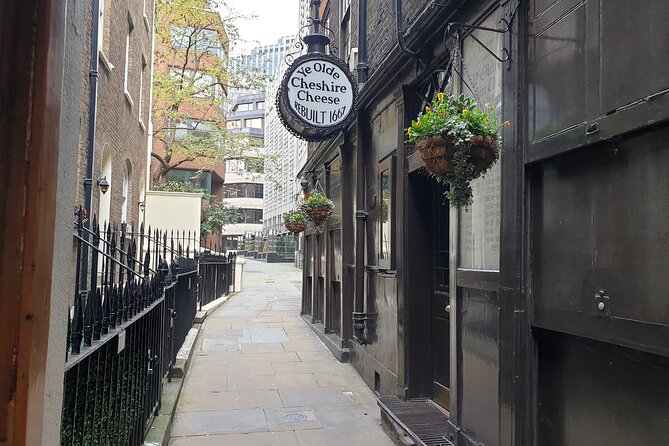
The official end point is outside Ye Olde Cheshire Cheese at 145 Fleet Street, not far from Blackfriars Station. This is a practical ending because you are near public transport and within reach of several central London areas.
The pub itself is part of the atmosphere of old Fleet Street, but the tour does not include a meal or pub admission. Think of it as a meeting and finishing landmark rather than an included extra.
Ending here also gives you choices. You can stop for food, continue toward the river, or use Blackfriars Station. Since the walk finishes in a busy central area, it is easy to build the tour into a larger day of sightseeing.
What $27.78 gets you
At $27.78 per person, the cost is reasonable if you value a guide who can connect scattered sights into one story. You are paying for the route, the explanations, and the chance to ask questions in a small group.
You are not paying for entry to the Tower of London, the Monument, the Bank of England Museum, Guildhall, or St. Paul’s Cathedral. That is not unusual for a city walking tour, but you should include separate admission costs if you plan to enter any of them.
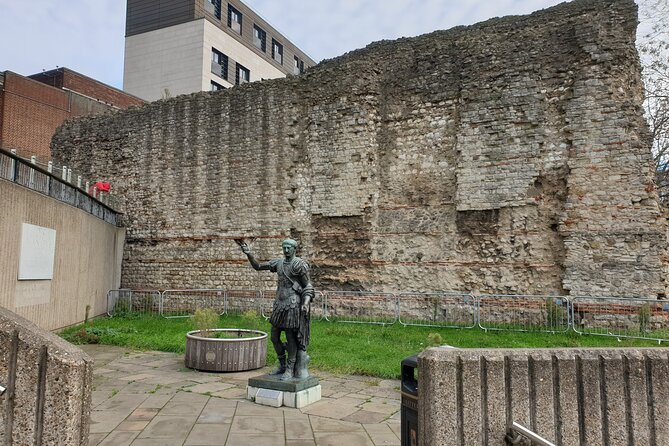
The value is strongest for a first visit or for anyone who has walked through the City before without knowing what they were seeing. The guide can point out side attractions, including free museums with Roman ruins and artifacts. Those suggestions may be as useful as the formal stops, especially if you want to keep exploring after the walk.
The tour is also a good way to avoid spending a full day inside one major attraction. In two hours, you get a broad introduction to several periods of London history. The tradeoff is limited time at each place.
Group size, guide style, and pace
The maximum group size is 15. That is small enough to keep the guide close, although the actual feel will depend on how many people book your departure.
Tom receives especially strong praise for his storytelling, clear answers, and enthusiasm for London. He is also described as willing to suggest other places to visit and local spots to enjoy afterward. That makes the tour more than a fixed script. You can ask about a building, a museum, or a neighborhood and get help shaping the rest of your day.
The pace deserves attention. The route includes seven stops and covers a lot of ground in roughly two hours. One assessment describes it as an extremely long walking tour, and the warning about mobility problems should be taken seriously.
You should be comfortable walking and standing for the duration. The tour is near public transport, and service animals are allowed. Most people can participate, but the supplied information does not promise step-free access or special mobility arrangements, so contact the provider before booking if that is important for you.
Who should book this London walk
I would choose this tour if you like history but do not want a formal lecture. It suits visitors who enjoy connecting buildings to events and who appreciate small details that are easy to miss alone.
It is also a good fit if you have already seen the main sights and want more context. The route adds Roman traces, legends, civic history, wartime damage, and the Great Fire to the usual list of royal and religious landmarks.
Families with older children may enjoy it if they can manage the walking. The stories cover dramatic subjects, and the changes of location help maintain interest. For anyone with limited mobility, a shorter route or a private arrangement may be more comfortable.
You should also consider this tour if you want practical ideas for the rest of your stay. Tom’s recommendations for free museums and nearby attractions can help turn a two-hour walk into a useful plan for the day.
Booking, cancellation, and practical planning
Confirmation is provided when you book, and the tour is offered in English with a mobile ticket. You can cancel for a full refund up to 24 hours before the start time. Cancellations or changes made less than 24 hours before the start are not refundable.
Allow extra time to reach Trinity Square, particularly if you are unfamiliar with the City. The walk starts at the Tower and ends on Fleet Street, so it does not return you to the starting point.
Wear comfortable shoes and plan your next activity near Fleet Street, Blackfriars, or central London. If you want to enter the Tower, Monument, Bank of England Museum, Guildhall, or St. Paul’s, research those admissions separately and allow additional time.
Should you book it?
Book this walk if you want London explained as a city repeatedly reshaped by fire, war, royal power, religion, finance, and legend. Tom’s clear storytelling and useful suggestions appear to be the biggest reasons to choose it, while the small group keeps the experience personal.
Skip it if you want long interior visits, a relaxed pace, or a tour built for limited walking. For $27.78, it offers good value as a lively introduction to the City, provided you understand that admissions are extra and the route moves at a steady clip.
FAQ
How long does the walking tour last?
The tour lasts approximately two hours.
Where does the tour begin?
It begins at 38 Trinity Square, London EC3N 4DJ, near the Tower of London.
Where does the tour end?
It ends outside Ye Olde Cheshire Cheese at 145 Fleet Street, near Blackfriars Station.
Is admission to the attractions included?
No. Admission is not included for the Tower of London, the Monument to the Great Fire of London, the Bank of England Museum, Guildhall, or St. Paul’s Cathedral. St. Dunstan in the East and the London Stone are listed as free stops.
How large is the group?
The tour has a maximum of 15 travelers.
Can I cancel for a refund?
Yes. You can cancel at least 24 hours before the start time for a full refund. Cancellations or changes made less than 24 hours before the start time are not accepted for a refund.
Just added around London
- Priority Access Tour of Westminster Abbey with London Eye option★ 4.5 · 149 reviews
- Wonderful Westminster Tour & Visit Windsor Castle★ 4.0 · 11 reviews
- Westminster Abbey Guided Private Tour★ 5.0 · 22 reviews
- Enter Buckingham Palace & See The Main Westminster Sights Tour★ 5.0 · 5 reviews
- Warwick Castle Including Return Train Tickets from London★ 4.0 · 9 reviews
- West End Donut Adventure Sweets and Sights in London★ 5.0 · 20 reviews
- Warner Bros Studio Tour London – The Making of Harry Potter with Hotel Pick-up★ 4.5 · 30 reviews
- Warner Bros. Studio Tour London The Making of Harry Potter with return transfers★ 4.5 · 159 reviews
London Walking Tours, compared.

Magical London: Harry Potter Guided Walking Tour
Read our review →

Tour for Muggles The Ultimate Harry Potter Walking Tour in London
Read our review →

Harry Potter Movies Walking Tour (Kids Go Free)
Read our review →
Changing of the Guard Guided Walking Tour in London
Read our review →
The Great British Rock and Roll Music Walking Tour
Read our review →
Jack the Ripper Walking Tour – Ripper Vision Tours
Read our review →Browse the lists this tour appears in